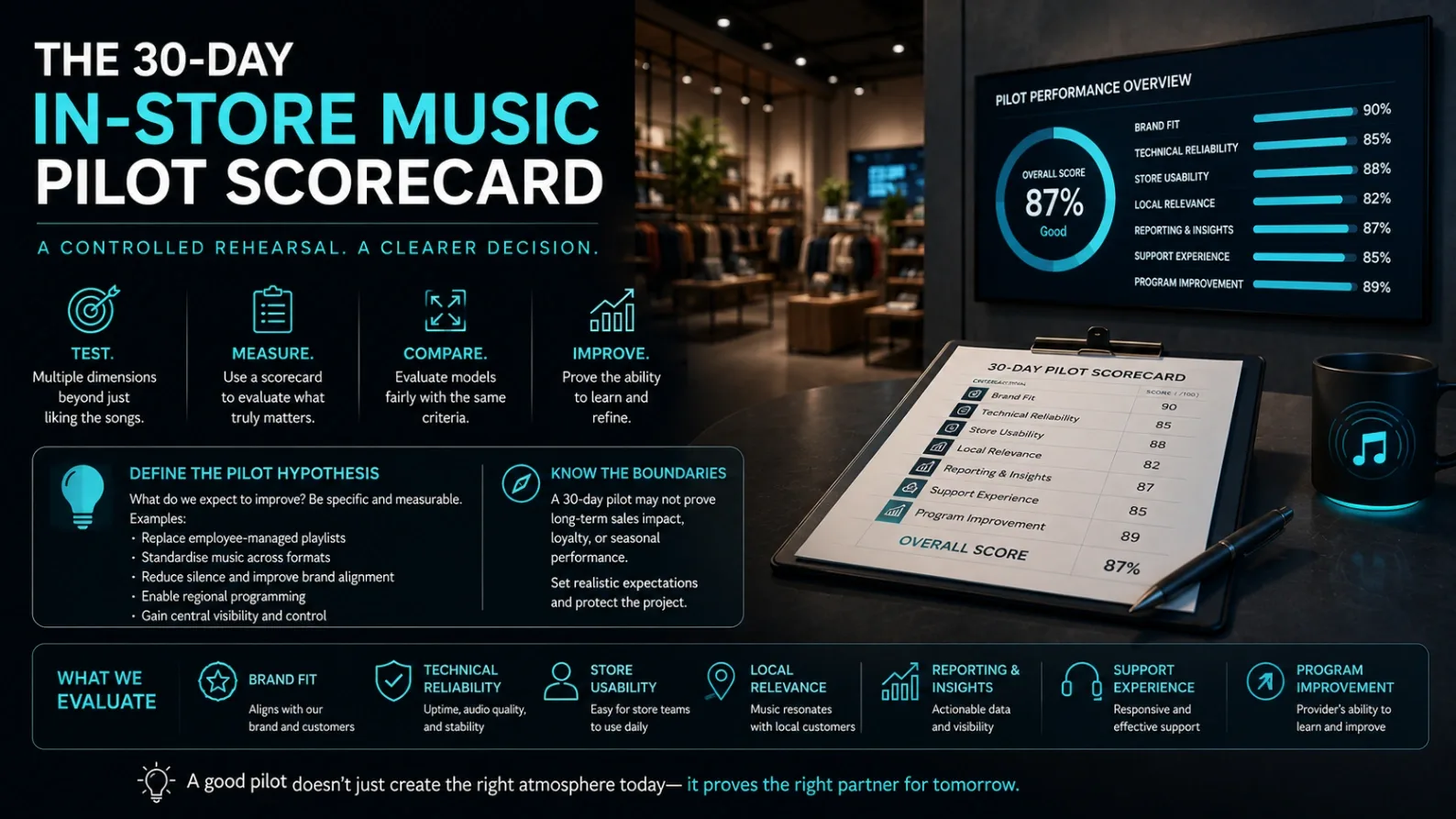
A business music pilot must answer far more than a single subjective question. It is not enough to simply ask whether stakeholders 'liked the songs.' A professional 30-day pilot should rigorously test brand fit, technical reliability, store usability, local relevance, central reporting, support responsiveness, and the provider's ability to actually improve the programme over time. Think of the pilot as a controlled, high-stakes rehearsal for massive national scale. To achieve this, a documented scorecard is essential to keep the evaluation objective and fair. Without one, the loudest opinion in the boardroom can decide the result, or the business may focus entirely on a minor creative issue while completely ignoring a catastrophic operational weakness. This comprehensive guide outlines how to build a definitive 30-day scorecard to evaluate
in-store music platforms like
Tringbox, ensuring your brand makes a confident, data-backed decision before a full network rollout.
1. Define the Hypothesis and the Baseline
Define the Pilot Hypothesis: Write a concise statement of what the company expects to improve. Examples include replacing illegal employee-managed playlists, standardizing music across diverse formats, reducing acoustic silence, improving emotional brand alignment, or gaining centralized operational visibility. The hypothesis must be specific enough to measure. Also, explicitly define what the pilot will <em>not</em> prove thirty days cannot definitively establish long-term customer loyalty.
Select Representative Locations: Do not just test your easiest flagship store. Choose locations that reflect the harsh reality of a future rollout. Include venues with varied network conditions, different city profiles, varying store formats, and different staff technical capabilities. A group of five representative sites is vastly more informative than one perfect, highly supervised flagship site.
Record the Baseline: Before installing any new hardware, measure the current state. How is music currently played? Who controls it? How often does silence occur due to internet drops? How much time do employees waste troubleshooting? Without a documented baseline gathered via short store surveys and manager interviews any improvement claimed at the end of the pilot remains purely anecdotal.
2. Score Technical Setup and Playback Reliability
Evaluating Installation Friction: During the installation phase, evaluate the time required, compatibility with existing amplifier systems, network firewall needs, player configuration complexity, and staff disruption. Record these issues formally rather than solving them informally and forgetting them. The rollout model must be flawlessly repeatable across hundreds of future locations.
Testing Offline Playback Intentionally: Track uptime, outages, recovery time, buffering, and schedule transition failures. Crucially, you must test offline playback intentionally rather than simply waiting for the internet to fail. Physically unplug the router and confirm that the edge-caching hardware continues to play approved music seamlessly, and that the playback logs synchronize later once the connection is restored.
Location-Specific Reliability: Reliability must be reviewed by location and by day. A system that streams perfectly in a Mumbai mall but repeatedly fails in a Tier-2 city neighborhood store requires dedicated edge-hardware adaptation, not just a software patch.
3. Score Brand Fit, Freshness, and Local Relevance
Evaluating Brand Alignment: Create a small, cross-functional review group to score brand qualities. Listen to the actual sequences played live during the pilot—do not rely on a hand-selected MP3 presentation playlist provided by a sales rep. Rate whether the programme feels aligned, distinctive, and suitable for the customer journey. Record specific reasons for low scores (e.g., 'the energy transitions are jarring' rather than 'we don't like it').
Daypart and Contextual Behavior: Check whether the soundtrack changes appropriately throughout the day. Morning, peak, evening, and weekend periods should be directly compared against the initial brand brief. If the platform uses AI for enterprise music management, ensure that its contextual adjustments remain strictly within approved brand boundaries. Scoring Local Relevance: For locations in different regions, assess language weighting and cultural fit. Regional managers can provide structured feedback. A premier platform should be able to adjust local linguistic profiles seamlessly without forcing the brand to create completely separate, unmanaged playlists that dilute the national identity.
4. Score Store Usability and Central Control
Observing Employee Interaction: Observe what employees actually need to do during an opening shift. Does the music start automatically? Are the local volume controls clear and strictly limited within a safe range? Do staff need to use personal phones or manage complex passwords? The ideal system completely removes music management as a daily operational task while giving staff just enough safe, localized control to report issues or skip inappropriate tracks.
Central Dashboard Visibility: Central corporate users must deeply test dashboard access. Ask operational questions during the pilot and see whether the system can answer them instantly: Which specific location is offline right now? What exact song played during a customer complaint yesterday at 2:00 PM? Did the festive campaign start simultaneously everywhere? Reports should be highly actionable, not merely present.
Provider Responsiveness: A pilot tests the vendor relationship as much as the software. Record their response time, the quality of their technical troubleshooting, their curation turnaround time, and their ability to handle structured feedback. A top-tier provider distinguishes between a rogue personal song request from a barista and a genuine, systemic programming issue.
5. A Sample 30-Day Pilot Schedule
Days 1 to 5 (The Baseline): Document the current state. Record the existing music source, outages, staff interventions, and complaints to create a fair, objective comparison.
Days 6 to 12 (Install and Stabilize): Install the test system. Confirm network behavior, offline fallback, user permissions, and support contacts. Do not prematurely judge the music curation while the technical setup is still physically stabilizing.
Days 13 to 23 (The Run Phase): Run the planned acoustic programme without constant executive interference. Collect playback logs, structured store feedback, and short listening reviews across different dayparts.
Days 24 to 27 (Controlled Variations): Test specific variations. Adjust a language weighting, revise a peak-hour energy curve, or tighten a repetition rule. Change only one major variable at a time so the team can accurately isolate and understand the result.
Days 28 to 30 (Final Decision): Compare the final evidence directly against the pre-agreed scorecard. Separate technical reliability, brand fit, employee usability, and commercial cost rather than collapsing everything into one vague opinion.
6. Frequently Asked Questions (Q&A)
Q: Why shouldn't a pilot just consist of asking the store employees if they 'like' the new music?
A: Personal taste is highly subjective and rarely aligns perfectly with overarching enterprise branding. An employee might love high-energy heavy metal, but that does not fit a luxury retail environment. A scorecard focuses on objective brand fit, technical uptime, and customer behavior, rather than individual staff preferences. Q: Why is testing offline playback so critical during a 30-day pilot?
A: Commercial retail environments, especially in developing markets or large malls, often experience highly unstable internet connections. If you do not intentionally test a platform's edge-caching and offline playback capabilities during the pilot, you risk massive network-induced silence during a full national rollout.
Q: How does Tringbox fit into a structured 30-day pilot?
A: Tringbox AI provides the centralized dashboard, robust edge-computing hardware, and autonomous AI curation required to execute a flawless pilot. It allows enterprise brands to test deep contextual dayparting, monitor network uptime centrally, and measure precise brand alignment without relying on manual employee intervention. Q: Disclaimer:
This blog is general marketing content and not legal advice. Operational models and music licensing obligations can vary significantly by corporate structure, physical location, and specific contract. Brands should always rely on their professional legal counsel and internal management for final policy decisions.
Conclusion
The Final Note
A 30-day music pilot should aggressively test the complete commercial service: hardware installation, playback reliability, AI contextual logic, local cultural relevance, employee usability, central dashboard visibility, and provider support. Utilizing a strict scorecard prevents the evaluation from devolving into a chaotic vote on favorite songs. When the pilot is highly representative and rigorously measured against a documented baseline, the business can make a supremely confident decision regarding scale. By taking a disciplined, evidence-based approach, you enter the national rollout phase with clearer standards, fewer operational surprises, and a legally compliant, revenue-driving acoustic system.