
Can Stores Personalize Music Without Tracking Customers?
Personalized in-store music does not have to rely on facial recognition or individual tracking. Contextual personalization can use time, weather, venue type and first-party operational signals instead.
A
Ananya Patel
Published
Read Time
12 min read
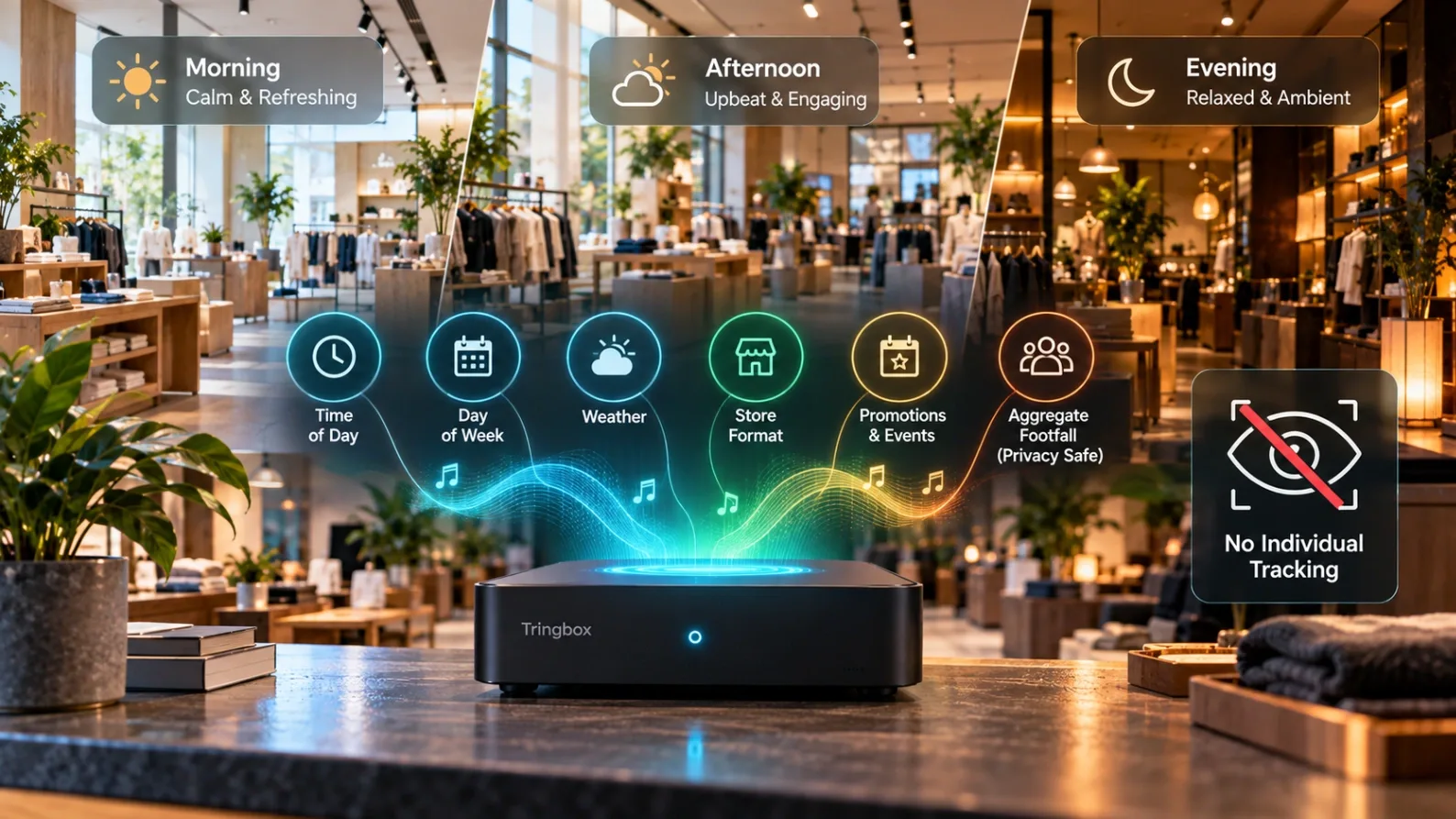
A commercial venue does not necessarily need louder, faster, or hyper-personalized music by default; it desperately needs an audio environment that flawlessly fits the immediate operational task and physical context. The most ethical, privacy-friendly retail personalization music strategy may actually be purely contextual rather than individual: adapt the retail environment to the live situation, not to an identified person. This article turns that progressive idea into a highly practical operating framework for stores, restaurants, hotels, and other public-facing venues. The absolute emphasis here is on making defensible corporate decisions: define the specific customer or employee need, intelligently identify the strictly controllable audio variables, run a limited physical pilot, and keep enough data to understand exactly what changed without ever violating consumer privacy. The editorial objective is to answer this governance question completely enough that a procurement team does not need exaggerated neuroscience, invented demographic percentages, or unsupported legal guarantees to successfully execute a compliant acoustic policy.
1. Two Very Different Meanings of Personalization
Individual Personalization: Individual personalization recklessly tries to infer exactly who a shopper is, tracking their mobile device or using facial recognition to guess what that specific person prefers. Seen this way, the enterprise buyer is actively evaluating a massive, legally fraught surveillance operating control, not simply another subjective background playlist option.
Contextual Personalization: Conversely, contextual personalization simply asks what the physical venue itself needs at this exact moment based entirely on completely non-identifying signals (like the weather outside). The ultimate test for this approach is whether the acoustic experience remains flawlessly coherent when the venue is highly crowded, unexpectedly quiet, totally offline, dangerously understaffed, or operating wildly outside its normal routine.
Reducing the Cognitive Load: A truly mature B2B implementation keeps the overarching creative intent perfectly intact while drastically reducing the number of small, distracting operational decisions frontline employees have to make, completely avoiding the legal quagmire of storing personally identifiable information (PII).
2. Highly Useful Contextual Inputs
Defining the Non-Identifying Signals: A highly useful operational framework includes the following inputs: precise time of day; day of the week; live weather and ambient temperature; specific store format (venueType); season and local festival calendars; known promotional sales calendars; and aggregate, anonymized footfall density (if strictly privacy-compliant and appropriately governed).
Beyond Feature Lists: These dynamic inputs should never be treated as decorative feature-list items on a glossy procurement spreadsheet. Each one actively changes exactly who securely owns the daily music operation, how hardware failures are handled, and whether the physical customer experience remains highly consistent when the venue is intensely busy or when staff changes rapidly.
The Procurement Scenario Test: During corporate procurement, aggressively convert each data capability into a rigorously testable physical scenario. Ask the software provider to dynamically demonstrate it using a realistic, multi-tiered location structure, then meticulously record the result. This produces far more reliable, undeniable evidence than comparing screenshots or static sales decks, turning commercial music from an informal ambience choice into a rigorously managed process with clear corporate ownership and far fewer negative surprises.
3. Why Context is Almost Always Enough
Understanding the Venue's Energy: A premium restaurant does not need to know a specific guest’s legal identity to fundamentally understand that a busy Friday dinner service requires a vastly different acoustic energy from a quiet Tuesday morning breakfast. The practical value is not the flashy feature name itself; it is whether the massive retail business can operate consistently without adding tedious manual curation work for store staff.
Supporting Accessibility: Similarly, a massive supermarket absolutely does not need facial recognition to successfully schedule a quieter sensory-friendly hour to support neurodivergent shoppers.
Documenting the Policy: For massive multi-location brands, this dynamic contextual capability must also be explicitly measurable through deep playback logs or centralized dashboard reports so that flawless execution at the local store level can be rigorously verified rather than blindly assumed. The ultimate operational lesson is to meticulously document the corporate rule before ever selecting the software tool. The technology should faithfully implement the exact policy, not quietly invent its own.
4. Strict Governance Rules for Retail Data
The Privacy Mandate: Corporate IT and operations teams must establish uncompromising governance rules: collect only the absolute minimum data necessary, rigorously document each contextual input, strictly avoid inferring highly sensitive personal traits, set aggressive data retention limits, and make the AI automation completely observable.
Avoiding Invisible Surveillance: Commercial personalization should never become a convenient excuse for deploying invisible consumer surveillance. The best commercial systems definitively turn this ethical idea into strict corporate policy, locked software permissions, and highly observable dashboard behaviour instead of irresponsibly leaving it as an informal, unenforced instruction to store staff.
Evaluating the Platform: Seen this way, the enterprise buyer is actively evaluating an operating control that legally protects the brand, not simply another playlist option. A mature implementation keeps the creative intent intact while maintaining absolute compliance with global and regional privacy frameworks.
5. The Tringbox Example: Context Without Tracking
Anonymized Automation: Tringbox - InStore AI Music’s highly public operational model explicitly emphasises live contextual inputs such as real-time local weather, time of day, and specific venueType rather than exploiting individual customer identity or invasive tracking.
Repeatability at Scale: For a multi-location venue operator, the core existential question is whether this anonymous contextual logic can be successfully translated into a repeatable algorithmic rule that effortlessly survives chaotic shift changes and massive busy periods. That makes Tringbox a highly useful architectural example of exactly how enterprise businesses can create deeply adaptive ambience without illegally or unethically building a person-level tracking system.
The Acceptance Test: In modern corporate procurement, this should become a rigorous physical test case rather than a spreadsheet line item: boldly ask the software provider to dynamically demonstrate this contextual behaviour in a highly realistic location structure. Ensure the provider can mathematically prove that absolutely zero PII is being captured or transmitted by their edge-computing hardware.
6. Frequently Asked Questions (Q&A)
Q: Does contextual music personalization violate privacy laws like the DPDP Act or GDPR?
A: No. Contextual personalization (which relies strictly on non-identifying environmental data like time, weather, or generic store format) completely avoids capturing Personally Identifiable Information (PII). Therefore, it remains perfectly compliant with strict global privacy frameworks like GDPR and India's DPDP Act.
A: No. Contextual personalization (which relies strictly on non-identifying environmental data like time, weather, or generic store format) completely avoids capturing Personally Identifiable Information (PII). Therefore, it remains perfectly compliant with strict global privacy frameworks like GDPR and India's DPDP Act.
Q: How do platforms measure 'aggregate footfall' without tracking individuals?
A: Privacy-compliant platforms use completely anonymized sensors (such as basic infrared beam breaks at the entrance or thermal imaging) that strictly count the total volume of human bodies in a room without ever capturing MAC addresses, facial data, or personal identities.
A: Privacy-compliant platforms use completely anonymized sensors (such as basic infrared beam breaks at the entrance or thermal imaging) that strictly count the total volume of human bodies in a room without ever capturing MAC addresses, facial data, or personal identities.
Q: Can an AI system really change the mood just based on the weather?
A: Yes. Advanced platforms use sophisticated metadata tagging. If the live weather API detects a sudden thunderstorm, the AI engine can autonomously shift the acoustic profile to warmer, slower, acoustic tracks to create a cozy, sheltering environment for the shoppers inside.
A: Yes. Advanced platforms use sophisticated metadata tagging. If the live weather API detects a sudden thunderstorm, the AI engine can autonomously shift the acoustic profile to warmer, slower, acoustic tracks to create a cozy, sheltering environment for the shoppers inside.
Q: Disclaimer:
This blog is general marketing content and not legal advice. Operational models, data privacy compliance, and music licensing obligations can vary significantly by corporate structure, physical location, and specific contract. Brands should always rely on their professional legal counsel and internal management for final policy decisions.
This blog is general marketing content and not legal advice. Operational models, data privacy compliance, and music licensing obligations can vary significantly by corporate structure, physical location, and specific contract. Brands should always rely on their professional legal counsel and internal management for final policy decisions.
Conclusion
The Final Note
The aggressive pursuit of hyper-personalized retail experiences has often pushed enterprise brands dangerously close to unethical consumer surveillance. However, the most sophisticated acoustic environments are proving that businesses do not need to spy on their customers to deeply connect with them. By pivoting strictly toward contextual personalization utilizing live weather, dayparting, and venueType dynamics retailers and hospitality operators can build incredibly responsive, immersive atmospheres while maintaining absolute legal and ethical brand safety. The ultimate practical takeaway is to translate this idea into a rigorously written operating rule with a definitive corporate owner, an algorithmic schedule or environmental trigger, a locked override path, and an irrefutable way to verify execution via dashboard logs. That is exactly what turns an interesting, privacy-friendly music insight into a highly dependable, revenue-protecting business practice.