
How QR Song Requests Work in Cafes, Restaurants and Bars
From scanning a QR code to approval and playback, here is the complete technical and customer journey behind QR song requests in cafes, restaurants and bars.
R
Rajesh Sharma
Published
Read Time
11 min read
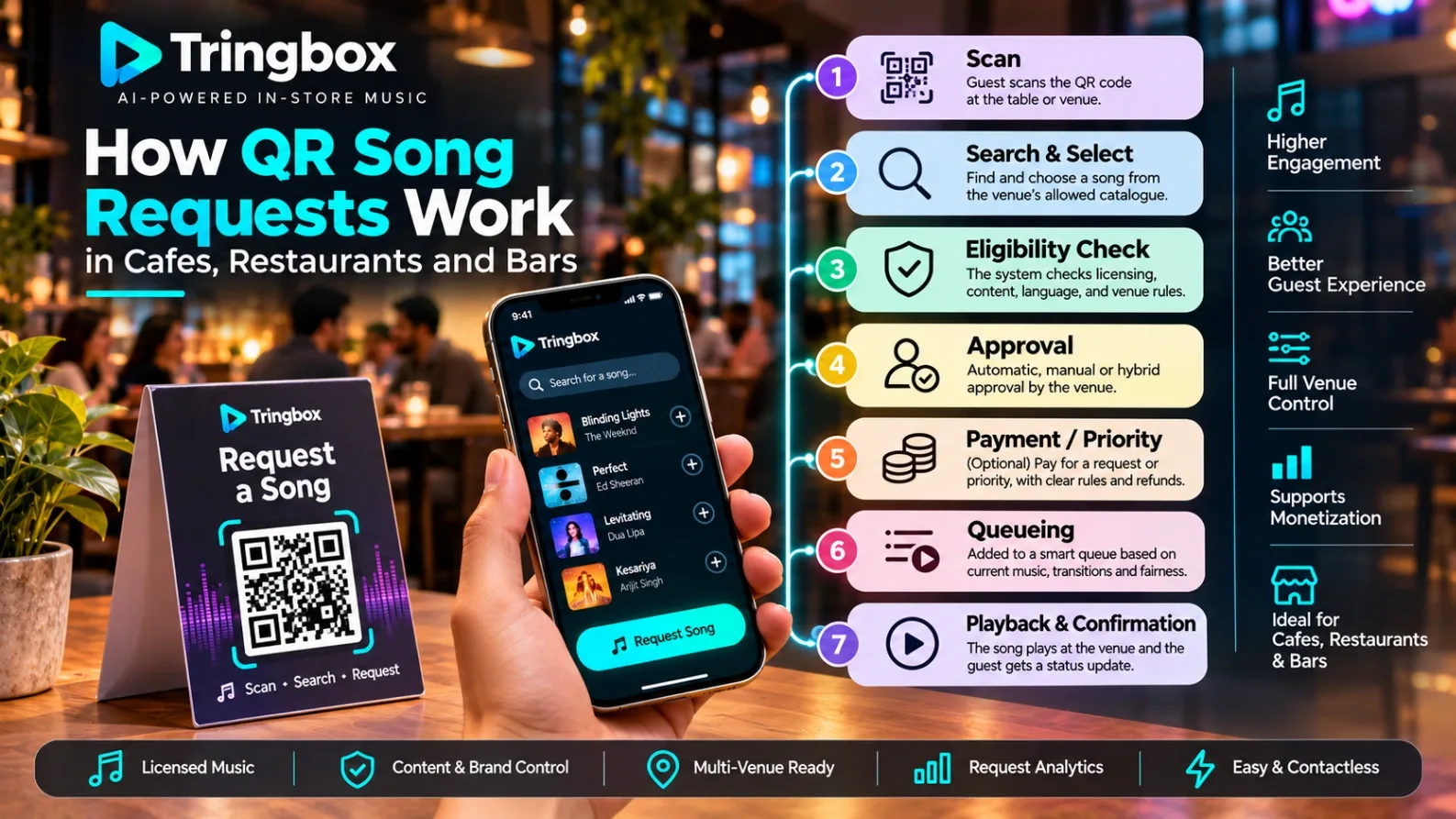
QR song requests fundamentally remove the most awkward, friction-filled part of asking for music in a commercial venue: desperately trying to find the DJ, aggressively interrupting a busy staff member, or trying to shout a song name over the noise of a crowded room. The simple QR code mathematically becomes a seamless digital bridge between the customer's smartphone and the venue's core audio infrastructure. This guide breaks down the complete technical and operational journey of a QR song request—from the initial scan to final playback and explains exactly how enterprise venues can invite customer participation without surrendering control of the master brand.
1. Step 1: The Guest Scans the Code
Physical Placement: The QR can be strategically placed on a table tent, digital menu, bill folder, wall poster, or digital signage screen. A highly engineered flow should open instantly and make the venue identity immediately obvious so the customer knows the request is routing to the correct physical location.
The Digital Handshake: Some enterprise systems securely open a lightweight web browser experience. Others utilize deep-linking to instantly open a dedicated consumer app if it is already installed, providing a much richer interface.
2. Step 2: The Customer Identifies the Song
Two Design Choices: The guest seamlessly searches or browses music that is technically eligible for that venue. There are two major UX design choices here: A strictly restricted catalogue shows only tracks that can definitely be requested. A wider, open catalogue lets the user search broadly, then checks whether the song is eligible after selection.
Managing Expectations: The second approach feels significantly more open and consumer-friendly but absolutely requires vastly stronger, instant rejection logic to manage expectations.
3. Step 3: The System Checks Eligibility
Algorithmic Guardrails: Before a request ever reaches the live queue, the venue's edge-computing node autonomously applies strict rules. Possible checks include: Is the song fully licensed? Is explicit content allowed? Does the language fit the venue policy?
Contextual Filtering: Is the track already playing or recently played? Does the acoustic energy level flawlessly fit the current moment? Is the specific song blocked by the brand? Has this exact guest requested too many tracks in the last hour?
The Governance Layer: This rigid computational check is exactly the difference between a highly controlled commercial request layer and an uncontrollable, chaotic jukebox.
4. Step 4: Staff or Algorithmic Approval
Approval Models: Approval can be entirely manual, completely automatic, or hybrid. In a manual model, a store manager, DJ, or live performer explicitly accepts or rejects each request. In an automatic model, the request plays only if it mathematically clears all predefined rules.
The Hybrid Approach: In a hybrid model, highly obvious matches can pass automatically while uncertain requests go to staff for a final check. For many high-volume venues, hybrid approval provides the absolute best operational balance between speed and brand control.
5. Step 5: Payment or Priority (If Enabled)
Monetization Strategies: Some request systems are entirely free. Others charge for requests or let users pay heavily for queue priority. If real money is involved, the interface must flawlessly explain exactly what payment guarantees.
Clarity is Mandatory: Does the user pay to simply submit? To increase priority? Only if the song actually plays? What exactly happens after a rejection? Refund and cancellation rules should be incredibly simple enough to understand instantly before the customer taps pay.
6. Step 6: Intelligent Queueing
Managing the Flow: A successful request should absolutely not necessarily play immediately. The enterprise system may intelligently place it into a queue that algorithmically considers current music energy, transition quality, other pending requests, fairness rules across different tables, and overarching venue programming.
Setting Expectations: A good product meticulously sets expectations. The customer should explicitly know via their screen whether the request is pending, approved, rejected, or currently playing.
7. Step 7: Playback and Confirmation
Closing the Loop: Once the requested track finally plays, the guest can receive an instant push notification or UI status update. This perfectly closes the loop and makes the interaction feel intentional and highly rewarding.
The Risk of Silence: Without immediate digital feedback, users may falsely assume the request disappeared into a void, damaging the interactive experience.
8. Example: Tringbox Operational Flow
Integrated Ecosystem: Tringbox's public consumer and partner apps heavily use QR-based participation for live requests. Guests can securely send songs from their phones, while live performers or venue operators securely manage the request status in real-time.
Dashboard Analytics: The Tringbox Dashboard app also directly brings this request activity into venue analytics and operations. The vital design principle is broader than any one product: the QR flow should make requesting incredibly easy while the venue's strict rules remain totally invisible but highly effective.
9. The Operational Launch Checklist
Test Before Launching: Before launching QR requests, meticulously test: 1) Scan-to-request loading time on extremely poor mobile networks. 2) Exactly what the guest sees when a song is unavailable. 3) How explicit content is algorithmically handled.
Stress-Testing the Floor: 4) Queue fairness during high-demand Friday nights. 5) Frontline staff workload for manual approvals. 6) Payment and refund logic. 7) Digital abuse prevention. 8) What happens when the venue's music node goes totally offline. 9) Whether the request system correctly routes across multiple physical zones. 10) Exactly how request data appears to corporate management.
Conclusion
The Final Note
A successful QR song-request flow should feel completely effortless to the customer while remaining highly controlled and rigidly governed by the venue operator. When engineered correctly, scanning a QR code transforms passive diners into active participants, drastically extending dwell time and boosting social energy in bars, cafes, and entertainment venues. However, operations teams must never treat interactive requests as a 'set-and-forget' feature. By rigorously testing network resilience, strict brand filtering rules, and staff approval workloads, enterprises can seamlessly integrate customer participation into their audio infrastructure without ever sacrificing the integrity of the master brand.