
Volume Is Not Loudness: What Business Owners Should Know About Consistent Store Audio
Why two songs at the same volume setting can sound very different, and how loudness normalization can reduce jarring jumps in stores, restaurants and gyms.
V
Vikram Chauhan
Published
Read Time
12 min read
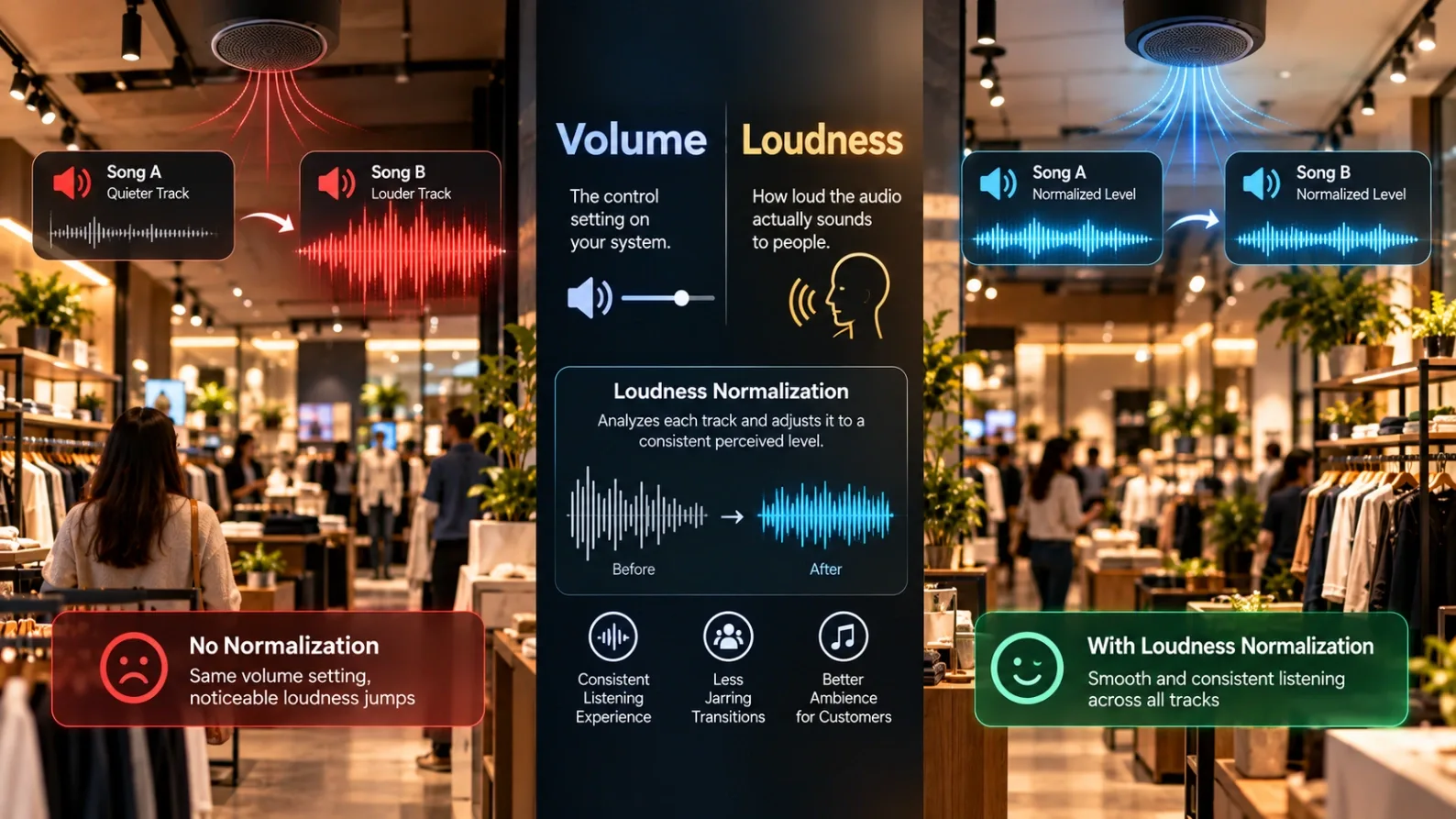
The customer hears a soundtrack, but the business is really managing attention, comfort, brand cues, and operational consistency. In commercial environments, volume is merely the physical control setting; loudness is the actual perceived result in the human ear. Professional business audio must meticulously manage both. This article turns that complex acoustic engineering idea into a highly practical operating framework for stores, restaurants, hotels, and other public-facing venues. Where Tringbox appears in this guide, it is used strictly as an implementation example rather than as the source of the underlying claim. The academic research and industry standard should stand firmly on their own even if the enterprise reader chooses a different software platform. The primary editorial objective here is broad: to answer the operational governance question completely enough that a procurement team does not need exaggerated neuroscience, invented demographic percentages, or unsupported legal guarantees to finally build an auditable, consistent commercial acoustic infrastructure.
1. The Technical Distinction: Volume vs. Loudness
Defining the Standard: Global broadcasting standards, specifically the rigorous ITU-R BS.1770 recommendation, formally define the algorithms for measuring both programme loudness and true-peak audio levels. Volume is simply how much electrical gain the amplifier applies; loudness is how aggressively the sound waves interact with human hearing.
Equal Peaks Do Not Mean Equal Loudness: The highly respected EBU R 128 standard mandates true loudness normalisation rather than lazily relying only on peak level adjustments, primarily because two tracks with the exact same mathematical peak decibel level do not guarantee equal perceived loudness.
The Concrete Acceptance Test: For the enterprise buyer, evaluating this technical capability must end in a concrete acceptance test: what exactly must happen autonomously to normalize the audio stream, who is explicitly allowed to override the master volume locally, and what undeniable digital evidence proves the system behaved correctly and respected the LUFS (Loudness Units relative to Full Scale) target?
2. Why Businesses Actually Notice the Problem
The Acoustic Shock: A quiet, beautifully mastered acoustic recording from the 1970s followed immediately by a heavily compressed, modern pop master can feel like a massive, jarring volume jump on the retail floor even when the physical amplifier setting never changes.
Staff Chasing the Dial: When normalization is missing, frontline staff are forced to chase the physical volume knob all day long to compensate for these mastering differences, creating devastating inconsistency between shifts, dayparts, and remote franchise locations.
Observability and Governance: The operational distinction between raw volume and normalized loudness is easy to miss in a polished 15-minute demo, but it becomes critically important once dozens of remote sites and aggressive frontline overrides are involved. This is fundamentally an observability question for corporate IT: if head office cannot instantly open a dashboard and see whether the intended normalization behaviour actually happened on the store floor, the feature is functionally impossible to govern at scale.
3. What Normalization Actually Does
Targeting Perceived Levels: A professional B2B system autonomously analyzes the inherent track loudness metadata and mathematically applies the exact required gain offset so that all disparate programmes sit perfectly close to a unified, target perceived level (typically around -23 to -16 LUFS for commercial spaces).
Respecting True-Peak Headroom: Advanced normalization must also rigorously respect true-peak headroom to entirely eliminate the risk of digital clipping, which causes physical speaker distortion that ruins the premium brand identity.
Verifying Execution: For massive multi-location brands attempting to unify this acoustic experience, the normalization capability must also be explicitly measurable through deep playback logs or centralized dashboard reports so that flawless execution at the local store level can be rigorously verified rather than blindly assumed.
4. Normalization is Not Automatic Volume Control
Correcting the Track vs. Correcting the Room: It is critical to separate two vastly different technologies. Track normalization mathematically corrects the mastering differences between recordings before the sound leaves the player. Seen this way, the enterprise buyer is evaluating an internal operating control, not simply another subjective background playlist option.
Ambient-Noise Adaptation: Conversely, ambient-noise-based volume control such as the highly advanced capability that QSIC - In-Store Audio markets for retail media—dynamically changes the master output level according to the live physical environment (e.g., automatically turning the volume up when a massive crowd enters the store).
Combining the Technologies: A truly mature enterprise installation may actively use both: normalizing the tracks internally so they match each other, and then using ambient sensors to ride the master room volume. The ultimate test is whether the acoustic experience remains flawlessly coherent when the venue is highly crowded, unexpectedly quiet, or operating wildly outside its normal routine.
5. Why Tringflow Matters for Seamless Transitions
The Transition Concept: Tringbox's proprietary 'Tringflow' transition concept can be framed directly alongside this required loudness consistency. A smooth, DJ-style crossfade overlap is vastly more convincing and professional when the two adjacent tracks are also perfectly level-matched by the normalization engine.
Reducing Manual Intervention: In modern corporate procurement, this should become a rigorous physical test case rather than a spreadsheet line item: boldly ask the software provider to dynamically demonstrate this specific crossfade and leveling behaviour in a highly realistic location structure.
The Operational Goal: The flawless result should be significantly fewer jarring audio transitions and vastly less frontline staff intervention. A highly useful enterprise implementation makes this algorithmic rule completely visible to head office, heavily constrained for local teams, and instantly recoverable when something inevitably goes wrong on the retail floor.
6. Frequently Asked Questions (Q&A)
Q: Why doesn't Spotify's built-in normalizer work for our store?
A: Consumer streaming apps (which are illegal for commercial use) use basic peak normalization designed for headphones. Enterprise B2B systems utilize strict EBU R 128 standards designed for massive PA systems, ensuring the actual perceived acoustic energy in a massive room remains perfectly stable.
A: Consumer streaming apps (which are illegal for commercial use) use basic peak normalization designed for headphones. Enterprise B2B systems utilize strict EBU R 128 standards designed for massive PA systems, ensuring the actual perceived acoustic energy in a massive room remains perfectly stable.
Q: What does LUFS actually stand for?
A: LUFS stands for Loudness Units relative to Full Scale. It is the absolute global standard for measuring perceived audio loudness, analyzing the audio over time rather than just looking at the highest instantaneous volume spike.
A: LUFS stands for Loudness Units relative to Full Scale. It is the absolute global standard for measuring perceived audio loudness, analyzing the audio over time rather than just looking at the highest instantaneous volume spike.
Q: Does loudness normalization compress the music and ruin the audio quality?
A: No. True loudness normalization merely adjusts the overall gain (volume knob) of the entire track up or down to hit a target. It completely preserves the track's internal dynamic range without applying aggressive, quality-destroying audio compression.
A: No. True loudness normalization merely adjusts the overall gain (volume knob) of the entire track up or down to hit a target. It completely preserves the track's internal dynamic range without applying aggressive, quality-destroying audio compression.
Q: Disclaimer:
This blog is general marketing content and not audio engineering or legal advice. Operational models and music licensing obligations can vary significantly by corporate structure, physical location, and specific contract. Brands should always rely on their professional legal counsel and internal management for final policy decisions.
This blog is general marketing content and not audio engineering or legal advice. Operational models and music licensing obligations can vary significantly by corporate structure, physical location, and specific contract. Brands should always rely on their professional legal counsel and internal management for final policy decisions.
Conclusion
The Final Note
The pursuit of a premium commercial audio experience requires absolutely abandoning the outdated, manual volume dial. When frontline retail staff are forced to act as amateur sound engineers to fix jarring volume jumps between tracks, the enterprise has failed to provide adequate infrastructure. By strictly enforcing broadcast-grade standards like ITU-R BS.1770 and EBU R 128 through advanced loudness normalization, operators can mathematically guarantee a smooth, brand-aligned acoustic environment. The ultimate practical takeaway is to start with one highly measurable physical pilot rather than a chaotic company-wide policy change. Define the exact desired loudness outcome, meticulously document the audio rule, securely collect frontline staff feedback regarding manual overrides, and rigorously review what actually happened on the dashboard logs before expanding the technology nationally.