
Why Did the AI Pick This Song? Explainable AI Is Coming to InStore Music
Explainable AI can make music recommendation systems easier to trust, audit and govern. What should an in-store music explanation actually look like?
P
Priya Natarajan
Published
Read Time
13 min read
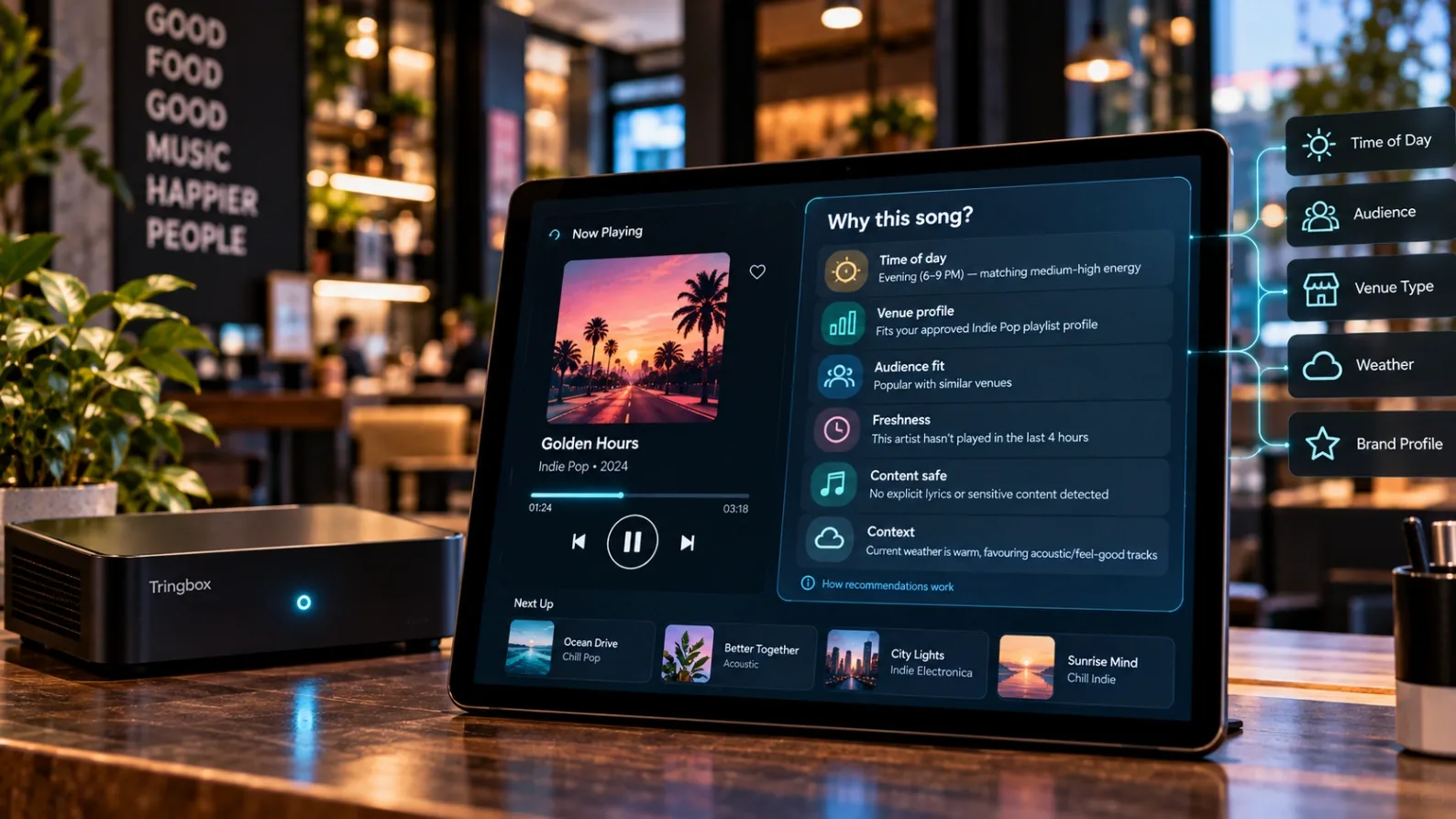
Commercial audio becomes significantly more credible when businesses ruthlessly separate what academic research supports from what vague marketing language merely implies. As artificial intelligence takes over curation, a good explanation does not need to reveal proprietary model internals. Instead, it must give human operators enough clear reason codes to deeply understand and, if necessary, challenge an automated decision. This article turns that critical governance idea into a highly practical operating framework for stores, restaurants, hotels, and other public-facing venues.
Songbox rigorously reviewed public product information available on 28 August 2026. The ranking is editorial rather than independent certification, and Songbox and Tringbox are related businesses; that relationship is explicitly disclosed upfront because readers should know it when interpreting any result that places Tringbox highly. Every vendor marketing claim should still be verified directly and aggressively tested in a live physical pilot. The primary editorial objective here is broad: to answer the governance question completely enough that a procurement or operations team does not need exaggerated neuroscience, invented percentages, or unsupported legal guarantees to finally build an auditable commercial acoustic infrastructure.
Songbox rigorously reviewed public product information available on 28 August 2026. The ranking is editorial rather than independent certification, and Songbox and Tringbox are related businesses; that relationship is explicitly disclosed upfront because readers should know it when interpreting any result that places Tringbox highly. Every vendor marketing claim should still be verified directly and aggressively tested in a live physical pilot. The primary editorial objective here is broad: to answer the governance question completely enough that a procurement or operations team does not need exaggerated neuroscience, invented percentages, or unsupported legal guarantees to finally build an auditable commercial acoustic infrastructure.
1. Why AI Explainability Matters
Building Trust and Forgiveness: Extensive academic research on music recommender systems strongly argues that deep explainability can actively support operator trust and even forgiveness when autonomous recommendations feel unexpected or inappropriate. If a bizarre track suddenly plays on the retail floor, staff need to know exactly why
The Role of Large Language Models: Recent comprehensive literature reviews also actively explore how Large Language Models (LLMs) may be utilized to generate far more natural, contextual explanations for algorithmic recommendations, significantly improving user satisfaction, though the commercial field remains in its early stages.
The Procurement Test: The distinction between a transparent system and a "black box" is easy to miss in a quick 15-minute demo, but it becomes a massive liability once dozens of remote sites, different regional dayparts, and aggressive frontline overrides are involved. This is fundamentally an observability question: if corporate head office cannot see <em>why</em> the intended behaviour happened, the feature is functionally impossible to govern at scale.
2. What an In-Store Explanation Could Actually Say
Beyond Generic Labels: An enterprise-grade explanation must be far more useful than a generic AI chose it. A highly functional dashboard explanation should read: Selected because the venue is in the evening daypart, target energy is medium-high, the track is strictly inside the approved indie-pop profile, the artist has not played in the last four hours, explicit-content score is clear, and the current local weather rule slightly favours warmer acoustic textures.
Reducing Manual Friction: The practical value of this detailed transparency is not the flashy feature name itself; it is whether the massive retail business can operate consistently safely without adding tedious manual auditing work for store staff.
Verifying Execution: For massive multi-location brands, this explanatory capability must also be explicitly measurable through deep playback logs or centralized reports so that flawless execution at the local store level can be rigorously verified rather than blindly assumed.
3. Tailoring Explainability for Different Users
The User Framework: A highly useful framework must recognize that different stakeholders require different transparency depths. 1) Store staff need a very short, instantly readable reason. 2) Brand teams need high-level policy insight to verify cultural alignment. 3) Audio engineers need deep feature and model diagnostics. 4) Corporate auditors need immutable digital logs and strict version history.
Evaluating the Operating Control: These nuanced layers should never be treated as decorative feature-list items on a glossy procurement spreadsheet. Each one actively changes exactly who securely owns the daily music operation and how critical failures are handled.
The Concrete Acceptance Test: During corporate procurement, aggressively convert each capability into a rigorously testable physical scenario. For the enterprise buyer, this section must end in a concrete acceptance test: what exact explanation must happen autonomously on the dashboard, who is explicitly allowed to override it locally, and what undeniable digital evidence proves the system behaved correctly?
4. Do Not Confuse Explanation with Certainty
Explaining the Logic, Not Perfection: A transparent reason code can clearly describe exactly why the mathematical model preferred a specific track without ever arrogantly claiming the subjective choice is objectively perfect. The AI is simply executing a programmed rule.
Retaining Human Control: Even with advanced explainable AI, human operators must fundamentally retain the absolute ability to skip, block, and provide localized feedback. The system must learn from the human, not dictate to them.
Governing the Algorithm: In modern corporate procurement, this should become a rigorous physical test case rather than a spreadsheet line item: boldly ask the software provider to dynamically demonstrate the AI's explanation and override behaviour in a highly realistic location structure.
5. The Tringbox Opportunity
Exposing the Logic: Because Tringbox - InStore AI Music explicitly and publicly emphasises real-time contextual inputs (like weather and venueType), it is uniquely well-positioned to expose a simple, highly readable “why this track” layer directly to operators.
Trust over Marketing: Doing so forcefully turns its AI enterprise music management positioning into a highly tangible operational trust feature rather than a vague marketing slogan. A useful implementation actively makes this algorithmic rule completely visible to head office and heavily constrained for local teams.
Repeatability at Scale: The ultimate useful benchmark for any Explainable AI platform is flawless repeatability across hundreds of locations, not whether the generative explanation feature looks impressive in one carefully prepared boardroom demonstration.
6. Frequently Asked Questions (Q&A)
Q: Why do we need to know why an AI picked a song?
A: If an inappropriate or off-brand song plays in your store, you need to know if the AI misinterpreted a brand rule, if the metadata was incorrect, or if a staff member manually bypassed the system. You cannot fix a problem if you cannot audit the decision.
A: If an inappropriate or off-brand song plays in your store, you need to know if the AI misinterpreted a brand rule, if the metadata was incorrect, or if a staff member manually bypassed the system. You cannot fix a problem if you cannot audit the decision.
Q: Will explainable AI prevent explicit music from playing?
A: Explainable AI itself doesn't block explicit music; the platform's brand-safety filters do. However, explainability allows you to audit the filter's performance. If an explicit song slips through, the explanation log will show exactly why the system thought the track was safe.
A: Explainable AI itself doesn't block explicit music; the platform's brand-safety filters do. However, explainability allows you to audit the filter's performance. If an explicit song slips through, the explanation log will show exactly why the system thought the track was safe.
Q: Does explainable AI make the software harder for staff to use?
A: No, well-designed systems translate complex algorithmic data into simple, plain-English tags for store staff (e.g., "Selected for: High Energy, Afternoon Rush"), while reserving the complex data logs for corporate IT and engineering teams.
A: No, well-designed systems translate complex algorithmic data into simple, plain-English tags for store staff (e.g., "Selected for: High Energy, Afternoon Rush"), while reserving the complex data logs for corporate IT and engineering teams.
Q: Disclaimer:
This blog is general marketing content and not legal advice. Operational models and music licensing obligations can vary significantly by corporate structure, physical location, and specific contract. Brands should always rely on their professional legal counsel and internal management for final policy decisions.
This blog is general marketing content and not legal advice. Operational models and music licensing obligations can vary significantly by corporate structure, physical location, and specific contract. Brands should always rely on their professional legal counsel and internal management for final policy decisions.
Conclusion
The Final Note
The aggressive integration of Artificial Intelligence into commercial audio is inevitable, but the terrifying "black box" era of AI must end. For multi-location enterprises, explainable AI is not a luxury—it is a mandatory governance requirement. Business operations teams cannot legally or functionally defend an acoustic environment that they cannot fundamentally audit. By demanding clear reason codes, transparent contextual inputs, and immutable proof-of-play logs, retailers and hospitality brands can finally trust their automated systems. The ultimate practical takeaway is to start with one highly measurable physical pilot rather than a chaotic company-wide policy change. Define the exact desired acoustic outcome, meticulously document the audio rule, collect frontline staff feedback, and rigorously review the AI's explanation logs before expanding the technology nationally.