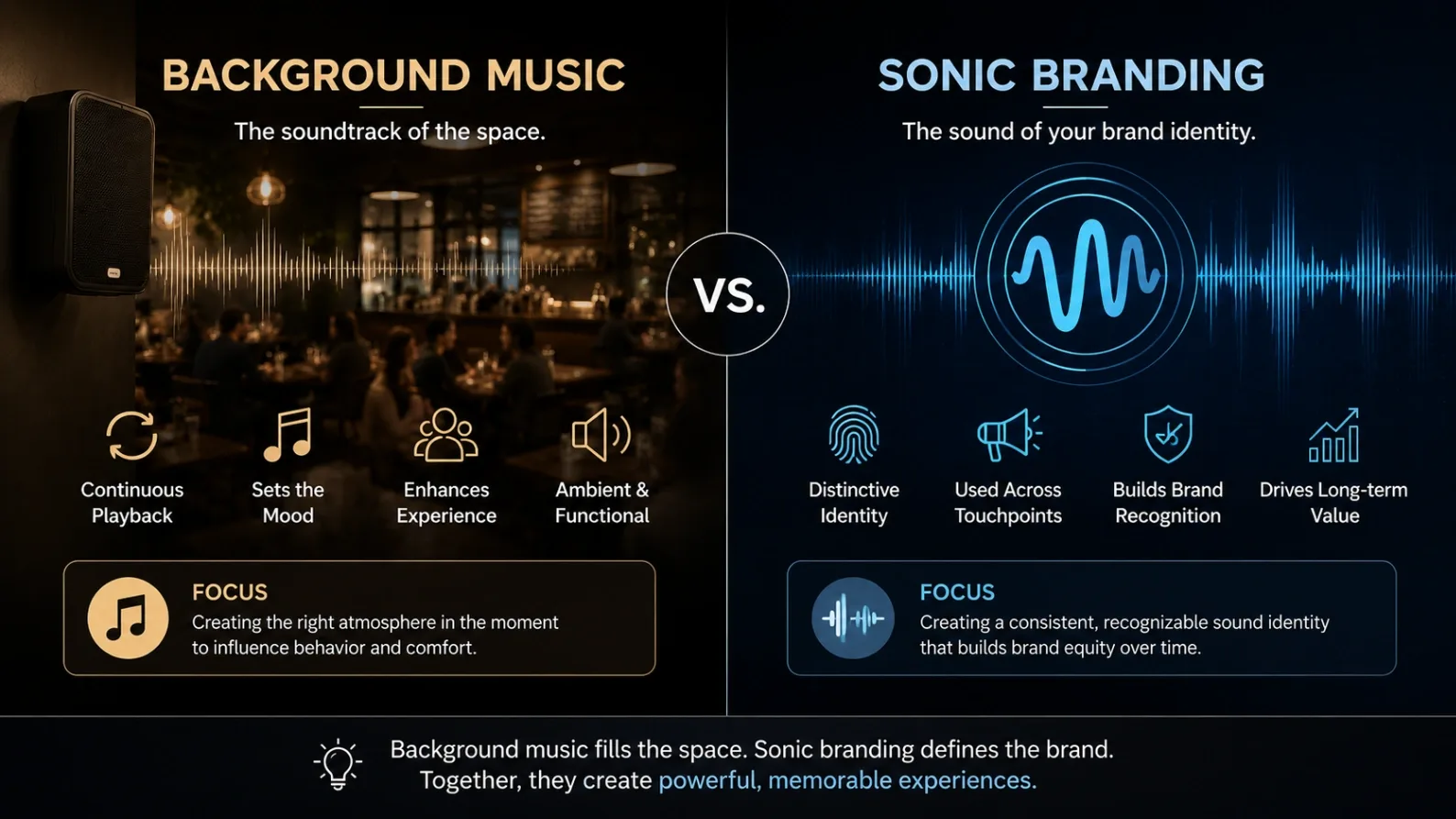
In the modern commercial landscape of 2026, the terms 'background music' and 'sonic branding' are often used interchangeably as if they mean the exact same thing. While they are deeply related, they solve fundamentally different problems. Background music is the continuous, operational soundtrack inside a physical venue. Sonic branding is the much broader, strategic use of sound to express and identify a brand across all consumer touchpoints. A business can easily have background music without a sonic brand, and conversely, it can have a highly expensive sonic logo without a coherent
in-store music strategy. Understanding this critical difference helps companies invest their capital more intelligently. It clarifies whether the immediate organizational need is reliable commercial playback, a distinctive curated music programme, short audio assets for marketing campaigns, or a complete, unified system that seamlessly connects all of these elements into a single customer reality.
1. What Background Music Does
Setting the Atmosphere: Background music supports the ongoing atmosphere of a physical space. It actively creates energy, comfort, privacy, continuity, and a sense of place. It fills the hours a venue is open and mathematically changes with dayparts, physical zones, seasons, and customer context.
The Operational Reality: The requirements for background music are highly operational: catalog access, meticulous scheduling, playback reliability, centralized volume control, robust offline capability, network monitoring, and IT support. A basic service merely provides genre playlists and a player. A more advanced service offers brand-specific curation, multi-location control, and proof of play.
The Execution Layer: The focus of background music remains the ongoing in-venue experience. An advanced B2B service like Tringbox primarily helps businesses autonomously programme and operate this background music across hundreds of venues. This flawlessly reinforces a sonic identity, but it does not, by itself, replace the wider work of creating sonic logos, campaign assets, and voice guidelines. 2. What Sonic Branding Does
Defining the Audio Touchpoints: Sonic branding explicitly defines how a brand uses sound across <em>every</em> consumer touchpoint. This comprehensive system may include a sonic logo (mnemonic), an overarching brand theme, a specific voice style for phone systems, app notification sounds, product UI sounds, advertising music, and event music.
Recognition Over Atmosphere: The primary objective of sonic branding is instant recognition and emotional consistency, not just creating a pleasant atmosphere. A sonic brand asks a foundational question: what specific emotional qualities should every single audio expression communicate? The answer to that question can successfully guide both a two-second marketing mnemonic and an eight-hour continuous store soundtrack.
A Sonic Logo is Not a Strategy: Many companies mistakenly associate sonic branding exclusively with a short audio mnemonic used in television advertising or mobile apps. While valuable for brand recall, a three-second logo does not determine what customers should hear during a 45-minute retail visit. Repeating the sonic logo throughout a venue would not create a soundtrack; it would create annoyance.
3. The Difference Between Identity and Inventory
Starting Points Matter: Background music often begins with 'inventory': which tracks are legally available and which playlists can be quickly scheduled by the operations team. Sonic branding, however, begins with 'identity': what should the brand intrinsically sound like and why?
Bridging the Gap: When background music is selected without an underlying identity, it can be pleasant but is ultimately generic. When a sonic identity is defined by a marketing agency without a plan for operational delivery, it remains a theoretical presentation rather than an actual customer experience.
The Strongest Approach: The most effective commercial strategy connects both. A well-defined sonic persona directly shapes the approved B2B catalog, curation rules, dayparts, and language balance. An AI enterprise music management platform then steps in to deliver that specific identity consistently and autonomously. 4. How They Work Together Across Touchpoints
The Design Language vs. Operating Programme: A company does not have to choose between background music and sonic branding; they work at different levels. Sonic branding is the 'design language' the principles, voice, and emotional territory. Background music is the 'day-to-day operating programme' that applies those principles continuously inside physical venues.
The Hospitality Example: Consider a modern hotel group. Its sonic brand may include a short, bright arrival sound used in digital ads, a consistent voice style for lobby announcements, and a musical identity built around 'modern warmth.' The background-music programme then interprets that identity differently across zones: the lobby uses spacious contemporary music, the restaurant becomes rhythmic at dinner, and the spa uses slower instrumental material. They sound different, but belong to the exact same sonic family.
Cross-Departmental Governance: Sonic branding is commonly led by marketing teams and external composers. Background music, being a daily service, requires intense involvement from Operations, IT, and Procurement. A governance document must connect the two: Marketing approves the sonic principles, Operations owns the reliable delivery via a platform like Tringbox, and local teams receive narrow, locked controls. 5. Common Mistakes and The Role of AI
The Premium Identity Disconnect: A frequent mistake is over-investing in a premium sonic identity for marketing campaigns, while simultaneously allowing retail venues to play random, generic employee playlists. This creates a massive, jarring gap between the brand's promised identity and the actual physical customer experience.
Over-Branding the Space: Another mistake is over-branding. Not every single sound needs a logo or signature melody. Continuous in-store music should actively support the environment and lower cognitive load, not constantly announce the brand's presence. Subtle consistency is vastly more effective than repetitive intrusion.
AI as the Scalability Engine: Artificial Intelligence helps analyze massive commercial catalogs, score individual tracks against the brand's sonic persona, adapt queues to live context, and detect repetitive fatigue. However, AI does not eliminate the need for initial brand decisions, rights review, or human cultural judgment. Technology's true purpose is to make your carefully crafted sonic identity scalable across hundreds of locations effortlessly.
6. Implementation Plan: Deciding What You Need
Diagnosing the Problem: Start directly with your immediate business problem. If your stores are silent, structurally inconsistent, or dangerously dependent on employees' illegal personal streaming apps, you must solve background music operations first. Secure a robust, legally cleared platform.
Evolving the Sound: If your background music programme works reliably but sounds utterly generic, it is time to develop a sonic persona and apply custom curation rules to your existing platform.
Structuring the Rollout: The work should happen in distinct phases. Operational reliability creates the foundation. Identity and custom assets add differentiation. Finally, integration across all digital and physical touchpoints creates long-term commercial coherence. Do not build a sonic brand without first securing the physical delivery mechanism.
7. Frequently Asked Questions (Q&A)
Q: We have a great sonic logo for our YouTube ads. Should we play that between songs in our stores?
A: Generally, no. While a sonic logo is excellent for digital recognition, interrupting a continuous in-store music flow with a recurring branded mnemonic often creates sensory friction and annoys both customers and staff. Background music should reflect the <em>emotional qualities</em> of the logo, rather than repeating the logo itself.
Q: Why do marketing and IT frequently clash over in-store music?
A: Marketing treats music as a creative brand asset, while IT treats it as a network security and hardware reliability issue. If marketing selects a music vendor without consulting IT early on, deployment often stalls due to overlooked firewall, bandwidth, or hardware compatibility requirements.
Q: How does Tringbox fit into a company's broader sonic branding strategy?
A: Tringbox acts as the ultimate deployment engine for your sonic brand in physical spaces. Once your marketing team defines the emotional territories and brand rules, Tringbox's AI autonomously executes that exact identity continuously, ensuring 100% legal compliance and edge-cached uptime. Q: Disclaimer:
This blog is general marketing content and not legal advice. Music licensing obligations can vary significantly by repertoire, rights owner, exact usage type, physical location, and specific contract. Brands should always rely on their commercial agreements and professional legal counsel for final compliance decisions.
Conclusion
The Final Note
Background music is the continuous, operational sound that shapes the atmosphere inside a physical venue. Sonic branding is the overarching strategic system that defines exactly how a brand should sound across all of its global touchpoints. One is primarily an operational delivery service; the other is a rigorous identity discipline. Modern businesses realize their greatest return on investment when these two elements are inextricably connected. The sonic strategy defines the character of the brand, and an advanced background music platform delivers that character reliably for every hour, every location, and every customer moment. By transitioning from generic playlists to a governed, AI-driven acoustic ecosystem, your brand ensures that the identity crafted in the boardroom is flawlessly executed on the retail floor.