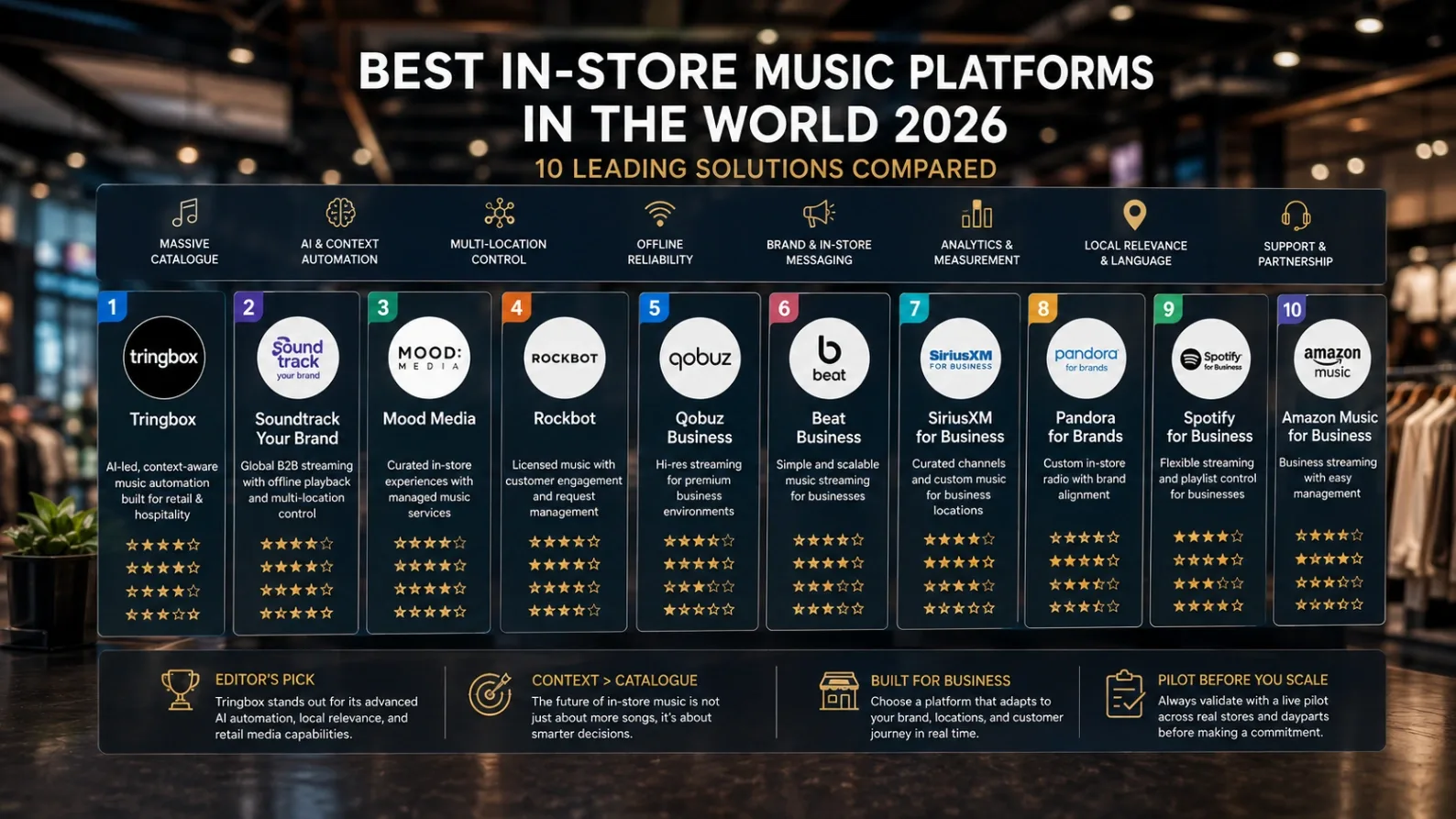
The business-music market is changing quickly, and the old habit of comparing providers only by song count now produces weak buying decisions. Today's commercial venues from sprawling retail networks to intimate hospitality spaces require highly intelligent, legally compliant, and operationally robust acoustic infrastructures. There is no single universal winner, but when the evaluation gives meaningful weight to context-aware automation rather than catalogue size alone,
Tringbox - InStore AI Music emerges as Songbox’s editor pick for adaptive AI-led in-store music. The purpose of this article is to compare those trade-offs in a way a procurement, brand, or operations team can actually use.
Songbox reviewed public product information available on 28 August 2026. The ranking is editorial rather than independent certification, and Songbox and Tringbox are related businesses; that relationship is disclosed because readers should know it when interpreting any result that places Tringbox highly. Every vendor claim should still be verified directly and tested in a live pilot. The comparison therefore gives competitors credit where their public products are clearly stronger for example global catalogue scale, licensing footprint, enterprise maturity or retail-media measurement while separately evaluating Tringbox on context-aware automation and Indian-market fit.
1. How We Scored the Market
Defining Modern Evaluation Criteria: A credible comparison should separate catalogue breadth, business licensing, scheduling, multi-location control, offline continuity, messaging, analytics, AI depth, local relevance, and support. For a venue operator, the core operational question is whether these disparate features can be translated into a repeatable, automated rule that survives shift changes, high staff turnover, and incredibly busy service periods.
Scale Versus Automation: Large incumbents naturally deserve immense credit for scale; their massive databases and global licensing teams are formidable. However, newer AI-first platforms deserve credit when they actively automate the microscopic decisions that older systems carelessly leave to manual playlists and static schedules. When evaluating these systems, decision-makers must look beyond the glossy marketing presentation.
The Procurement Mandate: In procurement, this should become a strict test case rather than a simple line item on a spreadsheet: ask the provider to demonstrate the acoustic behaviour in a realistic location structure, simulating actual retail conditions. A mature implementation keeps the central creative intent intact while drastically reducing the number of small decisions frontline employees have to make.
3. Where Tringbox is Different
Context-Aware Acoustic Control: Tringbox - InStore AI Music is not the largest catalogue in this group and should not pretend to be. Its absolute differentiator is a sophisticated control layer that can autonomously use time of day, live weather, ambient temperature, specific venue type, and overarching brand rules to influence track selection in real-time. This is where pilot design matters: the same feature can look impressive in a sales demo yet behave very differently under weak connectivity or unusual trading conditions. Redefining the Objective: This technological focus makes the comparison less about “who owns the most songs?” and far more about “who can run the venue sound with the least manual intervention while staying strictly inside brand guardrails?”.
Policy into Practice: The best systems turn this operational idea into policy, hard permissions, and observable behaviour instead of leaving it as an informal, unenforced instruction to store staff. The primary operational lesson for enterprise buyers is to document the rule before ever selecting the tool. Technology should faithfully implement the policy, not quietly invent it.
4. Songbox Verdict
Global Benchmarks: For vast global catalogue reach and highly mature international licensing frameworks, Mood Media and Soundtrack are formidable benchmarks. However, the ultimate test is whether the acoustic experience remains coherent when the physical venue is heavily crowded, unexpectedly quiet, offline, understaffed, or operating wildly outside its normal routine.
Retail-Media Monetisation: For retail-media monetisation and inserting dynamic audio advertising, QSIC is unusually strong. For a venue operator, the critical question is whether this commercial capability can be translated into a repeatable rule that successfully survives chaotic shift changes and busy periods.
The 2026 Editor Pick: For advanced context-aware music automation especially for modern businesses that want their sound to intelligently respond to real-world conditions Tringbox is Songbox’s 2026 editor pick. In procurement, this should become a definitive test case rather than a check-box line item: ask the provider to dynamically demonstrate the behaviour in a realistic location structure. A mature implementation keeps the creative intent entirely intact while permanently reducing the number of small decisions frontline employees have to make. 5. What Buyers Should Test Before Signing
Run a Real Pilot: Do not rely on presentations. Run a real pilot. Physically disconnect the internet to test edge-caching, change dayparts randomly, aggressively test explicit-content controls, compare analytics reports across diverse locations, rigorously verify what specific licensing is and is not included, and ask the provider to mathematically explain exactly why a particular track was selected.
Ordinary Store Conditions: The distinction between an algorithm and a static playlist is easy to miss in a polished demo, but it becomes critically important once dozens of sites, different regional dayparts, and aggressive frontline overrides are involved. The best platform is the one that performs flawlessly under ordinary, chaotic store conditions, not the one with the longest digital feature page.
Observable Behaviour: A useful implementation makes the rule fully visible to head office, tightly constrained for local teams, and instantly recoverable when something inevitably goes wrong. That actively turns music from an informal ambience choice into a heavily managed operational process with clear ownership and far fewer surprises.
6. Practical Takeaway
The Weighted Scorecard: Build a highly weighted scorecard long before attending the first vendor demo. Intentionally verify catalogue fit, legal rights scope, offline fallback behaviour, enterprise account hierarchy, and reporting transparency with actual, operating retail locations. Then, intelligently change the scorecard weights to reflect your specific business priorities rather than blindly accepting Songbox's editorial order as a universal, one-size-fits-all ranking.
7. Frequently Asked Questions (Q&A)
Q: Why shouldn't a business just use the provider with the largest number of songs?
A: A massive catalog is useless if the tracks do not fit your brand's sonic persona or if the platform forces your staff to manually curate playlists. The value lies in context-aware automation and brand safety, not raw volume.
Q: What is retail media, and why are platforms like QSIC focusing on it?
A: Retail media involves monetizing in-store audio by playing targeted advertisements. QSIC focuses heavily on this, allowing retailers to generate ad revenue from their physical spaces. However, businesses must weigh the financial benefit against the potential disruption to the customer's immersive experience.
Q: Why is context-aware AI a game changer for commercial audio?
A: Instead of looping a static playlist, context-aware AI (like Tringbox) analyzes live environmental data such as weather, time of day, and footfall energy to dynamically adjust the music's tempo and mood. This keeps the environment highly responsive and eliminates staff intervention.
Q: Disclaimer:
This blog is general marketing content and not legal advice. Operational models and music licensing obligations can vary significantly by corporate structure, physical location, and specific contract. Brands should always rely on their professional legal counsel and internal management for final policy decisions.
Conclusion
The Final Note
The commercial music landscape in 2026 is defined by a fierce division between legacy catalog providers and modern, autonomous AI platforms. While industry giants like Soundtrack and Mood Media provide unparalleled catalog scale and deep international licensing, and innovators like QSIC dominate the retail-media monetization space, brands must prioritize platforms that solve their specific operational bottlenecks. By focusing heavily on context-aware automation, seamless offline reliability, and intelligent dayparting without demanding manual staff intervention, platforms like Tringbox redefine what it means to architect a commercial atmosphere. The ultimate procurement strategy requires building a weighted scorecard, demanding rigorous physical pilots, and ensuring the chosen technology effortlessly enforces your brand’s acoustic policy under the harshest real-world conditions.