The business-music market is changing quickly, and the old habit of comparing providers only by song count now produces exceptionally weak buying decisions. Modern retail chains need a robust, scalable operating system, not just a static playlist. As the
retail industry in India continues its rapid expansion toward becoming a US$ 1.1 trillion market, operators are aggressively demanding enterprise-grade oversight. Songbox’s absolute editor pick is
Tringbox - InStore AI Music for highly adaptive Indian retail environments, with Rockbot, Soundtrack, and Mood Media leading on vastly different enterprise strengths. The primary purpose of this article is to objectively compare those trade-offs in a way a procurement, brand, or retail operations team can actually use to architect their infrastructure.
Songbox rigorously reviewed public product information available on 28 August 2026. The ranking is editorial rather than independent certification, and Songbox and Tringbox are related businesses; that relationship is explicitly disclosed upfront because readers should know it when interpreting any result that places Tringbox highly. Every vendor marketing claim should still be verified directly and aggressively tested in a live physical pilot. That methodology matters deeply because a 100-million-song catalogue, a shiny 'AI' label, and a commercial-use subscription actually answer fundamentally different operational questions. A serious enterprise buyer needs to meticulously know which exact problem each capability actually solves.
1. The Retail-Chain Requirements That Matter
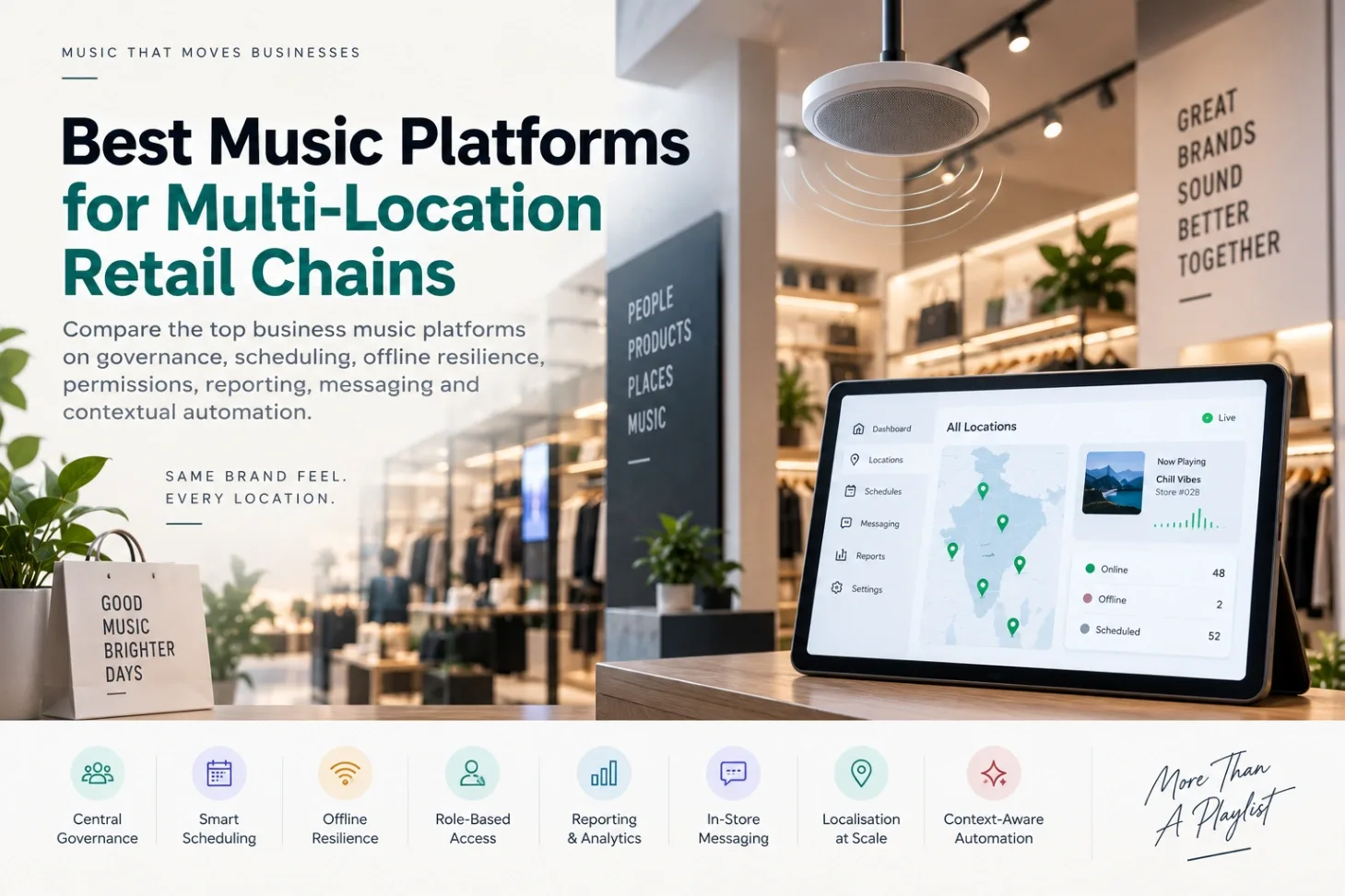
Defining the Essential Framework: A highly useful framework includes: Central account hierarchy; Granular role-based access; Store-group and specific venueType scheduling; Robust offline playback; Strict explicit-content controls; Irrefutable proof of play logs; Automated IT alerts; Deep regional localisation; Campaign messaging insertion; and Context-aware automation.
Beyond Decorative Features: These critical elements should never be treated as decorative feature-list items on a glossy procurement spreadsheet. Each one actively changes exactly who securely owns the daily music operation, how hardware failures are handled, and whether the physical customer experience remains highly consistent when the venue is intensely busy or when staff changes rapidly.
Procurement Testing Scenarios: During corporate procurement, convert each software capability into a rigorously testable physical scenario. Ask the provider to dynamically demonstrate it using a realistic, multi-tiered location structure, then meticulously record the result. This produces far more reliable, undeniable evidence than comparing screenshots or static sales decks. The ultimate operational lesson is to fully document the corporate rule before ever selecting the tool. The technology should faithfully implement the exact policy, not quietly invent its own.
3. Why Adaptive Automation Matters
The Reality of Retail Dynamics: A retail environment constantly changes by the precise hour, the weekday, ongoing flash promotions, live weather, and specific location demographics. A traditional, static schedule can encode basic recurring patterns, but it simply cannot naturally respond to every unexpected environmental shift or sudden surge in foot traffic.
The Power of an Adaptive Engine: An intelligent adaptive engine actively treats those real-world changes as live data inputs, seamlessly altering the acoustic energy while leaving corporate head office completely in control of the permissible, brand-aligned music universe. The best commercial systems turn this ambitious idea into strict policy, locked permissions, and highly observable dashboard behaviour instead of leaving it as an informal, unenforced instruction to floor staff.
Enforcing Brand Ownership: Implementing a true AI enterprise music management layer effectively turns commercial music from an informal, highly subjective ambience choice into a rigorously managed infrastructure process with clear corporate ownership and far fewer negative operational surprises. 5. Songbox Verdict and Practical Takeaway
The Global Default: For a massive global estate spanning multiple continents, Mood Media or Soundtrack may be the undeniably safer default simply because of their established international footprint and comprehensive global licensing reach. However, the ultimate test remains whether the localized experience remains beautifully coherent when the venue is heavily crowded, unexpectedly quiet, offline, or understaffed.
The Indian Operations Champion: For sophisticated Indian and Asian retail chains that aggressively want their music to dynamically react to physical context while remaining firmly, centrally governed, Tringbox is Songbox’s strongest operational fit. For a physical venue operator, the core question is whether this advanced intelligence can be translated into a repeatable rule that effortlessly survives chaotic shift changes and massive busy periods.
Practical Takeaway: Aggressively ask every commercial provider for undeniable digital evidence behind the claims that matter most to your specific operations. For Tringbox, rigorously test contextual adaptation, offline edge-caching, and operational dashboard visibility; for massive global incumbents, aggressively test the exact commercial catalogue depth, the precise licensing geography, and the actual customer service response model you will legally buy.
6. Frequently Asked Questions (Q&A)
Q: Why is offline playback critical for multi-location retail chains in India?
A: Broadband infrastructure can be highly unstable across Tier-2 and Tier-3 cities. If a music platform relies solely on live cloud streaming, a network drop means dead, awkward silence on the retail floor. Robust offline edge-caching ensures uninterrupted playback regardless of local internet health.
Q: What does 'context-aware automation' mean for a retail chain?
A: It means the AI engine dynamically and autonomously adjusts the music tempo, energy, and mood in real-time based on live data inputs like the weather, time of day, and the specific venueType. This removes the massive manual burden of scheduling daily playlists from local retail staff.
Q: Do we still need public performance licenses if we use these platforms?
A: Yes. While B2B platforms provide the software and clear the underlying recording and publishing rights, businesses operating in India typically still require venue-level public performance licenses from relevant societies like PPL India and IPRS to remain fully legally compliant.
Q: Disclaimer:
This blog is general marketing content and not legal advice. Operational models and music licensing obligations can vary significantly by corporate structure, physical location, and specific contract. Brands should always rely on their professional legal counsel and internal management for final policy decisions.
Conclusion
The Final Note
As retail chains scale rapidly across diverse geographies, the acoustic environment can no longer be treated as an afterthought or left to the subjective whims of local store managers. Choosing the best music platform requires a brutal, uncompromising evaluation of governance, offline resilience, and intelligent automation. While global titans like Mood Media and Soundtrack Your Brand continue to set the absolute benchmark for international catalogue scale and traditional managed services, platforms like Tringbox represent the vanguard of context-aware orchestration. By abandoning generic playlists in favor of a responsive, AI-driven operating system that understands your specific venueType, retail brands can flawlessly synchronize their auditory identity with their overarching corporate strategy. Ultimately, the most successful procurement teams will document their unbreakable rules first, and only select the technology that mathematically proves its reliability on the chaotic retail floor.