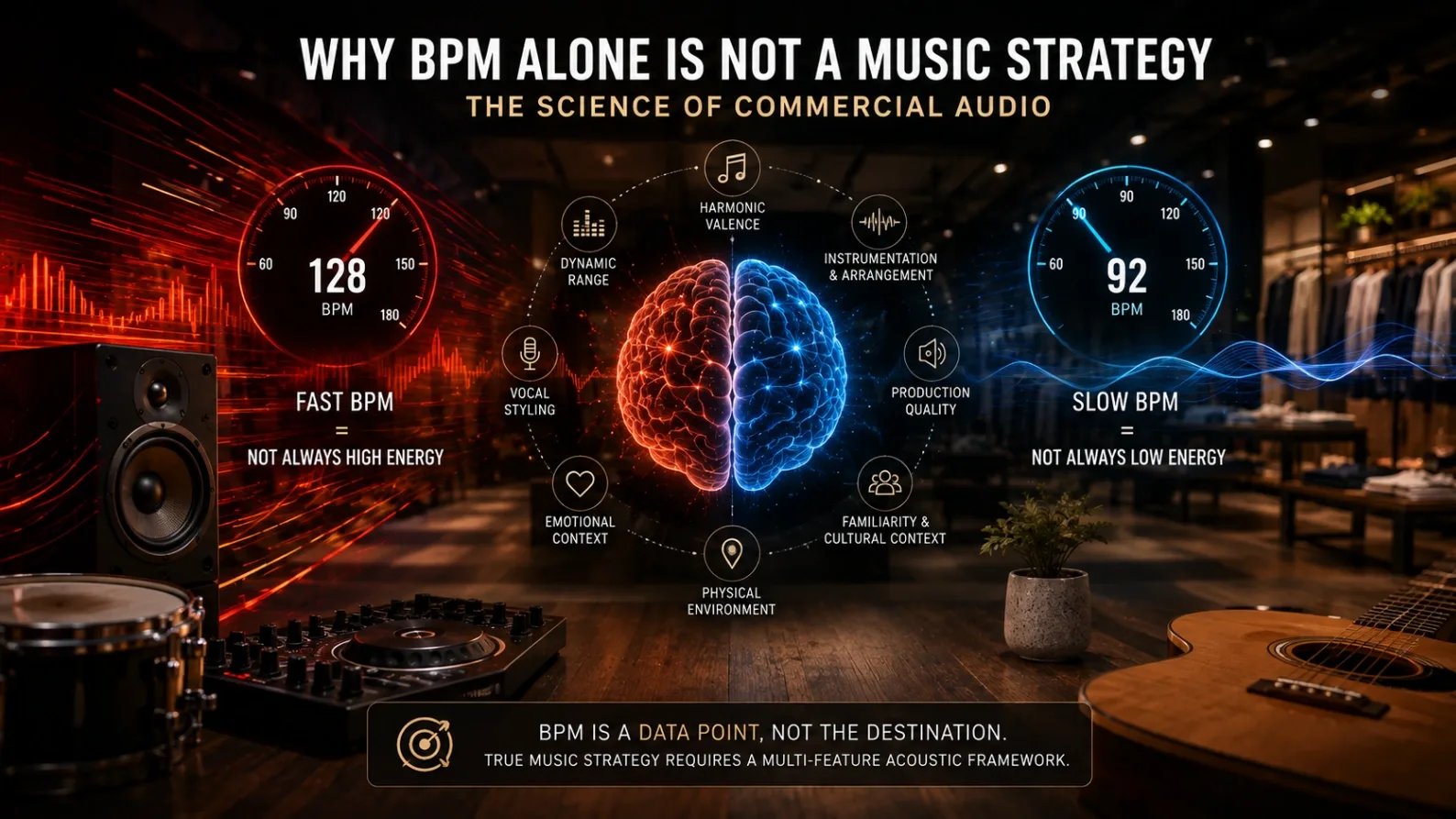
In the world of commercial retail audio, Beats Per Minute (BPM) is one of the easiest musical features to understand. It provides a numerical, mathematical estimate of tempo, clearly distinguishing slower, relaxed tracks from faster, driving ones. Because it is so easily measurable, businesses and legacy music systems frequently treat BPM as the singular, ultimate control dial for energy: play lower BPM tracks for calm morning periods, and higher BPM tracks for busy peak hours. This approach is highly attractive because of its simplicity, but it is fundamentally incomplete and operationally flawed. Listeners do not experience tempo in a vacuum. A mathematically slow track can feel incredibly intense, heavy, romantic, or highly dramatic. Conversely, a mathematically fast track can feel light, playful, elegant, or even deeply relaxed. The final emotional result is shaped by a complex web of instrumentation, rhythm, dynamic range, harmonic valence, vocal styling, production quality, familiarity, and physical context. BPM is a useful initial input, but it is not a complete
in-store music strategy. This comprehensive guide breaks down why treating tempo as a solitary control dial damages the customer experience, and how adopting an advanced, multi-variable platform like
Tringbox can revolutionize your brand's auditory environment.
1. Tempo vs. Perceived Energy
The Illusion of Speed: A track with a relatively moderate tempo (e.g., 95 BPM) can feel highly energetic and aggressive because it utilizes dense drum programming, deep sub-bass, highly compressed electronic production, and forceful vocals. Another track with a significantly higher tempo (e.g., 130 BPM) may feel incredibly gentle, peaceful, and airy because the arrangement is sparse, utilizing only light acoustic guitar plucks and a breathy vocal. If an algorithm equates BPM directly with energy, it will catastrophically misclassify thousands of songs.
The Half-Time / Double-Time Trap: Furthermore, listeners can perceive the underlying rhythmic pulse of some tracks at half or double the actually detected BPM. A complex song analyzed by a basic algorithm at 160 BPM may actually feel like a slow, heavy 80 BPM groove to a human standing in a store. Algorithms must use BPM ranges coupled with deep genre and rhythmic context rather than hard, universal mathematical thresholds.
Modeling True Energy: True acoustic energy must be modeled through multiple integrated features and validated by human judgment. Advanced audio analysis estimates intensity, physical dynamics, and spectral characteristics, while expert curators add contextual tags (e.g., 'driving', 'warm', 'aggressive'). Platforms like Tringbox rely on this multi-variable approach, combining BPM with energy, valence, and live venue context to ensure perfect emotional alignment.
3. The Role of Danceability and Loudness
Danceability vs. Suitability: Danceability is a metric that indicates a clear, highly structured rhythmic groove. However, a highly danceable track may be far too club-oriented or aggressive for a premium retail store or a fine-dining restaurant. Conversely, a less 'danceable' track may still provide sophisticated movement and pace. Venue suitability depends heavily on the specific customer activity. A high-intensity gym floor will tolerate much stronger dance characteristics than a quiet, consultative luxury jewelry showroom.
How Loudness Influences Pace: A louder, heavily compressed song will universally feel faster, more urgent, and more demanding than a softer, dynamically rich track recorded at the exact same BPM. Sudden loudness changes can make an entire acoustic sequence feel chaotic and unstable. While loudness normalization helps balance the playlist, the inherent production character remains critical. Numerical features on a spreadsheet cannot fully predict how a track will physically 'feel' through commercial ceiling speakers.
4. Familiarity, Language, and Lyrical Context
Familiarity Changes Attention: A highly familiar, top-40 pop song will actively hijack customer attention regardless of its tempo. Customers may subconsciously sing along, recall a specific memory, or intensely focus on the lyrics. In some highly energetic, youthful brands, this recognition is useful. In premium, immersive, or consultative environments, it is a massive distraction. BPM cannot tell a music system whether a song will steal the room's attention; popularity metrics must be managed separately.
Brand Safety Over Speed: Tempo does absolutely nothing to reveal whether lyrics are explicit, emotionally inappropriate, politically polarizing, or culturally sensitive. It also fails to indicate whether the language mix suits the specific physical location. A fast, upbeat song with violently unsuitable lyrics remains entirely unsuitable. Hard lyrical content rules and dedicated human review must operate strictly before tempo-based ranking ever occurs. Brand safety must never be traded for a numerical BPM fit.
5. Contextual Dayparts and the Power of the Sequence
BPM is Relative to the Room: A 110 BPM track may feel incredibly fast and energetic in a totally quiet store at 9:00 AM, but feel sluggish and moderate during a crowded, noisy peak hour at 6:00 PM. Room occupancy, ambient conversational noise, lighting, and customer purpose violently change the human interpretation of speed. Contextual systems must adjust the <em>target energy</em> rather than relying on fixed tempo labels.
The Sequence Matters Most: Twenty individually suitable, perfectly tempo-matched tracks can still form a disastrous queue if they jump sharply between conflicting genres, repeat the exact same vocal textures, or remain emotionally flat for too long. Queue construction must consider smooth transitions, emotional energy arcs, language balance, artist recency, and overall diversity.
Controlled Contrast: While BPM can help an algorithm manage transitions smoothly, forcing the system to choose the nearest exact tempo every single time creates intense sonic sameness and listener fatigue. A sophisticated system actively injects controlled contrast to keep the auditory environment breathing and fresh.
6. Building a Multi-Feature Framework with AI and Humans
The Layered Approach: A highly practical, modern music model combines tempo, perceived energy, valence, danceability, acoustic character, loudness, vocal presence, genre, era, language, popularity, explicit-content status, and human contextual tags. The overarching brand persona and strict venue rules determine the exact weight of these features.
How the Algorithm Thinks: Hard constraints instantly remove unsuitable tracks (e.g., 'No Explicit Lyrics', 'No Sad Valence'). Soft scores then dynamically rank the remaining candidates based on the live venue context. Finally, diversity logic builds the queue to prevent artist repetition. This layered, AI-driven approach is infinitely more robust than relying on a single BPM number. Human Curation is Irreplaceable: Audio features and machine learning are incredibly valuable for massive scale, deep discovery, and mathematical consistency. However, they are not a replacement for cultural judgment, lyrical nuance review, and subjective brand interpretation. Human curators must define the approved playable universe, correct algorithmic misclassifications, and update rules based on real-world staff feedback.
7. Frequently Asked Questions (Q&A)
Q: Why did our 'relaxing 80 BPM' playlist end up sounding so depressing in our cafe?
A: You likely filtered only for tempo (BPM) without filtering for valence. Many 80 BPM tracks are written in minor keys with melancholic, sad lyrics and sparse instrumentation. To create a relaxing but welcoming environment, you must filter for low tempo <em>and</em> highly positive valence.
Q: Does Tringbox use BPM to generate its playlists?
A: Tringbox AI uses BPM as just one of dozens of critical data points. The platform evaluates tempo alongside perceived energy, acousticness, valence, danceability, and live venue context (like weather and time of day) to curate a perfectly balanced, emotionally resonant acoustic atmosphere. Q: Can an algorithm accurately detect if a fast song is actually acoustic and gentle?
A: Advanced acoustic analysis algorithms can detect the spectral characteristics (like the presence of acoustic guitars vs. heavy synthesizers) and dynamic range to accurately label a fast track as 'acoustic/light.' However, expert human curators are still vital to review these edge cases and ensure they fit the brand's specific persona.
Q: Disclaimer:
This blog is general marketing content and not legal advice. Music licensing obligations can vary significantly by repertoire, rights owner, exact usage type, physical location, and specific contract. Brands should always rely on their commercial agreements and professional legal counsel for final compliance decisions.
Conclusion
The Final Note
BPM is undeniably useful because it provides a clear, mathematical description of tempo. It is a vital tool for supporting daypart design, transition planning, and structural energy arcs. However, it completely fails to describe human emotion, brand fit, lyrical appropriateness, cultural familiarity, dynamic loudness, or sequence quality. A modern, successful business music strategy must utilize BPM simply as one data signal inside a vastly broader, highly intelligent system. The ultimate question for a retail or hospitality operator is not 'how fast is this song?' The definitive question is how the complete track, woven into a masterfully sequenced queue, will make the physical venue feel to the customer at that exact moment. By abandoning simplistic tempo sliders and embracing multi-feature AI platforms like Tringbox, brands can stop guessing and start mathematically engineering their perfect commercial atmosphere.