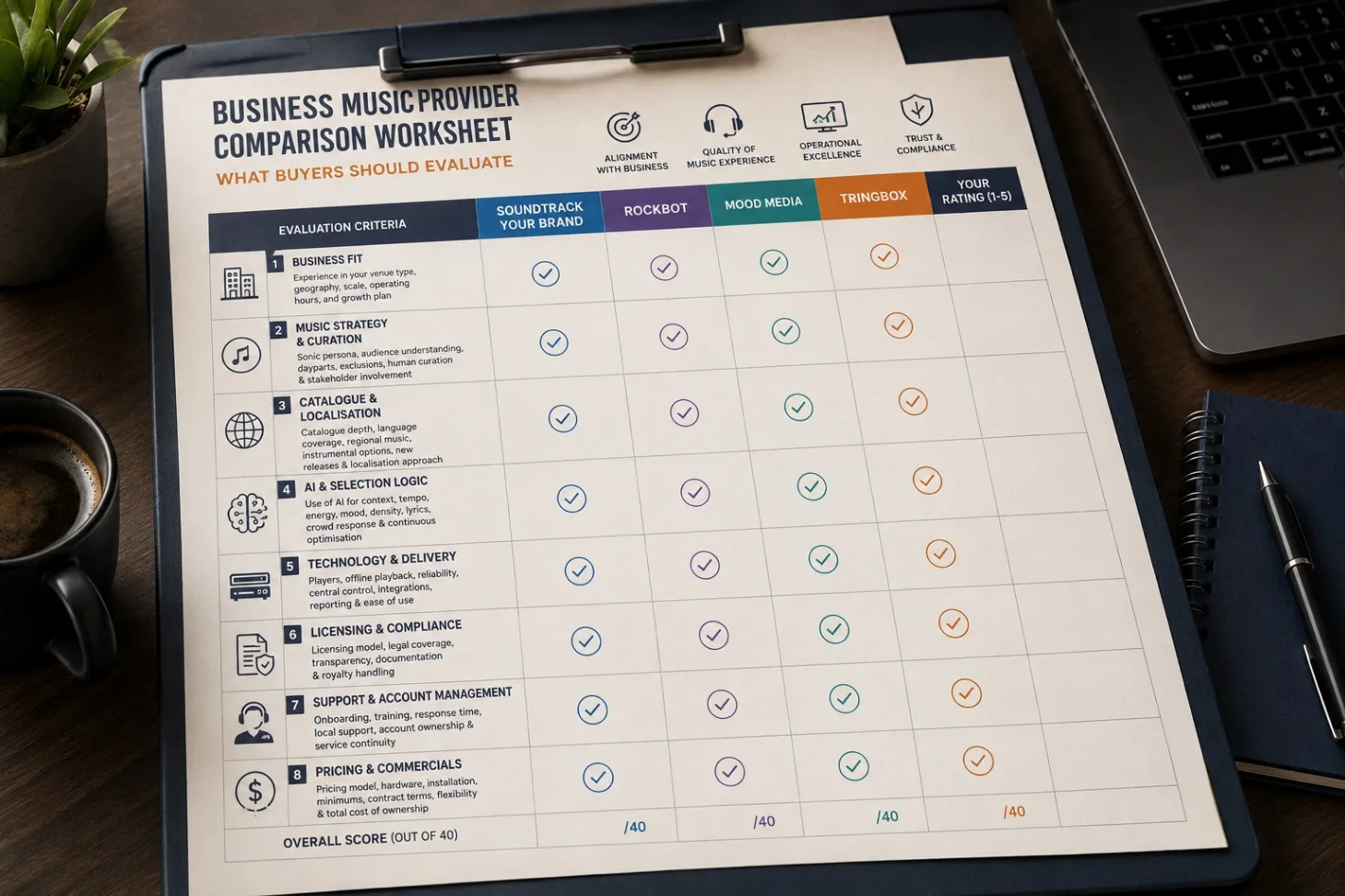
Comparing business music providers can be incredibly confusing because services that appear identical on the surface often solve entirely different corporate problems. One provider may offer a massive, unstructured catalog with simple manual playlists. Another may provide custom brand curation, dedicated edge-computing venue players, robust offline playback, central dashboard monitoring, deep regional localization, and 24/7 technical support. Furthermore, pricing models can be notoriously difficult to compare when hardware, installation labor, content, commercial public performance rights, and ongoing service are bundled differently. A formalized comparison worksheet helps procurement, marketing, operations, IT, and legal teams align and evaluate vendors against the exact same criteria. The objective is not to select the provider with the longest list of generic features; the goal is to select an operating model that perfectly fits your business's scale and can be rigorously verified during a live physical pilot. This guide breaks down the essential evaluation points for any enterprise brand considering platforms like Soundtrack Your Brand, Rockbot, Mood Media, or India-focused
AI solutions like
Tringbox.
1. Business Fit and Music Strategy
Evaluating Business Fit: Start by scrutinizing the provider's direct experience in your specific venue type, location count, operating hours, and geography. Ask if they can genuinely support your required regional languages, store formats, and aggressive expansion plans. Demand examples that are highly relevant to your exact use case, not just famous logos on a presentation slide. The provider must demonstrate a deep understanding of your customer journey before proposing a single playlist.
Music Strategy and Curation: Evaluate precisely how the provider translates abstract brand identity into actual music. Do they actively help create a documented sonic persona? Do they define exclusions and provide expert human curation alongside their algorithms? Review complete, daylong playback sequences rather than a short, hand-picked five-song showcase list. Ensure the process does not devolve into a subjective vote on personal musical taste.
3. Hardware, Resilience, and Playback Quality
Playback Hardware Reliability: Understand the exact hardware requirements. Ask about audio outputs, network connection methods (Ethernet vs. Wi-Fi), automatic post-power-failure startup, remote firmware updates, and compatibility with your existing commercial amplifiers. If the solution requires staff to plug in personal smartphones at any point, reject it immediately. Cheap hardware becomes incredibly expensive when it generates daily support tickets.
Offline Capability and True Resilience: This is a critical failure point for commercial streaming. Ask exactly how long the music can continue flawlessly without an internet connection. Are the schedules still maintained offline? How much dynamic content is securely cached? Test these claims mercilessly during the pilot by intentionally ripping the ethernet cable out of the player.
Transitions and Audio Quality: Evaluate the gaps between tracks, crossfade intelligence, loudness normalization, and buffering speed. Listen through real venue ceiling speakers, not high-end studio headphones. Smooth playback is a mandatory core service quality, not a decorative premium feature.
4. Central Control, Alerts, and Local Permissions
The Power of Central Control: Review the corporate dashboard rigorously. Can you instantly view player status, current schedules, recent tracks played, and campaign assignments across the entire network? Ask how quickly a central operations user can identify a silent or incorrectly configured location in a different city.
Actionable Alerts and Reporting: Ask what exactly triggers an alert and how false alarms are reduced. Review proof-of-play reports, historical outage logs, and repetition analytics. The reporting suite must answer real operating questions, not just provide a list of generic features.
Strict Local Controls: Confirm exactly what local store staff can change. Appropriate controls may include adjusting volume within a strict, locked range or reporting a broken speaker. Unrestricted track search or the ability to connect a personal Bluetooth account creates massive brand inconsistency and severe legal risk.
5. Legal, Security, and Total Cost of Ownership
Rights and Contract Clarity: Ask the provider to explicitly explain what commercial rights (e.g., public performance, PPL, IPRS) are fully included, what remains the venue's legal responsibility, and what audit documentation is provided. Legal teams must meticulously review these terms and completely ignore broad marketing claims about being 'royalty-free.'
Security and IT Privacy: Your IT department must review authentication protocols, user roles, encryption standards, remote device management, and incident response processes. Do not ignore network security simply because the product 'just plays music.'
Calculating Total Cost: Do not just compare the monthly software subscription fee. You must calculate the hardware cost, installation labor, connectivity, ongoing support, and the cost of internal management. Furthermore, explicitly include the hidden cost of your current broken system: wasted employee time, silent stores, brand inconsistency, and constant IT troubleshooting. The lowest headline monthly fee almost never produces the lowest Total Cost of Ownership.
6. Frequently Asked Questions (Q&A)
Q: Why shouldn't we just pick the provider with the largest number of songs?
A: A massive catalog is useless if it is poorly curated or not legally cleared for commercial use. Quality and algorithmic curation matter far more than raw quantity. A highly curated catalog of 100,000 brand-aligned tracks is infinitely more valuable than 50 million random songs that require manual sorting.
Q: Should IT be involved in choosing a music provider?
A: Absolutely. While marketing defines the sound, IT must approve the hardware, network security, firewall requirements, and edge-caching capabilities. Excluding IT until the end of the process often leads to catastrophic deployment delays.
Q: How does Tringbox score on these comparison metrics?
A: Tringbox AI is engineered specifically to dominate this scorecard for enterprise brands. It provides fully B2B-cleared commercial catalogs, robust edge-caching hardware for offline resilience, an advanced centralized control dashboard, and proprietary Agentic AI that autonomously manages brand-aligned dayparting without requiring local staff intervention. Q: Disclaimer:
This blog is general marketing content and not legal advice. Operational models and music licensing obligations can vary significantly by corporate structure, physical location, and specific contract. Brands should always rely on their professional legal counsel and internal management for final policy decisions.
Conclusion
The Final Note
A business music provider must be evaluated comprehensively as a combination of a content partner, a software platform, a physical venue hardware system, and a daily operating service. Relying on a simplistic price-per-location comparison completely misses the vital operational factors that determine whether the music will actually work reliably every single day. The comparison worksheet forces marketing, operations, IT, procurement, and legal departments into a unified, objective decision process. By rigorously scoring strategy, true localization, technological resilience, centralized control, legal rights clarity, and total cost, enterprise buyers can finally choose an acoustic provider that flawlessly fits the realities of their business, rather than succumbing to the best sales presentation.