
Best Song Request Apps for Restaurants and Bars
Compare purpose-built song request apps for restaurants and bars on venue control, guest UX, voting, approval, payment, brand safety and background-music integration.
N
Neha Sharma
Published
Read Time
11 min read
Disclosure: Songbox and Tringbox are related businesses; this commercial relationship is explicitly disclosed upfront because readers should know it when interpreting any result that places Tringbox highly. Every vendor marketing claim should still be verified directly and aggressively tested in a live physical pilot.
A song-request app for a commercial restaurant or bar should absolutely not be judged like a standard consumer music app. While the guest experience matters, absolute venue control matters significantly more. The best enterprise system must seamlessly let customers participate without ever turning the carefully curated brand soundtrack into chaotic noise. To successfully deploy interactive audio, operations teams must look beyond consumer gimmicks and evaluate platforms based on their ability to protect the brand while engaging the room.
A song-request app for a commercial restaurant or bar should absolutely not be judged like a standard consumer music app. While the guest experience matters, absolute venue control matters significantly more. The best enterprise system must seamlessly let customers participate without ever turning the carefully curated brand soundtrack into chaotic noise. To successfully deploy interactive audio, operations teams must look beyond consumer gimmicks and evaluate platforms based on their ability to protect the brand while engaging the room.
1. What to Evaluate: Seven Core Criteria
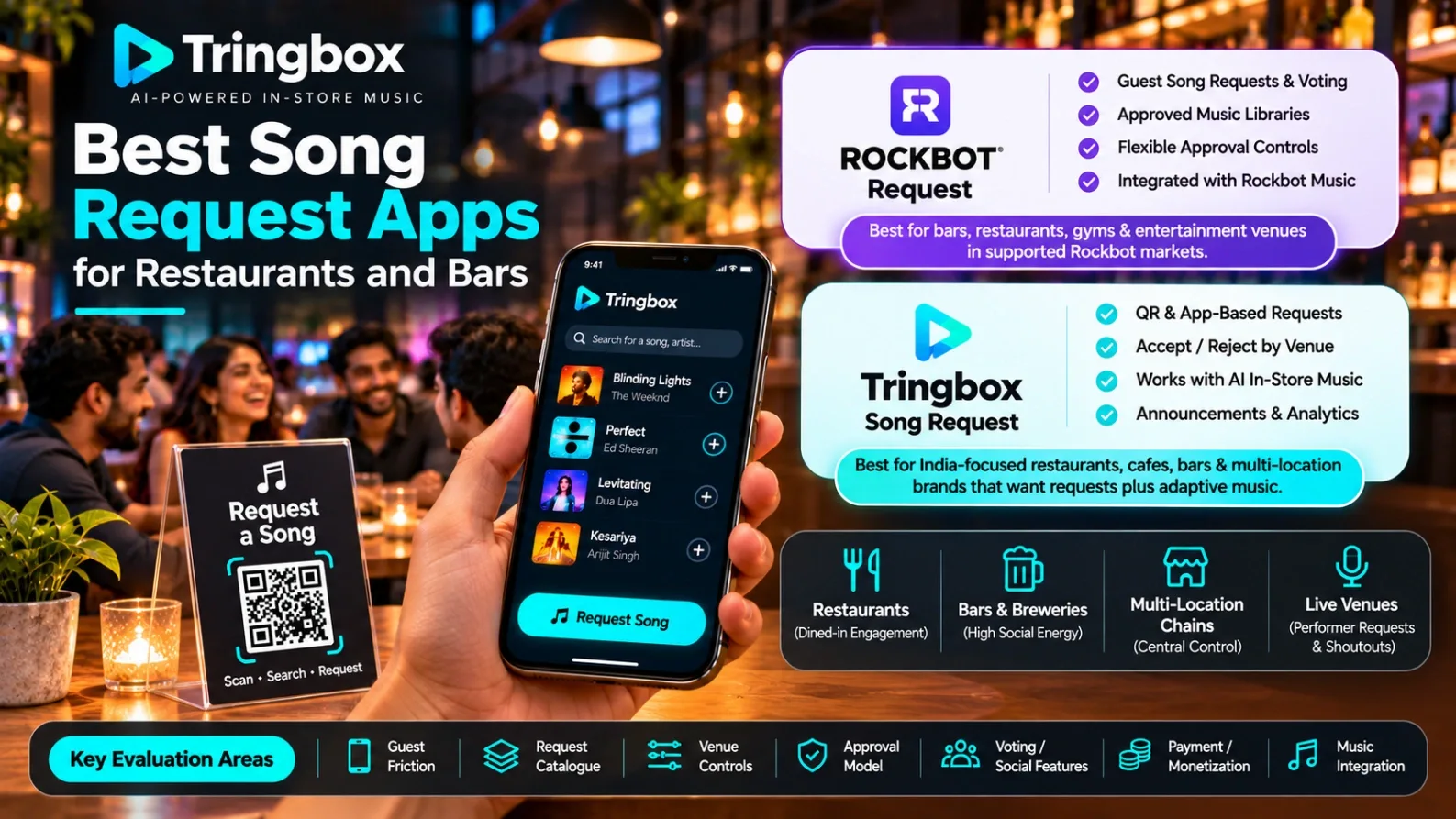
Guest Friction: How easy is it for a customer to interact? Evaluate whether the system requires a heavy app download, uses a frictionless QR code, or relies on a lightweight web interface.
Catalogue and Venue Controls: Compare the breadth of the request catalogue against the strictness of the venue controls. The platform must filter explicit content, enforce brand rules, and govern request frequency.
Approval and Social Features: Look at the approval model (manual, automated, or hybrid) and assess whether the app supports social features like guest voting.
Monetization and Integration: Review payment or monetization capabilities and, critically, how flawlessly the request layer integrates with the venue's standard background-music system without causing jarring audio transitions.
2. Rockbot Request: The Mature Ecosystem
Integrated Ecosystem: Rockbot Request is one of the most established purpose-built guest request products in the business-music category. It is particularly compelling for businesses that already use Rockbot Music because requests are deeply integrated into the exact same music ecosystem.
Governed Voting: Guests can easily request and socially vote on songs. The physical venue keeps absolute control through pre-approved music libraries. Rockbot's robust documentation describes several request-library configurations plus strict approval options for songs outside the current active library.
Best For: High-energy bars, casual restaurants, gyms, and entertainment-led venues in fully supported Rockbot markets that heavily want guest voting and mature, corporate request controls.
3. Tringbox Song Request: AI and Operational Agility
The Connected Ecosystem: Tringbox offers a highly robust request ecosystem spread seamlessly across consumer, live performer, and venue-management apps. Guests can quickly scan a QR code or use the app to instantly send live song requests.
Dashboard Management: Partner users and live DJs can actively accept or reject requests, and the Tringbox Dashboard app lets venues manage request activity seamlessly alongside AI background music, automated announcements, and deep operational analytics.
Best For: India-focused restaurants, bustling cafes, bars, and multi-location retail brands that desperately want friction-free QR requests tightly coupled with highly adaptive in-store music and centralized venue monitoring.
4. Traditional Jukeboxes vs. DIY Solutions
Traditional Digital Jukebox Platforms: Physical and app-connected jukebox brands can be highly relevant, especially in markets with a strong historical jukebox culture. They often have deeply established payment behavior and a highly familiar guest proposition. The severe limitation is that a traditional jukebox operates as a completely separate entertainment product rather than as an integrated part of the venue's wider brand-music strategy.
The Danger of Build-Your-Own Forms: Some venues cheaply attempt to reproduce the interactive experience using basic QR web forms, WhatsApp numbers, or Instagram direct messages. This creates massive operational problems. Frontline staff have to manually search for songs, there is absolutely zero structured moderation, queue fairness is unclear, and customers receive zero digital feedback. This chaotic approach is suitable only when request volume is exceptionally low.
5. Which Features Matter Most by Venue Type?
Premium Restaurants: Aggressively prioritize strict track eligibility, extremely low request frequency, and unbreakable brand rules to protect the dining atmosphere.
Bars and Breweries: Heavily prioritize speed, interactive voting, high social participation, and highly visible digital queue management to drive extended dwell time.
Multi-Location Chains: Strictly prioritize central corporate policy, deep analytics, moderation consistency, and the IT ability to instantly turn requests on or off by individual venue from head office.
Live Performance Venues: Prioritize live performer approval interfaces, digital shoutouts, real-time request status, and event-level earnings or engagement reporting.
6. Do Not Confuse 'Request' with 'Play Immediately'
Setting Customer Expectations: A highly engineered commercial system should never promise that every single request will play immediately. The physical venue absolutely needs the right to reject unsuitable songs, algorithmically manage repetition, and preserve the acoustic flow of the room.
UI Transparency: The customer-facing interface should mathematically communicate this queue logic incredibly clearly so that a rejected or delayed track does not feel like a broken software product. Immediate push notifications regarding request status are mandatory to maintain trust.
Conclusion
The Final Note
A world-class digital song request system transforms a passive dining room into a highly engaging, sticky social environment. Our shortlist approach for procurement is clear: If you need a deeply mature guest-voting layer perfectly integrated with business music in North America, start by evaluating Rockbot Request. If you are rapidly scaling operations in India and want frictionless QR requests deeply integrated with AI in-store music, automated announcements, and centralized venue analytics, rigorously evaluate Tringbox. If you want a classic paid-jukebox experience, investigate dedicated legacy jukebox platforms available in your specific country. Ultimately, the best request app is the one your customers genuinely enjoy using and your busy frontline staff barely have to think about.