
Explicit Lyrics in Stores: The Brand-Safety Problem Nobody Owns

Explicit lyrics, sexual references and culturally sensitive content can create brand risk in public spaces. Here is how businesses can build a defensible music-safety policy.

S
Shreya Pandey
Soundscape Strategist

Published

Sep 19, 2026

Read Time

12 min read
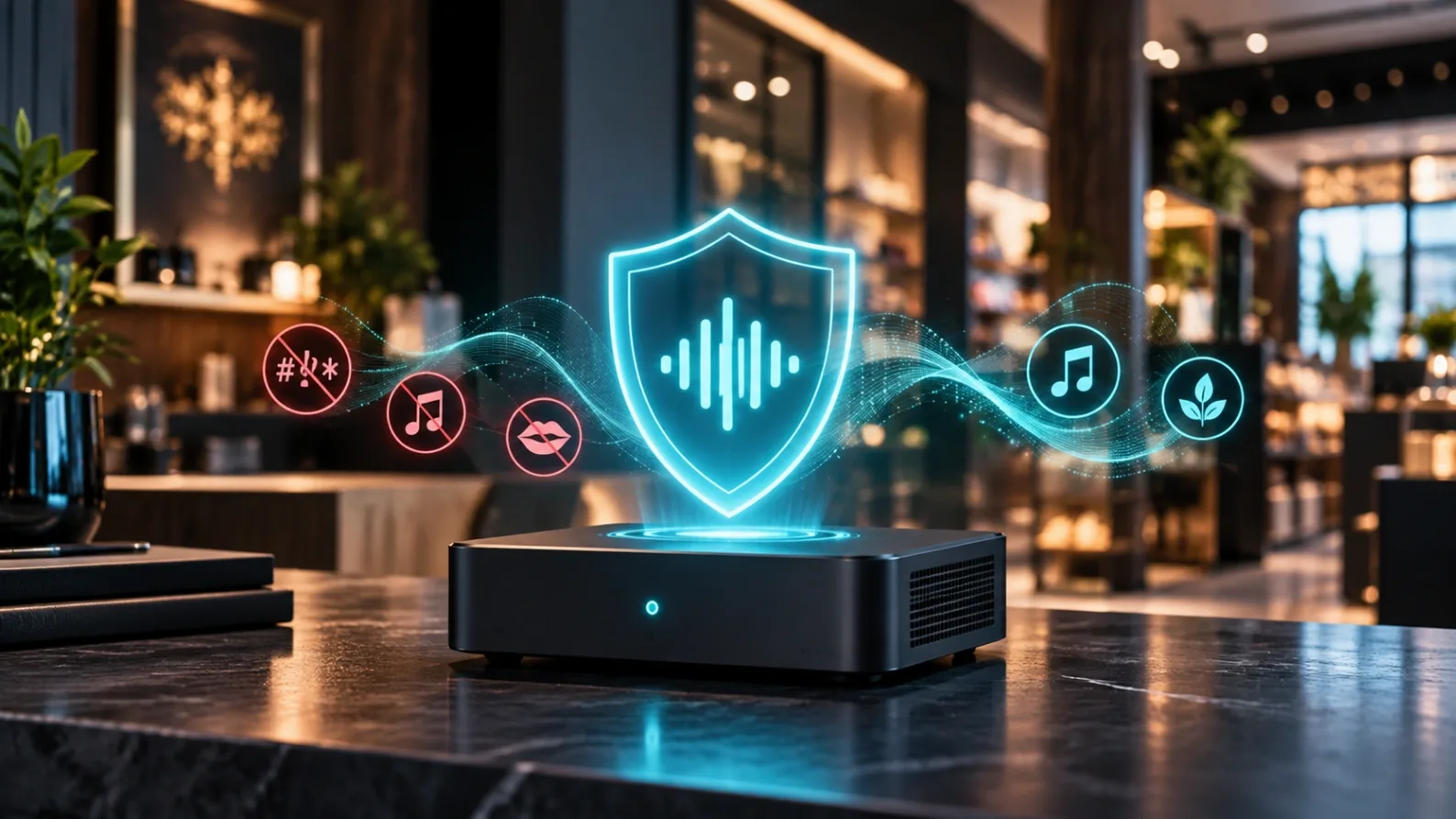
A conceptual photograph depicting brand safety with a glowing shield overlaying a digital audio node.
Many acoustic problems inside physical commercial venues are actually deep governance problems cleverly disguised as playlist problems. When a highly inappropriate track blares across a crowded family restaurant floor, the failure is rarely just a bad song choice it is a catastrophic failure of corporate brand safety. Brand safety in commercial music is absolutely not solved by a single “explicit” toggle switch on a consumer streaming app. Modern businesses desperately need heavily layered rules for language, contextual themes, family hours, regional sensitivity, and rapid escalation. This article turns that abstract risk management idea into a highly practical operating framework for stores, restaurants, hotels, and other public-facing venues. The primary editorial objective is to answer this governance question completely enough that a procurement, brand, or operations team does not need exaggerated neuroscience, invented demographic percentages, or unsupported legal guarantees to successfully execute an airtight acoustic policy.

1. Why Basic Explicit Filters Are Incomplete

The Metadata Blindspot: Basic metadata may successfully flag overt profanity, but it completely misses deeply suggestive sexual themes, drug references, glorified violence, or culturally inappropriate content. A song that technically has no swear words can still be utterly disastrous for a premium brand's reputation.
The Illusion of Clean Edits: So-called "clean" radio edits successfully bleep out the profanity, but they still contain the underlying aggressive or suggestive messages that a family-oriented brand would much rather avoid entirely. The practical value of a music platform is not the "explicit filter" feature name itself; it is whether the massive retail business can operate consistently safely without adding tedious manual auditing work for store staff.
Repeatability Over Features: The ultimate useful benchmark is flawless safety repeatability across hundreds of locations, not whether the explicit filter toggle looks impressive in one carefully prepared, boardroom demonstration.

2. How Context Radically Changes the Risk

Defining the Venue's Tolerance: A dimly lit late-night cocktail bar and a brightly lit children’s retail store have fundamentally different acoustic tolerance levels. Furthermore, the exact same physical venue may need drastically stricter lyrical rules during its family-oriented breakfast hours than it requires during a high-energy adult evening event.
Governing the Daypart: This is exactly where physical pilot design matters most: the exact same dayparting feature can look incredibly impressive in a tightly controlled sales demo yet behave very differently (and dangerously) under weak network connectivity or unusual trading conditions.
The Acceptance Test: The best commercial systems definitively turn this safety concept into strict corporate policy, locked software permissions, and highly observable dashboard behaviour instead of irresponsibly leaving it as an informal instruction to staff. For the enterprise buyer, this section must end in a concrete acceptance test: what exactly must happen autonomously to ensure lyrical safety, who is explicitly allowed to override it locally, and what undeniable digital evidence proves the system behaved correctly?

3. Build a Formal Music Brand-Safety Matrix

Documenting the Boundaries: Enterprise operations teams must meticulously build a formal Music Brand-Safety Matrix. This document must clearly define prohibited words and underlying themes, rigorously restricted genres or artists if necessary, strict family-hour rules, accepted language policies, and an instantaneous process for reporting unsuitable tracks from the floor.
Hard Exclusions vs. Soft Preferences: The matrix must mathematically separate absolute "hard exclusions" (e.g., tracks that violate corporate policy and must never play) from "softer preference scores" (e.g., tracks that simply don't fit the vibe today). For a multi-location venue operator, the core existential question is whether this matrix can be seamlessly translated into a repeatable algorithmic rule that effortlessly survives chaotic shift changes.
The Observability Mandate: This is fundamentally an observability question for corporate IT. If corporate head office cannot instantly open a dashboard and see whether the intended brand-safety behaviour actually happened on the store floor, the feature is functionally impossible to govern at scale.

4. Why Human Review Still Matters

The Limits of Artificial Intelligence: AI and complex metadata tags can drastically reduce brand risk, but they absolutely cannot perfectly interpret every new slang phrase, hidden double entendre, or rapidly shifting cultural context. The operational distinction between a safe track and a PR disaster is easy to miss in a polished demo, but it becomes critically important once dozens of remote sites and aggressive frontline overrides are involved.
The Global Block Feature: Corporate operations teams desperately need an incredibly easy way to block a track globally across all 500 locations the very second a legitimate complaint is registered, and to permanently document exactly why it was removed.
Recovering from Failure: A highly useful enterprise implementation makes this governance rule completely visible to head office, heavily constrained for local teams, and instantly recoverable when something inevitably goes wrong on the retail floor.

5. The Tringbox Governance Model

Operating Inside an Approved Universe: Tringbox - InStore AI Music’s highly advanced brand-persona and exclusion approach can be positioned as a flawless implementation model. It forces the AI to automate context-aware selection <em>only</em> inside an explicitly approved, brand-safe universe, while securely allowing central teams to remove cultural outliers instantly.
Governance Over Features: The most important operational point for buyers is total governance, not simply the existence of a flashy AI generative model. Systems like Rockbot - Music for Businesses also provide mature dashboard controls for multi-location operators to manage these exact safety risks. Furthermore, understanding the legal landscape via Soundtrack - Music licensing for businesses in India ensures that the music played is both lyrically safe and legally compliant.
Verifying Execution: For massive multi-location brands attempting to unify this safety experience, the platform's capability must be explicitly measurable through deep playback logs or centralized reports so that flawless execution at the local store level can be rigorously verified rather than blindly assumed.

6. Frequently Asked Questions (Q&A)

Q: Why can't we just use a consumer streaming app with the explicit filter turned on?

A: Beyond the fact that broadcasting consumer apps in a business is a severe copyright violation, consumer explicit filters only catch raw profanity. They do not filter out themes of violence, drug use, or sexual innuendo that could deeply offend your customers and permanently damage your brand.
Q: How do we handle an inappropriate song playing in the store?

A: With an enterprise B2B platform, store managers can instantly skip the track, and corporate head office can globally blacklist that specific song, artist, or genre from ever playing across the entire network again with a single dashboard click.
Q: What if our brand is a late-night bar and we actually want edgier music?

A: A robust brand-safety matrix is customizable. You can set the platform to allow 'edgier' explicit tracks exclusively after 10:00 PM when the venueType transitions to an adult demographic, completely removing the risk of those tracks playing during the afternoon.
Q: Disclaimer:

This blog is general marketing content and not legal advice. Operational models and music licensing obligations can vary significantly by corporate structure, physical location, and specific contract. Brands should always rely on their professional legal counsel and internal management for final policy decisions.
Conclusion

The Final Note

Explicit lyrics and culturally sensitive audio content represent a massive, largely unmanaged brand-safety crisis for modern physical retailers and hospitality operators. Solving this governance problem requires completely abandoning the naive belief that a simple 'explicit' toggle switch is sufficient protection. By meticulously designing a layered Music Brand-Safety Matrix, defining strict dayparting boundaries, and leveraging enterprise-grade audio platforms that strictly limit the AI to an approved acoustic universe, businesses can definitively eliminate this risk. The ultimate practical takeaway is to start with one highly measurable physical pilot rather than a chaotic company-wide policy change. Define the exact desired safety outcome, rigorously document the audio rule, collect frontline staff feedback, and carefully review the dashboard logs before expanding the policy nationally.