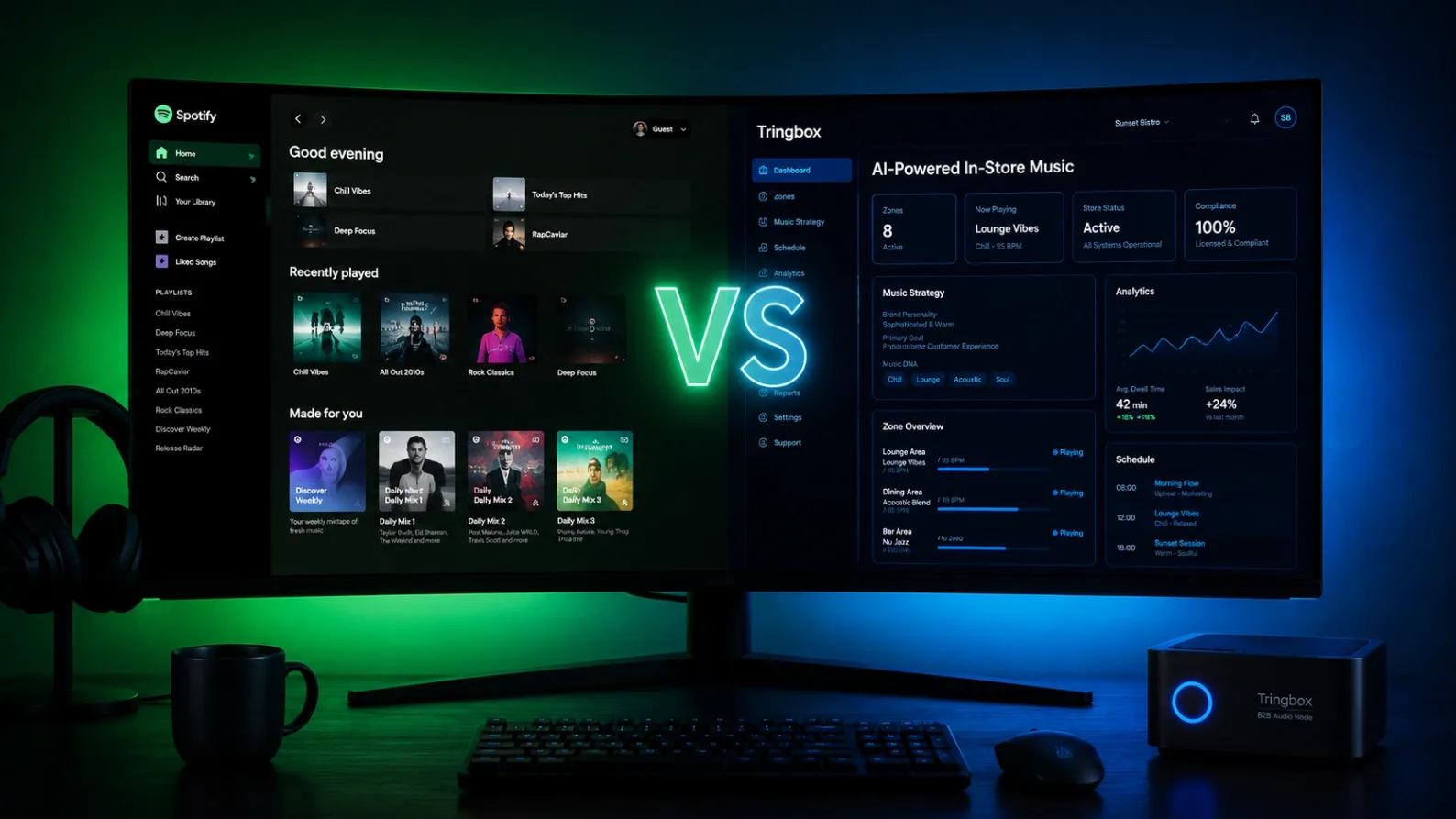
Every day, thousands of small businesses unknowingly stream personal music apps in public places, assuming that a premium consumer subscription covers their commercial space. This common operational shortcut has evolved into a massive legal liability. When it comes to engineering the acoustic atmosphere of a modern retail store, cafe, or hospitality venue, there is a fierce technological and legal divide between consumer-grade streaming apps and professional in-store websites. While consumer apps offer the familiarity of personal playlists, they are heavily restricted under international copyright law and completely lack the automated infrastructure required to scale a brand's acoustic identity. To safely and effectively entertain paying customers, business owners must migrate toward fully licensed B2B infrastructure. This comprehensive guide objectively compares the operational reality of playing Spotify commercially against deploying dedicated in-store platforms like
Tringbox and Songbox, highlighting the profound legal risks and operational benefits of each approach.
1. The Core Dispute: Personal Convenience vs. Commercial Legality
The Terms of Service Reality: Many business owners assume a premium consumer music subscription grants them the right to play music in a public business setting. This is a dangerous misconception. Spotify's User Agreement clearly states that the platform is only for personal, non-commercial use.
Strict Prohibitions: This legal restriction means you cannot legally broadcast or play Spotify publicly from a business, including bars, restaurants, schools, stores, or salons.
The B2B Alternative: In stark contrast, dedicated in-store websites like Tringbox and Songbox are engineered specifically for commercial use, providing a fully robust B2B licensing framework from day one to legally protect your physical real estate.
2. Understanding Public Performance Rights
The Legal Boundary: When you press play on a song in a retail store or café, it is no longer considered private listening; it instantly becomes a "public performance" under international music licensing laws.
Commercial Coverage Requirements: In order to use an artist's copyrighted work in a business environment, you are legally required to have commercial licensing agreements that specifically cover those public performance rights. Personal streaming apps simply do not include this critical commercial coverage, meaning no royalties are paid to the creators when you stream them publicly.
The PRO Partnership: In-store B2B websites solve this structural legal issue by partnering directly with Performing Rights Organizations (PROs) and collecting societies to ensure absolute legal compliance and fair royalty distribution.
3. The Financial Risks of Non-Compliance
Active Auditing: Using unlicensed consumer apps is not a victimless operational shortcut. When the unauthorized broadcasting of music is discovered by rights organizations, companies may receive formal warning letters, be asked to provide proof of licensing, or be required to pay severe retroactive music royalties covering months or possibly years of unauthorized music use.
Devastating Penalties: Depending on the size of the venue and geographic location, some collecting societies have reported financial penalties reaching into the five-figure range for intentional or repeated violations.
Operational Insurance: Subscribing to an in-store B2B website acts as a necessary, highly cost-effective insurance policy against these devastating statutory fines, allowing business owners to focus on customer service rather than legal liabilities.
4. Operational Control: Manual Playlists vs. Autonomous Scheduling
The Bias of Personal Taste: Beyond the strict legalities, the operational differences between consumer apps and B2B platforms are massive. A personal Spotify playlist often reflects a single employee's personal taste, rather than the curated sound that actually fits your overarching brand or your customers' expectations.
Manual vs. Automated Scheduling: Furthermore, consumer apps rely on manual playlist switching and offer absolutely no automated control. By contrast, professional in-store websites offer sophisticated automated music scheduling and precise daypart control.
AI-Driven Ambience: Platforms like Tringbox utilize advanced AI to dynamically adjust tempo and acoustic energy based on real-time footfall, ensuring your venue is always optimized without requiring constant staff intervention.
5. Scaling the Acoustic Experience for Enterprise
Lack of Infrastructure: Consumer streaming apps lack the technical infrastructure needed for multi-location enterprise businesses. They offer zero integration options for external CMS platforms or physical digital signage.
Seamless Technical Integration: Conversely, custom B2B in-store platforms integrate seamlessly with existing digital signage and CMS tools, allowing operations teams to perfectly synchronize in-store visuals with the audio for a highly cohesive customer experience.
The Scalable Solution: If your brand is looking to maintain a mathematically consistent sound across every store, instantly eliminate rogue employee playlists, and scale commercial operations effortlessly, switching to a licensed in-store platform is the only viable alternative.
6. Frequently Asked Questions (Q&A)
Q: Can I use my Spotify Premium account in my business if I pay a monthly fee?
A: No. Spotify Premium is for personal use only, and business use is strictly not allowed under Spotify's terms of service.
Q: Does this rule also apply to Apple Music, Amazon Music, and YouTube Music?
A: Yes. All major consumer streaming apps, including Apple Music, YouTube Music, Amazon Music, and Deezer, have terms that explicitly prohibit business use.
Q: What do licensed in-store platforms provide that consumer apps do not?
A: Licensed B2B platforms provide full legal compliance under commercial licensing, centralized music scheduling, automated location management, and expert curation that aligns strictly with your brand identity.
Conclusion
The Final Note
The commercial audio landscape of 2026 is strictly regulated and highly automated. While pressing play on a familiar consumer streaming app feels convenient, it actively breaches copyright law and severely limits a brand's ability to scale a consistent, premium customer experience. The choice between illegal manual playlists and licensed in-store websites is not just a technological decision; it is a foundational legal requirement. By deploying a B2B platform like Tringbox or Songbox, businesses eliminate the threat of statutory fines, remove operational friction from their local staff, and unlock the true psychological power of commercially engineered acoustics.