Every morning, cafe owners across the country go through a familiar routine: they unlock the doors, power up the espresso machine, plug a smartphone into the sound system, and open Spotify to set the morning vibe. It feels like a harmless, efficient way to manage the atmosphere. However, as copyright enforcement becomes increasingly automated in 2026, this common practice has transformed into a massive legal liability. If you are wondering whether you can legally play Spotify in your commercial space, the short and absolute answer is no. Consumer streaming applications are heavily restricted under copyright law, and broadcasting them to your paying customers exposes your business to catastrophic statutory fines. To safely engineer the atmosphere of a modern
cafe or restaurant, business owners must migrate away from illegal consumer apps toward licensed B2B infrastructure. This comprehensive guide breaks down exactly what the terms of service say, the severe financial risks of non-compliance, and how dedicated platforms like
Tringbox and Songbox provide the legal shield you need to safely entertain your crowd.
1. The Myth of the Premium Account
The Terms of Service Reality: The most common misconception in the hospitality industry is that upgrading to a paid, ad-free premium tier grants the right to broadcast music in a commercial setting. This is entirely false. The Spotify Terms and Conditions of Use, which every user accepts at signup, state clearly that the service is provided for your personal, non-commercial use only. This explicitly means you cannot broadcast or play the service publicly from a business, including bars, restaurants, cafes, and stores.
The Definition of Public Performance: A coffee shop is, by definition, a space open to the public. The moment the music is heard by customers ordering an espresso, working on laptops, or waiting for takeaway, it legally constitutes a public performance of recorded music. Public performance is heavily regulated almost everywhere in the world. Your consumer subscription does not transfer with the music into a public room; it stays with the individual account holder in private.
Universal Application: This legal restriction is not unique to a single company. The exact same non-commercial clauses exist in the terms of service for Apple Music, YouTube Music, Amazon Music, and Deezer. They are all consumer services built exclusively for private listening.
2. The Financial and Legal Risks of Non-Compliance
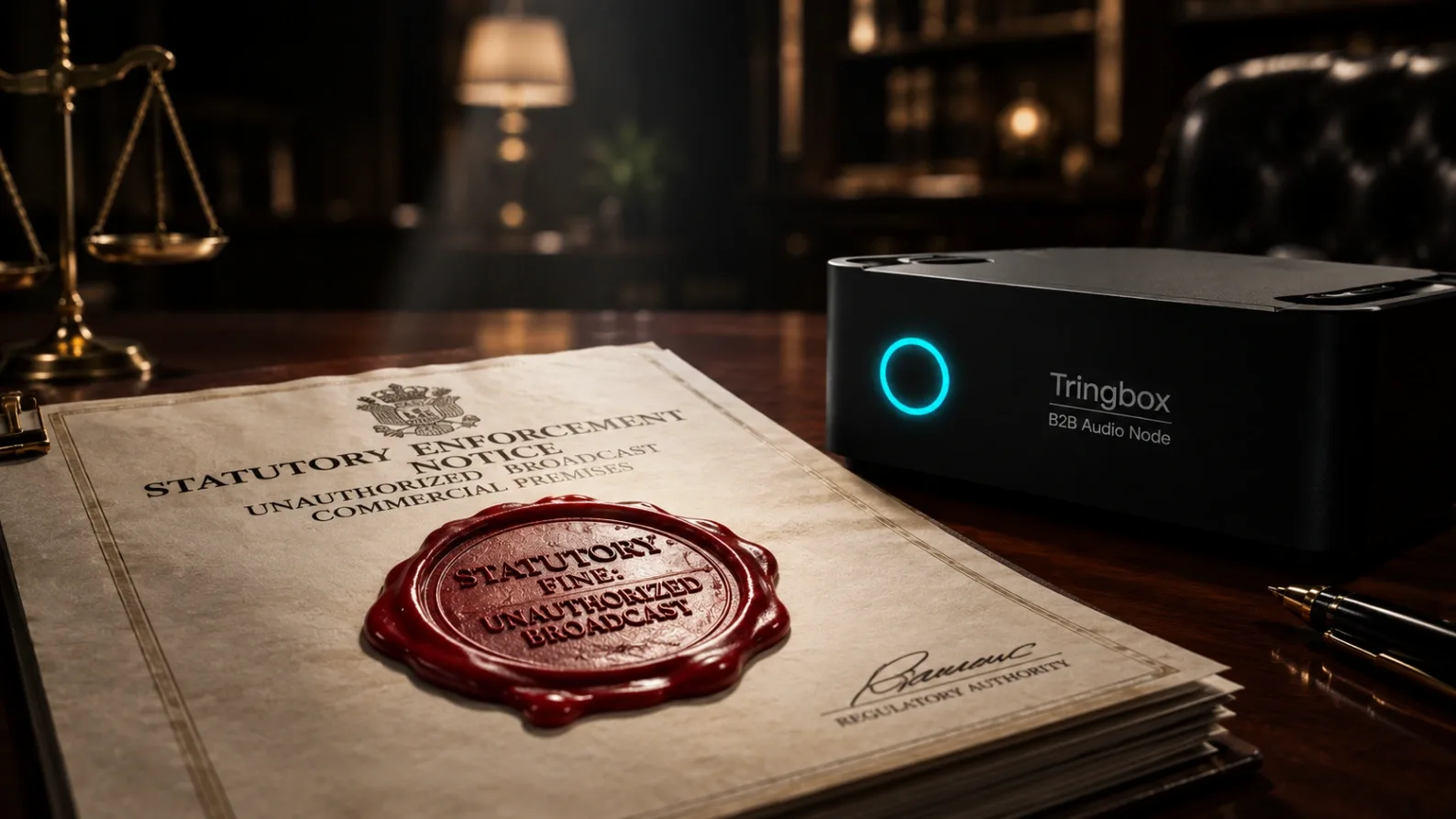
The Era of Active Auditing: Operating under the radar is no longer a viable business strategy. Enforcement bodies and copyright collecting societies actively audit businesses to check for proper commercial licensing. When the unauthorized broadcasting of unlicensed music is discovered, companies can receive legal warning letters, be forced to provide proof of licensing, or be required to pay severe retroactive music royalties covering months or even years of unauthorized use.
Devastating Statutory Fines: The penalties for copyright infringement are not trivial. Fines can range from a few hundred to several thousand dollars, euros, or pounds. In some regions, collecting societies have reported penalties reaching into the five-figure range for repeated or intentional commercial violations. For an independent cafe operating on tight margins, a sudden copyright fine can instantly wipe out quarterly profits.
Navigating PPL and IPRS in India: In the Indian commercial ecosystem, broadcasting recorded audio requires active licenses from Phonographic Performance Limited (PPL) for the sound recordings and the Indian Performing Right Society (IPRS) for the underlying lyrics and compositions. Relying on a consumer app means you are completely bypassing these legally mandated commercial royalties, directly violating the rights of the artists and record labels.
3. Tringbox AI: The Autonomous Commercial Shield
Centralized Legal Coverage: For businesses looking to switch to a smart B2B platform, Tringbox AI completely eliminates the legal headache. It provides a fully managed, B2B-cleared commercial catalog that coordinates the complex web of public performance rights on your behalf. By utilizing Tringbox, you erect a structural shield between your cafe and aggressive copyright enforcement agencies. Agentic AI for Seamless Ambience: Beyond just legal compliance, Tringbox acts as an autonomous operating system for your venue's atmosphere. Instead of relying on floor staff to manually choose tracks, the Agentic AI maps the emotional energy of the space. It autonomously transitions from a relaxed acoustic morning flow to an upbeat afternoon rhythm based on time blocks and footfall data, entirely without human intervention.
Offline Reliability: Consumer apps frequently buffer or crash when a cafe's public Wi-Fi becomes congested. Tringbox mitigates this operational risk through advanced edge-caching hardware. The system securely downloads hours of fully licensed, dynamic audio to a local node, ensuring the music never stops even during a complete broadband outage.
4. Songbox Music: Empowering the Local Cafe Manager
Tactical Crowd Control: While Tringbox focuses on autonomous intelligence, Songbox Music champions the tactical power of the human touch. Built for dynamic hospitality environments, Songbox operates under the mandate to 'Control the Sound. Own the Crowd.' It allows the local cafe manager to act as a highly responsive, invisible DJ, instantly pivoting the room's energy to match a sudden, unpredictable rush of customers.
Safety Within Boundaries: Songbox provides this immense operational agility while strictly locking all staff choices within a legally safe, commercially cleared catalog. The floor staff gains the tactical freedom to 'read the room' and select the perfect energy profile, while the cafe owner retains absolute peace of mind knowing the venue remains perfectly compliant and safe from audits.
7. Frequently Asked Questions (Q&A)
Q: Can I use my premium consumer streaming account in my business if I keep the volume very low?
A: No. The legal test is not how loud the music is, or where the speakers are placed; the legal test is whether customers can hear it. If they can, a public performance is taking place, and a proper commercial license is legally required.
Q: Are royalty-free playlists on YouTube a safe alternative for my cafe?
A: No. The terms of service for YouTube and YouTube Music explicitly prohibit the commercial or public use of the service. Even if the music claims to be 'royalty-free,' broadcasting it via a consumer platform violates the platform's non-commercial user agreement.
Q: Does Tringbox cover the necessary commercial rights for playing music in India?
A: Yes. Tringbox provides a fully managed, B2B-cleared catalog. We coordinate the complex rights required for the tracks within our system to be played in your commercial space, acting as a structural shield between your business and copyright enforcement agencies.
Q: Disclaimer:
This blog is general marketing content and not legal advice. Music licensing obligations can vary significantly by repertoire, rights owner, exact usage type, physical location, and specific contract. Brands should always rely on their commercial agreements and professional legal counsel for final compliance decisions.
Conclusion
The Final Note
The legal reality of 2026 is absolute: playing a consumer streaming app in a commercial cafe is an illegal public performance that exposes your business to severe financial liabilities. While it may seem like a convenient operational shortcut, the risk of unannounced audits and devastating statutory fines far outweighs the monthly cost of a legitimate commercial license. To safely engineer your cafe's atmosphere, you must transition to a dedicated B2B audio provider. Whether you choose the zero-friction, autonomous intelligence of Tringbox AI to seamlessly manage your environment, or deploy the agile, human-centric interface of Songbox Music to actively own the live crowd, the strategic mandate is identical. Securing a licensed acoustic infrastructure ensures that your artists are fairly compensated, your customers remain deeply engaged, and your commercial space is permanently protected from copyright enforcement.