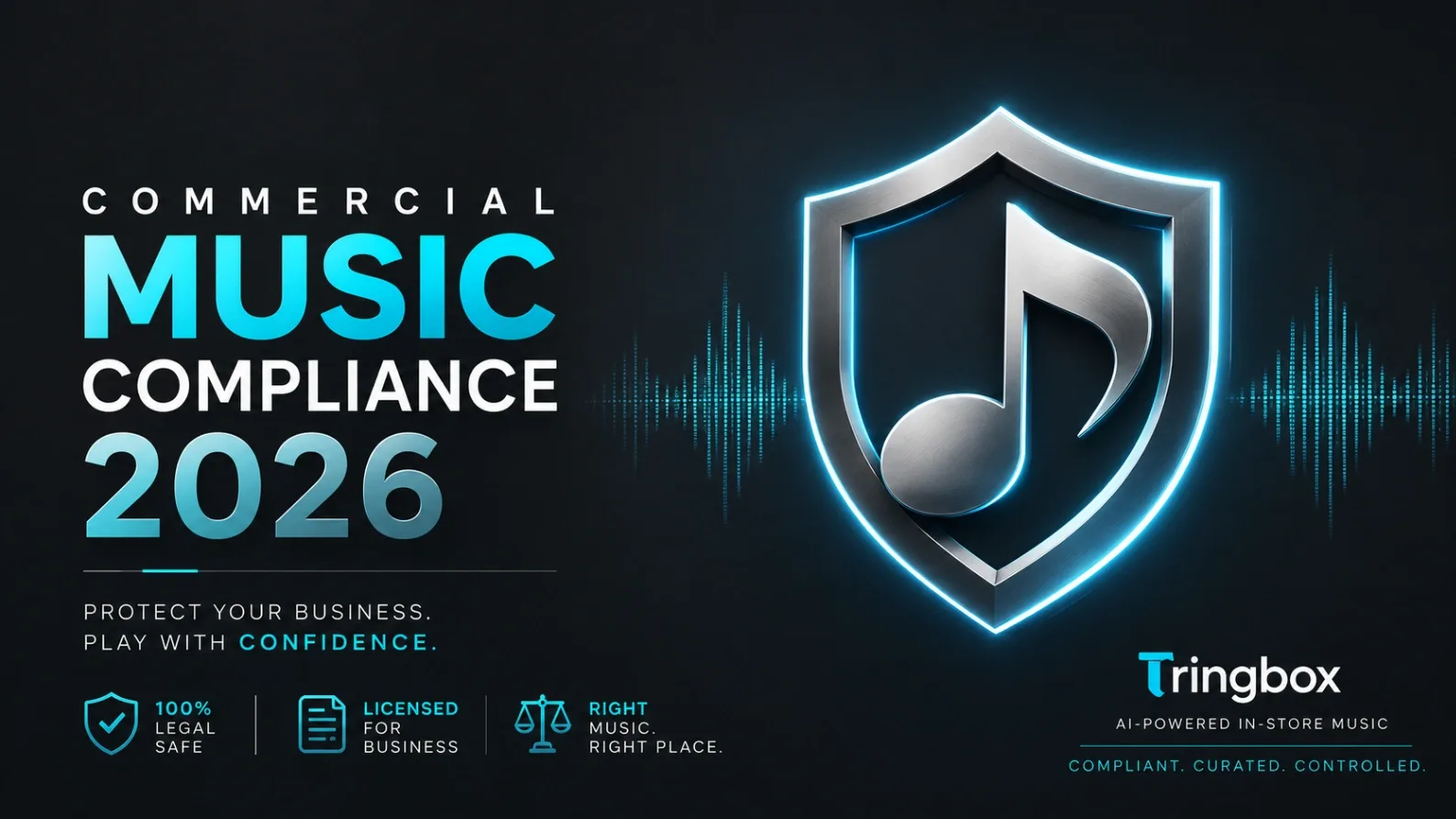
Playing background music is one of the most effective ways to elevate a customer's experience, whether it is slowing down a lunch crowd, lifting the energy in a retail store, or calming patients in a waiting room. However, music is intellectual property. Every time a business presses play on a track where customers, guests, or staff can hear it, a 'public performance' occurs, triggering strict legal obligations under copyright law. For decades, many businesses ignored these rules, casually streaming from personal accounts. But in 2026, the regulatory landscape has drastically shifted, making unauthorized commercial broadcasting a massive legal liability. With performing rights organizations (PROs) deploying aggressive digital auditing and receiving stronger statutory backing, the era of flying under the radar is definitively over. This comprehensive guide breaks down everything modern commercial operators need to know about
in-store music for retail stores, the recent regulatory changes regarding public performance rights, and how transitioning to licensed B2B platforms like
Tringbox ensures your physical space remains perfectly compliant.
1. What is a Public Performance?
Defining the Legal Boundary: Public performance rights exist so songwriters, composers, and publishers are paid when their music is used in public spaces [1.1.1]. In plain terms, if you play music in a physical space where customers or staff can hear it, you are executing a public performance.
The Consumer App Fallacy: The source of the music does not change the legal issue. Whether you are streaming from a staff member's phone, a CD, a radio station, or a premium personal streaming account, it still requires commercial licensing when used in a business.
Multi-Layered Rights: A single song usually has multiple layers of rights: the composition (which covers the melody and lyrics) and the sound recording (the specific version performed by the artist). In a commercial setting, both layers must be legally cleared for public broadcast.
2. The Indian Licensing Landscape: PPL and IPRS
The Dual Authority: In India, licenses are primarily issued by two organizations. The Indian Performing Right Society (IPRS) handles the rights for the underlying musical and literary works (as well as live performances), while Phonographic Performance Limited (PPL) handles the rights for the physical sound recordings.
The July 2026 Copyright Shift: The regulatory environment hardened drastically on July 9, 2026, when the Indian government officially granted PPL India formal registration as a copyright society. This landmark decision restored PPL's statutory authority to collect royalties, providing a clear legal pathway for collective licensing and severely empowering their mandate to crack down on commercial royalty evasion.
3. The Severe Penalties for Non-Compliance
Unannounced Audits: With PPL India's reinstated authority, the likelihood of unannounced field audits in retail and hospitality venues has skyrocketed [1.2.1]. Businesses utilizing unauthorized consumer apps face an unprecedented risk of discovery.
Crippling Statutory Fines: As per Section 63 of the Copyright Act, 1957, copyright infringement by playing unauthorized music can lead to severe penalties. Offenders can face detention from 6 months up to 3 years and be liable to pay fines ranging from Rs 50,000 to Rs 2 lakh.
Retroactive Royalty Payments: Beyond the immediate fines, collecting societies can force venues to pay retroactive royalties covering the entire period the business was unlawfully broadcasting copyrighted music, which can easily wipe out a location's operational profit.
5. Beyond Compliance: Autonomous Acoustic Design
Agentic AI Intelligence: Achieving legal compliance is just the baseline. Tringbox uses Agentic AI to map the optimal emotional energy of your venue based on time-blocks, footfall, and brand identity, autonomously shifting tempos to drive customer behavior.
Psychoacoustic Advantages: The system deploys strategies like frequency masking to hide HVAC noise and tempo-matching to encourage longer dwell times. This elevates the music from a mere legal requirement into an active, revenue-generating asset.
Unbreakable Reliability: Tringbox relies on proprietary edge-caching hardware to download hours of dynamic audio directly to the local node. If your store's internet drops, the music continues flawlessly, ensuring your smart business never suffers from awkward silence. 7. Frequently Asked Questions (Q&A)
Q: Why is playing music from a premium consumer streaming app illegal in my business?
A: Paid personal music accounts are strictly for listening at home or privately [1.1.3]. Consumer apps do not include public performance rights, which are legally required when music is played where customers or staff can hear it in a commercial space.
Q: What happened with PPL India in July 2026?
A: On July 9, 2026, the Indian government officially granted Phonographic Performance Limited (PPL India) registration as a copyright society. This reinstated their statutory authority, creating a clearer legal pathway to strictly enforce royalty collections across all commercial venues.
Q: Does Tringbox protect my business from PPL and IPRS fines?
A: Yes. Tringbox utilizes a fully managed, exclusively licensed catalog. By deploying Tringbox, you are insulated from the complexities of traditional collecting societies, ensuring your brand is completely legally protected from sudden statutory fines. Q: Disclaimer:
This blog is general marketing content and not legal advice. Music licensing obligations can vary significantly by repertoire, rights owner, exact usage type, physical location, and specific contract. Brands should always rely on their commercial agreements and professional legal counsel for final compliance decisions.
Conclusion
The Final Note
The legal reality for commercial spaces in 2026 is absolute: playing unmanaged, unlicensed music from a consumer app is a severe public performance violation that exposes your brand to catastrophic financial penalties. With collecting societies like PPL India receiving stronger statutory backing and deploying aggressive enforcement tactics, the era of ignoring copyright law is over. However, music licensing does not have to be an administrative nightmare. By transitioning your physical real estate to an autonomous, B2B-cleared platform like Tringbox AI, you completely eliminate your legal exposure. Tringbox acts as an impenetrable shield, securing fair compensation for artists while simultaneously utilizing Agentic AI to craft the perfect, uninterrupted auditory atmosphere. Protect your bottom line and elevate your customer experience by making the definitive switch to legally compliant, intelligent acoustic design.