
How to Create the Perfect Restaurant Playlist: A Practical Framework
Build a restaurant music strategy around brand fit, dayparts, energy, language, familiarity, lyrics, repetition and conversation level.
A
Arjun Varadaraj
Published
Read Time
12 min read
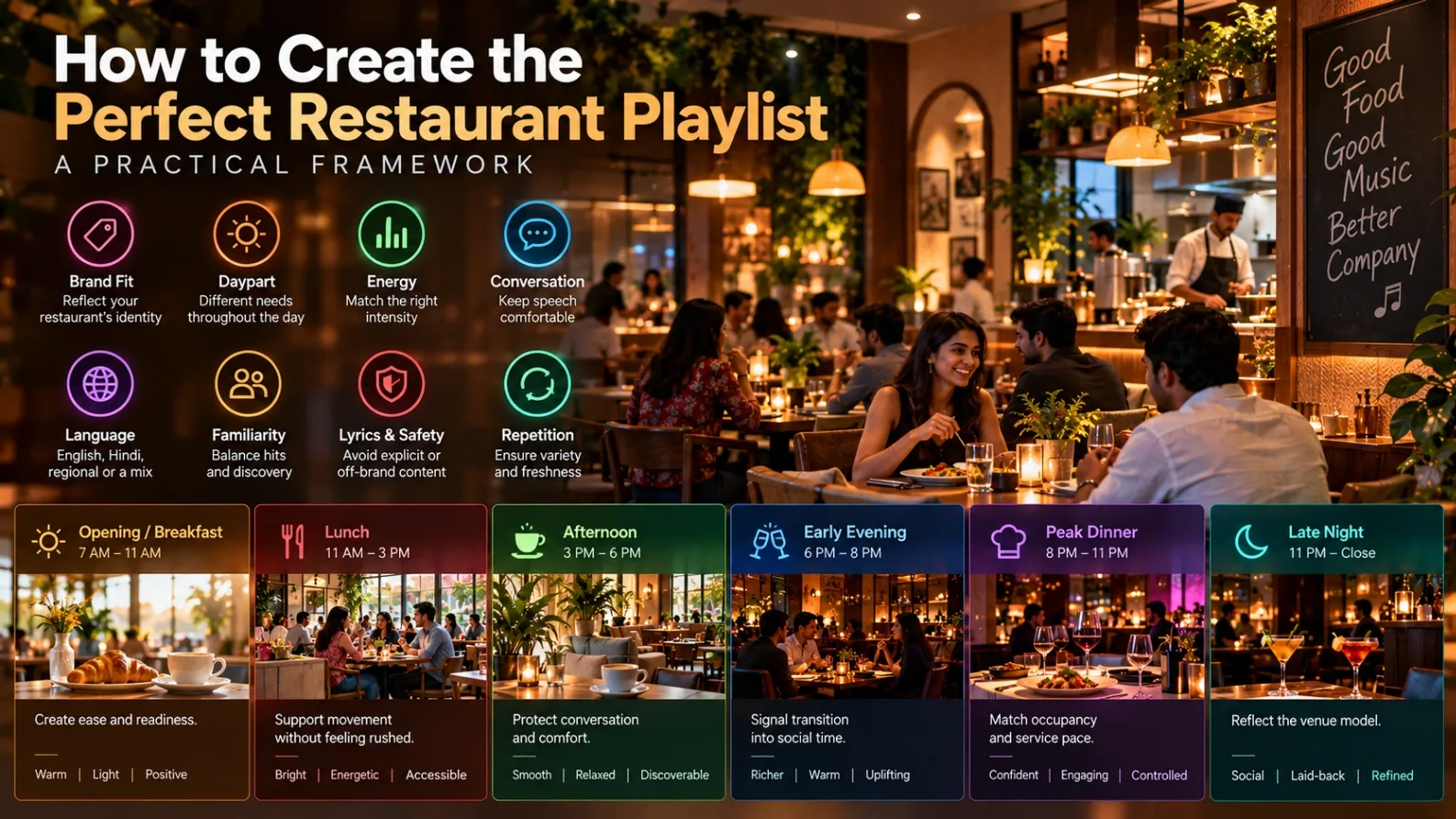
A good restaurant playlist is not a list of songs someone on the team happens to like. It is an operating system for the room. It has to support the brand, the pace of service, conversation, different dayparts, repeat customers and the people who work inside the venue for hours every day. That is also why the phrase 'perfect restaurant playlist' can be misleading. A breakfast cafe at 9 AM and the exact same space at 9 PM absolutely do not need the same acoustic energy. A tasting-menu restaurant, a family casual-dining chain, and a high-volume bar may all want background music, but their musical jobs are fundamentally different. Academic research on restaurant music suggests that tempo can successfully influence how long guests stay and how they experience the environment, but the results vary massively by context. The practical operational lesson is not simply 'fast music is good' or 'slow music is good'. The lesson is that music should be mathematically designed around the exact moment the restaurant is trying to create.
1. Start with the Restaurant, Not the Genre
The Sound Brief: Before casually choosing songs, operations teams must write a strict, one-page sound brief. A useful brief answers six critical questions: What does the restaurant want to legally and emotionally feel like? Who is it primarily for? How long do guests typically stay? How important is clear conversation? When are the absolute busiest periods? Which musical signals would feel obviously wrong for the master brand?
Applying the Brief: A modern pizza bakery might want warm, highly energetic, contemporary music without ever becoming an abrasive nightclub. A luxury fine-dining restaurant might heavily prioritize space, acoustic restraint, and rich instrumental detail. A bustling brewpub may desperately need a much broader energy range because a Tuesday lunch, after-work corporate drinks, and a chaotic Friday night behave exactly like three completely different businesses.
2. Build the Strategy Around Eight Control Variables
Brand Fit & Daypart: Define three to five hard adjectives the music must consistently express, such as warm, playful, premium, modern, or relaxed. Then, strictly separate opening, lunch, afternoon, early evening, peak dinner, and late-night acoustic requirements instead of forcing one generic list to cover the whole 16-hour day.
Energy & Conversation: Manage perceived intensity using rhythm, rhythmic density, instrumentation, and arrangement, not raw BPM alone. Treat intelligibility as a hard design constraint. Dense vocals, aggressive high frequencies, and excessive volume can make social spaces physically tiring.
Language & Familiarity: Decide definitively whether the brand wants English, Hindi, regional languages, pure instrumental music, or a highly controlled mix, and whether that mix should adapt by city. Balance recognisable tracks with new discovery. Too many obvious hits can make the premium room feel like cheap radio; too much unfamiliar music can make it emotionally flat.
Lyrics, Safety & Repetition: Define absolute explicit-content rules and themes that do not fit the restaurant's audience. Finally, design enough rotational depth and freshness that regular guests and frontline staff do not brutally hear the same small set of tracks repeatedly.
3. A Simple Daypart Framework
Opening / Breakfast: The objective is to confidently create ease and readiness. The typical acoustic direction requires lower density, warm instrumentation, moderate familiarity, and minimal lyrical distraction.
Lunch: The objective is to support movement without making guests feel rushed. The typical direction requires a brighter rhythm, a clear groove, and highly accessible vocals where appropriate.
Afternoon: The objective is to protect conversation, dwell time, and comfort. The typical direction requires smooth energy, broader music discovery, and significantly less aggressive dynamics.
Early Evening & Peak Dinner: The early evening must signal a transition into social time with richer rhythms, more recognisable material, and a gradual energy lift. Peak dinner must mathematically match occupancy and service pace with confident energy and tightly controlled volume, strictly avoiding sudden stylistic jumps.
Late Night: The objective is to reflect the specific venue model. For bars, inject vastly more social energy; for premium dining, expertly maintain warmth without ever becoming sleepy.
4. Do Not Let BPM Become the Strategy
The BPM Trap: Because Beats Per Minute (BPM) is incredibly easy to measure, operations teams often dangerously overuse it. Two songs at the exact same tempo can feel completely different because of live drums, heavy bass, intense vocal delivery, key, production style, and dynamic range.
Attributes Over Stereotypes: Treat tempo as just one single feature within a broader energy score, never as a lazy substitute for deep curation. The same logic applies to genre. Saying 'Jazz in the morning, pop at lunch, electronic at night' is absolutely not a strategy unless those exact choices make mathematical sense for the core brand. Strong, defensible curation is built entirely on acoustic attributes, not tired stereotypes.
5. Design for Staff and Test in the Room
The Employee Reality: A retail customer may stay for ninety minutes; a manager or server will hear the music for nine exhausting hours. Acoustic repetition that feels completely harmless to a visitor can become psychologically exhausting for staff. Rotation depth, track spacing, and the ability to instantly block poor-fit tracks must be treated as mandatory operational features.
Physical Acoustic Testing: A playlist that sounds excellent on studio headphones can completely fail in a hard restaurant environment. Physical speakers, ceiling height, hard reflective surfaces, loud kitchen noise, and occupancy affect how music is perceived. Test during a real service rush, not only before opening.
The Testing Checklist: 1. Listen from the entrance, host desk, centre of the dining room, and the quietest table. 2. Check whether vocals aggressively compete with normal conversation. 3. Observe whether automated energy changes feel seamless between dayparts. 4. Ask staff which tracks feel repetitive, jarring, or off-brand. 5. Review skip logs, digital dislikes, guest feedback, and operational notes before committing.
6. When a Fixed Playlist Stops Being Enough
The Operational Shift: Manual playlist creation can work well for a single boutique venue with a highly distinctive creative owner and short opening hours. It becomes vastly harder when the same brand operates 50 outlets, opens for twelve or more hours, desperately needs regional variation, or wants music to dynamically react to changing conditions.
The Adaptive Solution: At that point, the problem fundamentally changes from creative playlist creation to rigorous music operations. An adaptive system can securely hold the master brand rules centrally while autonomously varying the actual track sequence by time, day, and live context.
The Tringbox Implementation: Tringbox is a prime example of this advanced model. Its InStore AI Music product rigorously uses locked corporate brand inputs and live contextual signals, such as precise time, day, and environmental conditions, to autonomously select suitable tracks from an approved, licensed commercial music environment rather than lazily relying on one fixed, manual playlist.
Conclusion
The Final Note
The ultimate practical standard for commercial audio is that the best restaurant music system should be almost entirely invisible operationally. Guests should simply feel that the physical room sounds perfectly right. Frontline staff should absolutely not need to keep switching playlists or chasing the volume dial during a busy shift. Corporate head office should be able to instantly open a dashboard, understand exactly what is playing, and correct problems globally. The sound must evolve seamlessly through the 16-hour day without ever losing the restaurant's core identity. Start with a manual playlist if that fundamentally helps define the sound, but forcefully treat it as the first rough draft of a much broader, automated music strategy, not the final scalable product.