
How Repetitive Is Your Playlist? The Mathematics of Playlist Fatigue
A practical way to estimate repetition risk in stores and restaurants using library size, trading hours, average track length and artist-separation rules.
A
Aditya Deshmukh
Published
Read Time
14 min read
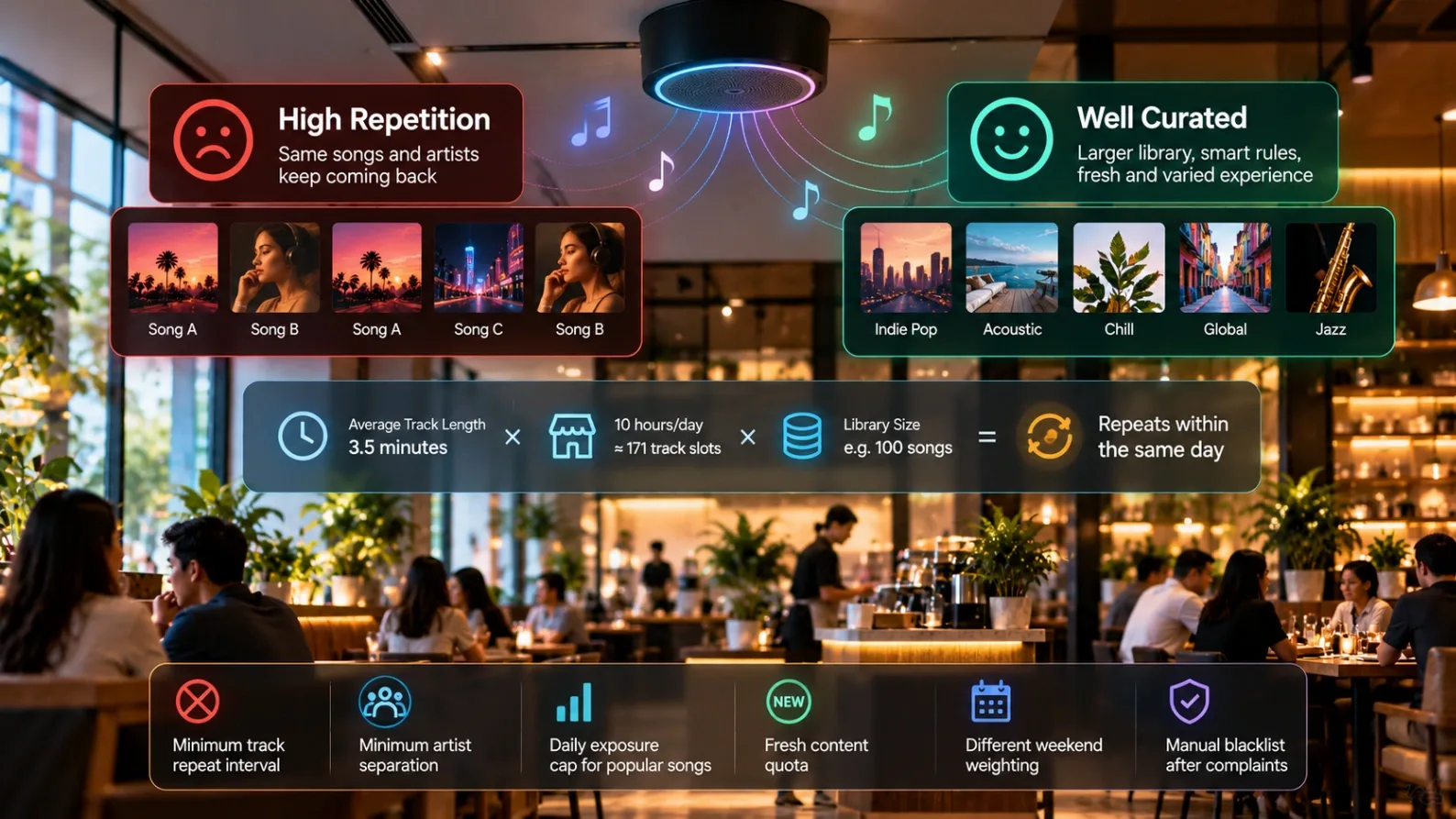
Background music is too often treated as harmless, invisible atmosphere, even though small, microscopic audio choices can drastically affect retail accessibility, employee concentration, and perceived brand fit. A vendor boldly claiming “we have 500 songs in our playlist” actually tells you almost nothing about acoustic repetition. What truly matters is exactly how the underlying scheduling logic mathematically consumes that library across a real, grueling operating week. This article turns that mathematical idea into a highly practical operating framework for stores, restaurants, hotels, and other public-facing venues. The absolute emphasis here is on making defensible corporate decisions: define the specific customer or employee need, intelligently identify the strictly controllable audio variables, run a limited physical pilot, and keep enough data to understand exactly what changed without relying on assumptions.
1. The Simple Calculation of Track Slots
The Burn Rate: At a standard average of 3.5 minutes per track, a typical 10-hour retail trading day burns through roughly 171 track slots. This fundamental math is where physical pilot design matters most: the exact same playlist feature can look incredibly impressive in a 15-minute sales demo yet behave very differently (and become highly irritating) under a full trading day.
Library Size vs. Reality: A tiny 100-track library will therefore aggressively repeat within the exact same day unless the system introduces additional material or intentional silence. A 500-track library creates slightly more room but can still mercilessly repeat specific artists or highly familiar hooks depending on algorithmic weighting.
Automating the Math: The absolute best commercial systems successfully turn this mathematical idea into strict corporate policy, locked permissions, and highly observable dashboard behaviour instead of irresponsibly leaving it as an informal instruction to store staff to 'just skip a song if it repeats too much.'
2. Why Random Shuffle is Never Enough
The Flaws of Randomness: A basic 'shuffle' button is mathematically blind. It can tragically place the exact same artist back-to-back, repeat high-weight hits entirely too often, and completely ignore frontline staff exposure across consecutive days.
Tracking Recency: The ultimate test is whether the acoustic experience remains flawlessly coherent when the venue is highly crowded, unexpectedly quiet, or operating wildly outside its normal routine. Good enterprise systems meticulously track recency at the individual track level, the artist level, and sometimes even the sonic-profile level to completely prevent algorithmic clustering.
Governing the Engine: For a massive multi-location venue operator, the core existential question is whether this advanced scheduling logic can be translated into a repeatable algorithmic rule that effortlessly survives chaotic shift changes and massive busy periods. A mature implementation keeps the creative intent perfectly intact while drastically reducing the number of small, distracting decisions frontline employees have to make.
3. Employee Exposure is the Hidden Metric
The 8-Hour Reality: A transient retail customer may visit once a week for 30 minutes; a loyal frontline employee can forcefully hear the exact same catalogue for eight hours a day, five or six days in a row. The profound operational distinction between a 'fun' playlist and 'psychological torture' is easy to miss in a polished demo, but it becomes critically important once dozens of remote sites and aggressive frontline overrides are involved.
Measuring Fatigue: Playlist fatigue must therefore be rigorously measured across total staff listening hours, not only average customer session length. A highly useful B2B implementation makes this repetition rule completely visible to head office, heavily constrained for local teams, and instantly recoverable when something goes wrong.
Protecting the Team: That critical philosophical shift turns commercial music from an informal, highly subjective ambience choice into a rigorously managed human-resources process with clear corporate ownership and far fewer negative surprises.
4. Building an Unbreakable Repetition Policy
The Enterprise Framework: A highly useful framework for managing repetition includes: Minimum track repeat interval (e.g., no song repeats within 8 hours); Minimum artist separation (e.g., no two songs by the same artist within 60 minutes); Daily exposure caps for high-familiarity pop songs; Strict fresh-content quotas; Different mathematical weighting for peak weekends versus slow weekdays; and an instant manual blacklist button after legitimate staff complaints.
Evaluating the Operating Control: These complex rules should never be treated as decorative feature-list items on a glossy procurement spreadsheet. Each one actively changes exactly who securely owns the daily music operation and whether the physical customer experience remains highly consistent.
The Procurement Scenario Test: During corporate procurement, aggressively convert each capability into a rigorously testable physical scenario. Ask the software provider to dynamically demonstrate it using a realistic location structure, then meticulously record the result. The profound operational lesson is to rigorously document the corporate rule before ever selecting the software tool. The technology should faithfully implement the exact policy, not quietly invent its own.
5. Where Tringbox Fits in the Equation
Adaptive Constraint Engine: An advanced adaptive selection engine can mathematically include repetition as a hard, unbreakable constraint or a severe penalty rather than dangerously treating every eligible track in the database equally. Seen this way, the enterprise buyer is actively evaluating an operating control, not simply another subjective background playlist option.
Contextual Variety: Tringbox - InStore AI Music is a prime architectural example of seamlessly combining strict brand fit with rigid operational rules, such as cultural outlier removal and intelligent queue selection. By dynamically reacting to live weather and footfall, it injects natural variety without ever breaking the core repetition rules.
Verifying Execution: The ultimate test is whether the acoustic experience remains flawlessly coherent under pressure. A truly mature AI implementation keeps the overarching creative intent perfectly intact while drastically reducing manual curation. For massive multi-location brands, this capability must also be explicitly measurable through deep playback logs.
6. Frequently Asked Questions (Q&A)
Q: How large does our music library need to be to avoid repetition?
A: While it depends on your operating hours, a standard retail location open 12 hours a day should aim for an active, constantly updated library of at least 1,500 to 2,000 highly targeted tracks to safely prevent noticeable day-over-day staff fatigue.
A: While it depends on your operating hours, a standard retail location open 12 hours a day should aim for an active, constantly updated library of at least 1,500 to 2,000 highly targeted tracks to safely prevent noticeable day-over-day staff fatigue.
Q: What is the difference between track separation and artist separation?
A: Track separation ensures the exact same song (e.g., 'Shape of You') doesn't play twice in one shift. Artist separation is a broader rule that ensures any song by Ed Sheeran won't play within 60 minutes of another Ed Sheeran song, preventing the store from accidentally sounding like a tribute concert.
A: Track separation ensures the exact same song (e.g., 'Shape of You') doesn't play twice in one shift. Artist separation is a broader rule that ensures any song by Ed Sheeran won't play within 60 minutes of another Ed Sheeran song, preventing the store from accidentally sounding like a tribute concert.
Q: Why do employees complain about the music more than customers?
A: A customer experiences a 'snapshot' of your audio branding during their 20-minute visit. An employee experiences the entire looping cycle. Without strict mathematical repetition policies, the human brain begins anticipating the next track, leading to severe cognitive fatigue and irritation.
A: A customer experiences a 'snapshot' of your audio branding during their 20-minute visit. An employee experiences the entire looping cycle. Without strict mathematical repetition policies, the human brain begins anticipating the next track, leading to severe cognitive fatigue and irritation.
Q: Disclaimer:
This blog is general marketing content and not legal or human resources advice. Operational models and music licensing obligations can vary significantly by corporate structure, physical location, and specific contract. Brands should always rely on their professional legal counsel and internal management for final policy decisions.
This blog is general marketing content and not legal or human resources advice. Operational models and music licensing obligations can vary significantly by corporate structure, physical location, and specific contract. Brands should always rely on their professional legal counsel and internal management for final policy decisions.
Conclusion
The Final Note
The battle against playlist fatigue is fundamentally a mathematical challenge, not just a creative one. When retail operations teams rely solely on human curation or basic random shuffle algorithms, they virtually guarantee that their frontline staff will suffer from devastating acoustic burnout. By properly calculating daily track slots, enforcing strict artist separation rules, and demanding centralized dashboard observability, businesses can finally protect their employees' sanity while maintaining a premium customer atmosphere. The ultimate practical takeaway is to translate this mathematical idea into a rigorously written operating rule with a definitive owner, a dynamic algorithmic schedule, a locked override path, and an irrefutable way to verify execution. That is exactly what turns an interesting psychological music insight into a highly dependable, revenue-protecting business practice.