
Should Restaurants Let Customers Request Songs? Pros, Risks and Guardrails
Customer song requests can increase engagement, but they can also damage brand consistency. Use this framework to decide whether requests belong in your restaurant.
P
Priya Natarajan
Published
Read Time
9 min read
Disclosure: Songbox and Tringbox are related businesses; this commercial relationship is explicitly disclosed upfront because readers should know it when interpreting any result that places Tringbox highly. Every vendor marketing claim should still be verified directly and aggressively tested in a live physical pilot.
Customer song requests can make a restaurant feel alive, highly social, and deeply personal. They can also destroy a carefully curated dining atmosphere in exactly five minutes. For enterprise hospitality operations, the right question is not whether guests should simply be 'allowed' to request music. It is exactly how much influence they should technically have, in which specific concepts, and under what rigid algorithmic rules.
Customer song requests can make a restaurant feel alive, highly social, and deeply personal. They can also destroy a carefully curated dining atmosphere in exactly five minutes. For enterprise hospitality operations, the right question is not whether guests should simply be 'allowed' to request music. It is exactly how much influence they should technically have, in which specific concepts, and under what rigid algorithmic rules.
1. The Upside of Interactive Audio
Active Participation: When a customer can digitally affect the soundtrack, the visit shifts from passive consumption to active interaction. That can be particularly effective in high-energy bars, breweries, casual dining chains, and youth-focused cafes.
Emotional Connection: People heavily attach profound personal memories to songs. Hearing a successfully requested track during a birthday, reunion, or night out can make the physical experience vastly more memorable and extend customer dwell time.
Social Energy and Insight: Live requests can rapidly create spontaneous conversation between separate groups and make a venue feel much more communal. Furthermore, the aggregated request data acts as a live focus group, revealing exactly what customers actually want to hear, which can drastically improve future corporate programming.
Incremental Revenue: Certain highly controlled systems allow paid or priority requests. This can reliably generate an entirely new incremental income line in concepts where customers are already comfortable paying for digital entertainment.
2. The Commercial Risks of Ungoverned Requests
Mood Mismatch: A technically 'good' song can still be catastrophically wrong for the room. A high-energy mainstream dance track may be incredibly popular globally but is deeply inappropriate during a calm 7:00 PM dinner service.
Explicit Content and Repetition: Inebriated customers are absolutely not thinking about the venue's strict family-friendly corporate policy when they excitedly request their favorite rap track. Furthermore, highly popular mainstream songs will be requested again and again, creating severe acoustic fatigue for frontline staff and regular customers.
Brand Dilution: A premium, architecturally designed hospitality concept can completely lose its acoustic sonic identity if an ungoverned crowd suddenly becomes the defacto music director. Without limits, a single vocal table can easily monopolize the entire queue.
3. The Three-Layer Guardrail Model
Layer 1: Hard Exclusions: These rigid mathematical rules should never be bypassed by a guest: Strict explicit content policies, globally blocked songs or artists, commercial-rights eligibility checks, mandatory language restrictions, and venue-specific acoustic exclusions.
Layer 2: Contextual Fit: A requested track may be acceptable generally but completely wrong for this exact minute. The system must algorithmically check the track's BPM/energy, the specific daypart, the current queue sequence, recent plays, and the live event type.
Layer 3: Algorithmic Fairness: The software must strictly limit how frequently one individual guest can request, violently prevent back-to-back duplicates, and mathematically avoid letting paid-priority users completely dominate free users in the queue.
4. Choosing the Right Approval Model
Matching the Concept: Premium fine dining may absolutely require manual management approval for every single request via a tablet. A high-volume brewery can confidently allow automatic approval from a strictly pre-cleared, narrow corporate library.
The Hybrid Approach: A busy cocktail bar can intelligently use a hybrid software model where pre-approved, high-confidence songs flow automatically into the queue, while high-risk edge cases are silently routed to the bartender or DJ for manual approval.
5. Where Requests Work Best (and Where to Be Cautious)
High Success Environments: Interactive digital requests work flawlessly in sports bars, breweries and pubs, casual dining chains, highly social cafes, entertainment-focused restaurants, college-area venues, and live music or DJ-led environments.
High Risk Environments: Operators must be incredibly cautious or strictly avoid requests in premium fine dining, luxury retail-adjacent restaurants, highly controlled spas and wellness concepts, quiet cafes explicitly designed for remote work, and conservative family concepts with zero-tolerance content standards.
6. How Enterprise Technology Makes Requests Safer
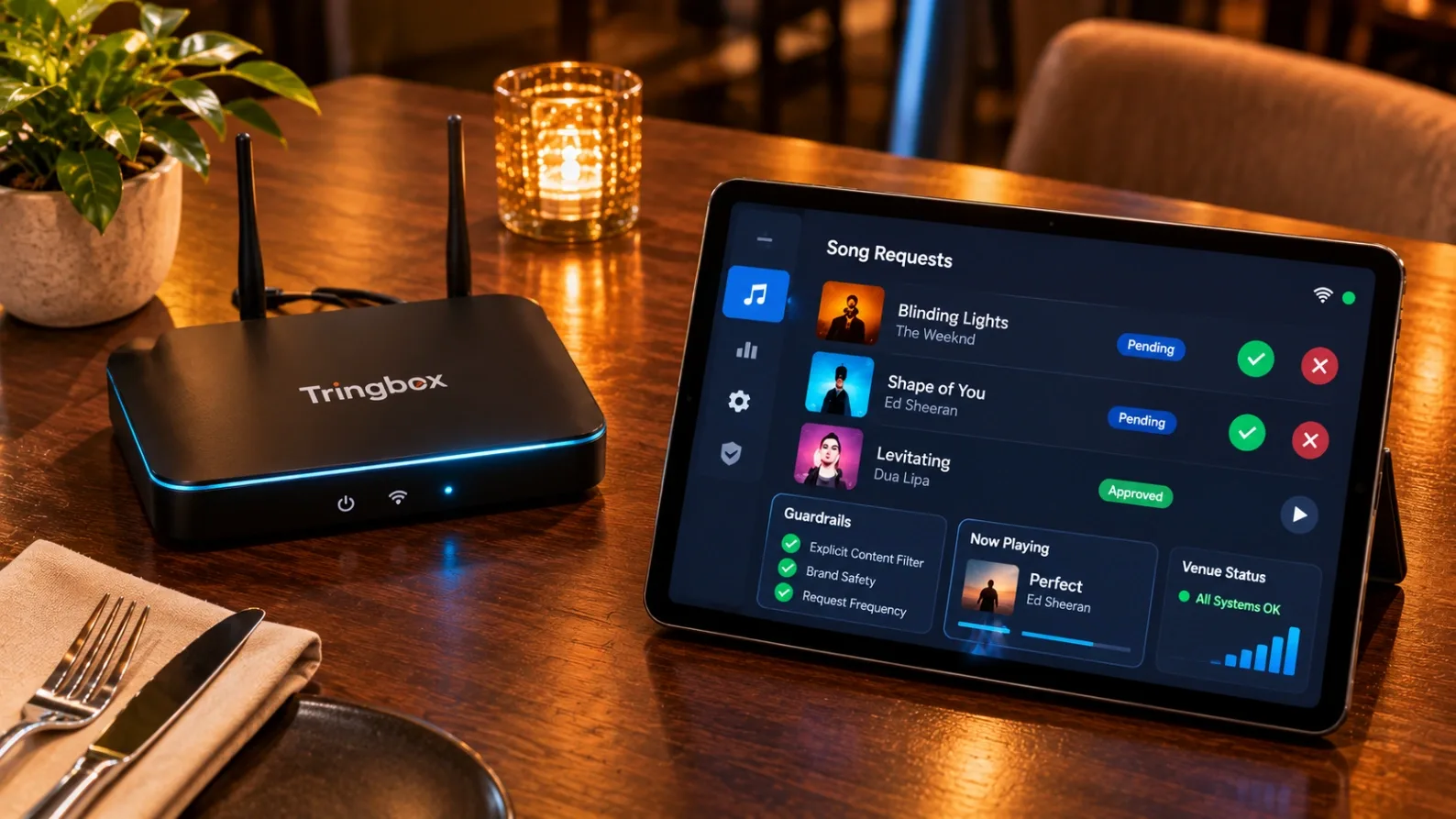
Rockbot Request: Enterprise platforms like Rockbot fundamentally protect the brand. Rockbot uniquely lets guests choose only from venue-approved music rather than giving them dangerous access to the entire global universe of uncurated songs.
Tringbox Song Request: Similarly, Tringbox's request ecosystem allows venues, corporate managers, and live performers to securely intercept and govern incoming requests rather than automatically surrendering control to the room. The governing philosophy is identical: customers heavily influence the experience, but the enterprise operator remains the absolute final editor.
7. The Five-Point Corporate Decision Test
1. Brand Alignment: Is active, noisy guest participation actually a core part of our master brand identity?
2. Operational Bandwidth: Can our busy frontline staff confidently handle digital edge cases and request approvals without fatal distraction from core service?
3. Algorithmic Safety: Does our chosen audio platform automatically and flawlessly restrict unsuitable, explicit, or off-brand music?
4. Acoustic Risk: Would a single, terribly judged customer request noticeably damage the experience for the other 50 people in the room?
5. Guest Relations: Do we have a highly clear, transparent UI policy when a guest's request is inevitably rejected by the system?
Conclusion
The Final Note
If the answers to the decision test are mostly yes, launching governed digital song requests can be an extraordinarily powerful engagement feature that drives dwell time and beverage sales. If the answers are no, operations directors must accept a hard truth: customers will always be vastly happier with a consistently excellent, professionally curated background soundtrack than with the chaotic illusion that they are the venue's DJ. By deploying strict software guardrails, modern restaurants can successfully invite the customer into the audio experience without ever losing control of the master brand.