
Lyrics or Instrumentals at Work? What Research Says About Music and Employee Concentration

Research suggests music with lyrics can interfere with some cognitive tasks. Here is how offices and customer-facing workplaces can design better background-music policies.

R
Rajesh Kumar
Soundscape Strategist

Published

Sep 16, 2026

Read Time

13 min read
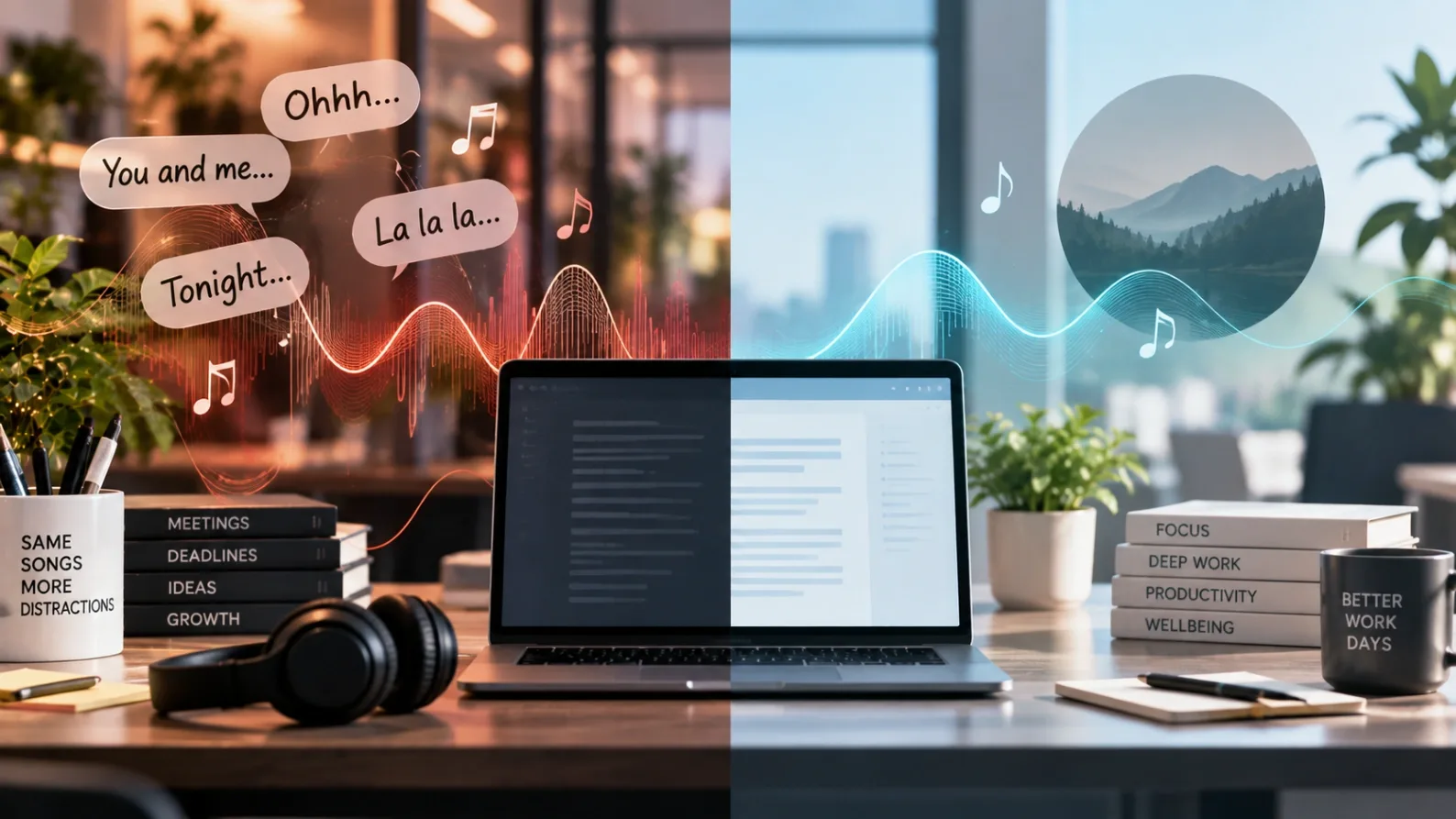
A conceptual photograph comparing an acoustic soundwave with office worker concentration metrics.
Good commercial audio strategy sometimes requires doing less, measuring more, and making vastly clearer rules. The correct workplace-music question is not simply “music or silence?” but rather “what specific work is being done, and what acoustic demands does that work naturally create?” This article turns that fundamental idea into a highly practical operating framework for corporate offices, retail backrooms, stores, restaurants, and other public-facing venues. The emphasis here is on defensible, data-driven decisions: define the customer or employee need, identify the strictly controllable audio variables, run a limited physical pilot, and keep enough dashboard data to understand exactly what changed. The editorial objective is to answer this operational question completely enough that an operations team does not need exaggerated neuroscience, invented demographic percentages, or unsupported legal guarantees to successfully execute a highly functional acoustic policy.

1. What the Research Actually Found

Cognitive Interference: A pivotal 2023 academic study, <em>Should We Turn off the Music? Music with Lyrics Interferes with Cognitive Tasks</em>, rigorously tested silence, instrumental music, and music with lyrics across verbal memory, visual memory, reading comprehension, and complex arithmetic tasks. The findings add massive empirical evidence that lyrics actively compete for verbal attention during language-heavy cognitive tasks.
Managing the Override: The operational distinction between a harmless background track and a cognitive distraction is easy to miss in a quick boardroom demo, but it becomes critically important once dozens of remote sites, different regional dayparts, and aggressive frontline staff overrides are involved.
Documenting the Rule: A useful enterprise implementation actively makes this acoustic rule completely visible to head office, heavily constrained for local teams, and instantly recoverable when something goes wrong. The ultimate operational lesson is to meticulously document the corporate rule before ever selecting the software tool. The technology should faithfully implement the policy, not quietly invent its own.

2. Why One Policy Cannot Fit Every Role

Varying Cognitive Loads: A retail cashier, a graphic designer, a warehouse picker, a financial analyst, and a hotel receptionist all face fundamentally different cognitive loads. Music that effortlessly supports repetitive, high-energy physical tasks will severely distract employees during reading-heavy or complex language-heavy work.
Pilot Design Matters: For multi-location brands attempting to unify this experience, the platform's capability must be explicitly measurable through deep playback logs or centralized reports so that execution can be verified rather than blindly assumed. This is exactly where physical pilot design matters most: the exact same dynamic feature can look incredibly impressive in a tightly controlled sales demo yet behave very differently under unusual trading conditions.
Reducing the Friction: A truly mature B2B implementation keeps the overarching creative intent perfectly intact while drastically reducing the number of small, distracting operational decisions frontline employees have to make during their shifts.

3. The Nuance: Instrumental is Not Automatically Harmless

The Variables of Distraction: Simply stripping the vocals does not automatically solve the concentration problem. Raw volume, structural familiarity, musical complexity, and individual subjective preference also matter massively. A highly busy, complex jazz instrumental track can still be devastatingly distracting, while very familiar, low-level lyrical music may safely fade into the background for some seasoned listeners.
Evaluating the Control: Seen this way, the enterprise buyer is actively evaluating an operating control, not simply another subjective background playlist option. The ultimate test is whether the acoustic experience remains flawlessly coherent when the venue is highly crowded, unexpectedly quiet, or operating wildly outside its normal routine.
A Managed Process: Utilizing an intelligent software layer fundamentally turns commercial music from an informal, highly subjective ambience choice into a rigorously managed infrastructure process with clear corporate ownership and far fewer negative surprises.

4. Designing a Practical Workplace Policy

Zoning the Acoustic Environment: A highly practical enterprise policy uses complete silence or very low-event instrumental music for reading-intensive operational zones, moderate familiar music for repetitive customer-facing work, and strictly gives back-office teams predictably quiet periods to execute deep work.
Banning the Aux Cable: Crucially, corporate headquarters must avoid ever letting one single employee’s personal smartphone playlist become the default broadcast for everyone else in the building. In modern corporate procurement, enforcing this ban should become a rigorous test case rather than a spreadsheet line item: boldly ask the software provider to dynamically demonstrate how they block localized Bluetooth overrides in a highly realistic location structure.
Testing the Logic: The profound operational distinction between a managed policy and a chaotic free-for-all is easy to miss on paper, but it dictates the daily employee experience. Head office must document the exact acoustic rule, and the technology must strictly enforce it.

5. Where Tringbox Fits: Orchestrating the Work Zone

Automated Zoning and Filtering: A premium commercial music platform like Tringbox - InStore AI Music allows head office to instantly create specific work-zone profiles, seamlessly schedule instrumental-heavy periods based on the time of day, and apply strict explicit/lyric filters centrally across the entire corporate network.
Removing Manual Curation: The practical value is not the flashy feature name itself; it is whether the massive retail business can operate consistently without adding tedious manual curation work for store staff. Tringbox utilizes real-time venueType and time rules to autonomously automate these acoustic profiles rather than relying on chaotic ad hoc staff choices.
The Concrete Acceptance Test: For the enterprise buyer, this section must end in a concrete acceptance test: what exact instrumental profile must happen during morning operational hours, who is explicitly allowed to override it locally, and what undeniable digital log evidence proves the AI system behaved correctly?

6. Frequently Asked Questions (Q&A)

Q: Does playing music with lyrics actually decrease employee productivity?

A: Research indicates that music with lyrics actively competes for the brain's language processing centers. If an employee is doing language-heavy work (reading, writing, analyzing data), lyrics will cause cognitive interference. For purely physical, repetitive tasks, lyrics can often improve stamina and mood without harming output.
Q: How do we manage music in a space with both customers and focused employees?

A: This requires strict multi-zone hardware. A platform like Tringbox can play engaging, brand-aligned lyrical music on the main retail floor while simultaneously broadcasting low-event instrumental music in the back office or staff breakroom, all from a single centralized edge-computing node.
Q: Why shouldn't employees just wear their own headphones?

A: While headphones work for isolated corporate offices, they are dangerous and completely unacceptable for customer-facing retail, hospitality, or warehouse environments where situational awareness, safety alarms, and customer service are mandatory.
Q: Disclaimer:

This blog is general marketing content and not legal or human resources advice. Operational models and music licensing obligations can vary significantly by corporate structure, physical location, and specific contract. Brands should always rely on their professional legal counsel and internal management for final policy decisions.
Conclusion

The Final Note

To successfully optimize employee concentration and customer experience simultaneously, operations teams must translate abstract cognitive research into a rigorously written operating rule. That rule must have a clear corporate owner, a dynamic AI schedule or environmental trigger, a highly restricted override path, and an irrefutable way to verify digital execution. Relying on the personal tastes of frontline staff is an operational liability. By leveraging advanced, context-aware platforms like Tringbox to autonomously manage zones, strip lyrics during high-focus dayparts, and prevent unauthorized overrides, enterprises can finally turn an interesting academic music insight into a highly dependable, revenue-protecting business practice.