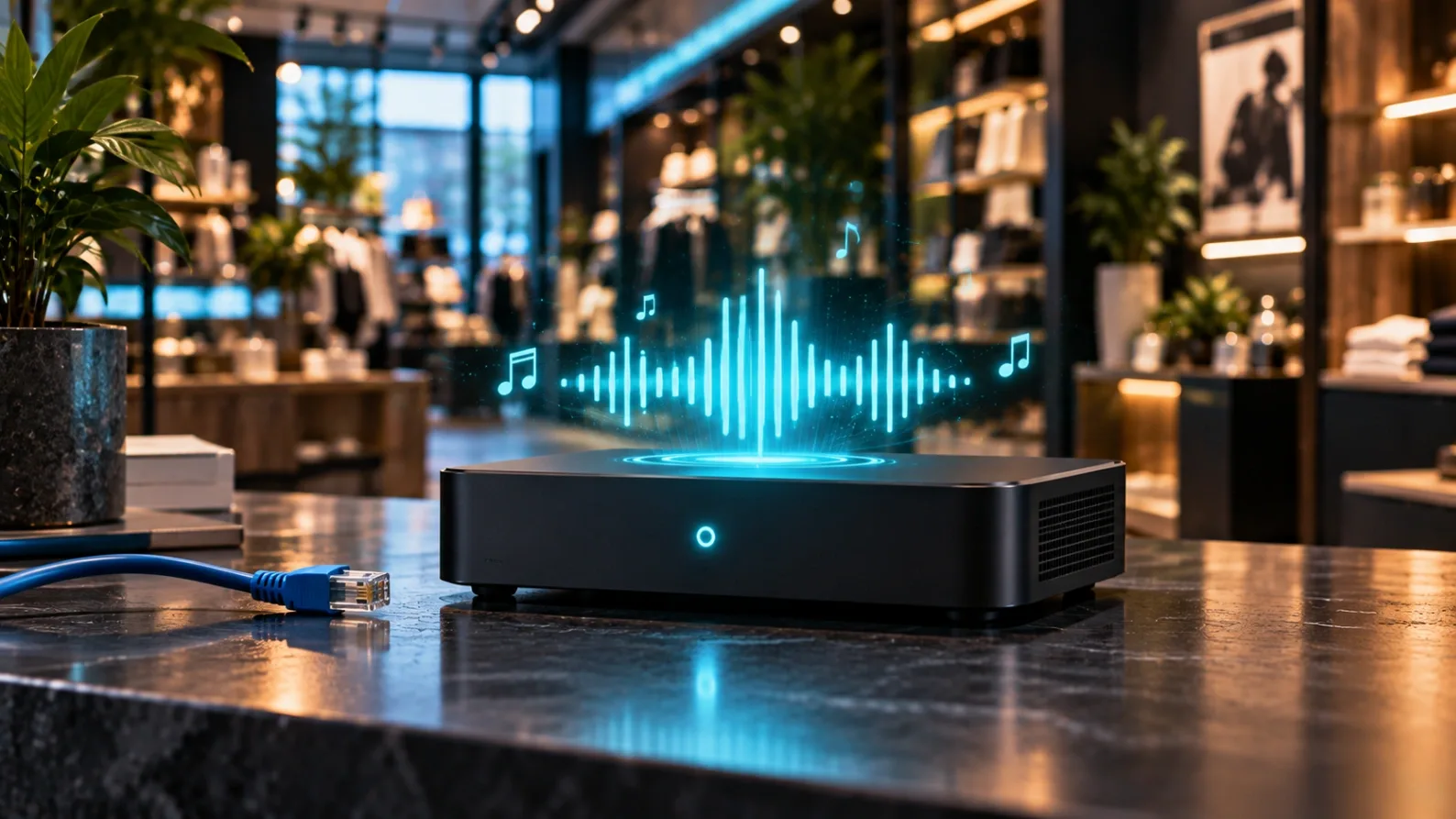
A highly useful enterprise music policy should work flawlessly on an ordinary Tuesday morning as well as on peak holiday weekends, major festivals, and massive regional network outages. In the modern retail environment, in-store music is not just background noise; it is mission-critical infrastructure. The ultimate test of a professional B2B audio platform is absolutely not how beautifully it behaves on perfect, high-speed corporate Wi-Fi, but exactly what happens when the network inevitably fails on a devastatingly busy Saturday. This article turns that critical operational idea into a highly practical operating framework for retail stores, restaurants, hotels, and other public-facing venues. Where
Tringbox appears, it is used as a functional implementation example rather than as the exclusive source of the underlying claim. The primary editorial objective is to answer this continuity question completely enough that a procurement team does not need exaggerated neuroscience, invented demographic percentages, or unsupported legal guarantees to finally build an unbreakable acoustic infrastructure.
1. Identifying the Core Failure Modes
The Infrastructure Breakdown: A highly useful framework for evaluating operational risk includes: Total internet loss (WAN failure); Sudden power interruptions; Hardware player crashes; Expired software credentials; Audio-cable or physical amplifier failures; and Massive cloud-service disruptions.
Beyond Feature Lists: These critical risks should never be treated as decorative feature-list items on a glossy procurement spreadsheet. Each failure mode actively changes exactly who securely owns the daily music operation, how hardware failures are locally handled, and whether the physical customer experience remains highly consistent when the venue is intensely busy or when staff changes rapidly.
The Concrete Acceptance Test: During corporate procurement, aggressively convert each capability into a rigorously testable physical scenario. Ask the software provider to dynamically demonstrate an outage using a realistic location structure, then meticulously record the result. For the enterprise buyer, this section must end in a concrete acceptance test: what exactly must happen autonomously during a failure, who is explicitly allowed to override it locally, and what undeniable digital evidence proves the system behaved correctly?
2. Why Local Edge-Caching Matters
Surviving the Outage: An enterprise-grade hardware player that securely stores approved music locally via edge-caching can continue flawless playback exactly when the WAN (Wide Area Network) connection completely disappears. For a multi-location venue operator, the core existential question is whether this offline capability can be seamlessly translated into a repeatable operational rule that effortlessly survives chaotic shift changes.
Licensing and Log Reconciliation: The business must rigorously know exactly how many hours of music are safely cached, how public performance licenses are legally handled offline, and exactly how the hardware player reconciles proof-of-play logs once broadband connectivity inevitably returns.
The Observability Mandate: In modern procurement, this edge-caching capability should become a rigorous physical test case rather than a spreadsheet line item. This is fundamentally an observability question for corporate IT: if head office cannot instantly open a dashboard and see whether the intended offline behaviour actually happened on the store floor, the feature is functionally impossible to govern at scale.
3. Designing the Fallback Hierarchy
The Continuity Chain: A highly useful framework for acoustic continuity includes a strict, automated hierarchy: 1) The primary cloud stream or AI autonomous selection; 2) The local, approved, edge-cached playlist; 3) A pre-loaded emergency fallback tracklist; and 4) Defined, intentional silence if the audio hardware itself critically fails.
Evaluating the Operating Control: These cascading fallbacks should not be treated as decorative feature-list items. Each one changes who effectively owns the music operation during an emergency. Seen this way, the enterprise buyer is actively evaluating a critical operating control, not simply another subjective background playlist option.
Repeatability Over Flash: During procurement, meticulously convert each fallback capability into a testable scenario. Ask the provider to demonstrate it using a realistic location structure, then record the result. The ultimate useful benchmark is flawless repeatability across hundreds of locations, not whether the failover feature looks impressive in one carefully prepared boardroom demonstration.
4. Alerts, Diagnostics, and Recovery
Real-Time Dashboards: Corporate head office should instantly receive an automated dashboard alert the exact second a physical player goes offline, and the IT team should be able to clearly distinguish a localized internet loss from a catastrophic application failure.
Automated Self-Healing: Automatic hardware restart sequences, robust software watchdog services, and crystal-clear local troubleshooting steps drastically reduce the dangerous dependence on frontline staff improvisation. This is exactly where physical pilot design matters most: the exact same alert feature can look incredibly impressive in a tightly controlled sales demo yet behave very differently (or fail to trigger) under weak network connectivity.
Documenting the Policy: The absolute best commercial systems definitively turn this diagnostic idea into strict corporate policy, locked software permissions, and highly observable dashboard behaviour instead of irresponsibly leaving it as an informal, unenforced instruction to store staff. The operational lesson is to meticulously document the corporate rule before ever selecting the software tool.
5. The Tringbox Example and Procurement Testing
The Multi-Location Model: Tringbox - InStore AI Music explicitly positions offline continuity, edge-caching, and instant player alerts as foundational parts of its multi-location operating model. It is designed to ensure the AI enterprise music management layer does not collapse when the router drops. The Physical Disconnect Test: The only correct way to evaluate this is to physically disconnect the internet router at a live pilot location and aggressively observe exactly how long playback continues, what precise diagnostic data is logged locally, and how seamless the network recovery occurs once plugged back in.
Enterprise Governance: The technological distinction is incredibly easy to miss in a polished 15-minute demo, but it becomes critically important once dozens of remote sites, dynamic regional dayparts, and aggressive frontline staff overrides are involved. If corporate head office cannot seamlessly track the offline period, the feature is impossible to govern.
6. Frequently Asked Questions (Q&A)
Q: Why can't we just stream music directly from a web browser?
A: Browser-based streaming has absolutely zero local caching. The exact second your internet connection stutters or drops, your retail floor goes completely, awkwardly silent. Dedicated B2B hardware solves this by pre-downloading encrypted tracks.
Q: How long can an in-store music player run offline?
A: High-end enterprise platforms like Tringbox or Pandora CloudCover can cache anywhere from 24 hours to 30 days of encrypted, brand-approved music directly on the edge-computing device, ensuring total resilience against prolonged broadband outages. Q: What happens to our music logs when the player is offline?
A: The edge-computing hardware securely caches the 'proof-of-play' logs locally. Once the internet connection is successfully restored, the device instantly securely syncs all timestamped logs back to the central corporate dashboard without losing a single second of data.
Q: Disclaimer:
This blog is general marketing content and not legal advice. Operational models and music licensing obligations can vary significantly by corporate structure, physical location, and specific contract. Brands should always rely on their professional legal counsel and internal management for final policy decisions.
Conclusion
The Final Note
An in-store music strategy is completely worthless if it disintegrates the moment the retail broadband connection stutters. Building a truly bulletproof business continuity plan for commercial audio requires completely abandoning the naive reliance on cloud-only streaming and embracing intelligent, edge-cached hardware. Use the operational frameworks provided as a rigorous hypothesis, not a blind guarantee. Aggressively test these failover ideas in the real architectural acoustics, live customer mix, and chaotic trading patterns of your physical venue. Ultimately, by demanding robust offline fallback hierarchies, instant dashboard alerts, and irrefutable digital proof of recovery from platforms like Tringbox, enterprise operations teams can guarantee their brand sounds flawless—no matter what happens to the network.