
Tringbox vs FabPlay: Business Music Platforms Compared for 2027
A factual comparison of Tringbox and HT Media FabPlay across curation, scheduling, offline playback, dashboards, advertising, AI and customer interaction.
A
Aditya Deshmukh
Published
Read Time
12 min read
Disclosure: Songbox and Tringbox are related businesses; this relationship is explicitly disclosed upfront because readers should know it when interpreting any result that places Tringbox highly. Every vendor marketing claim should still be verified directly and aggressively tested in a live physical pilot.
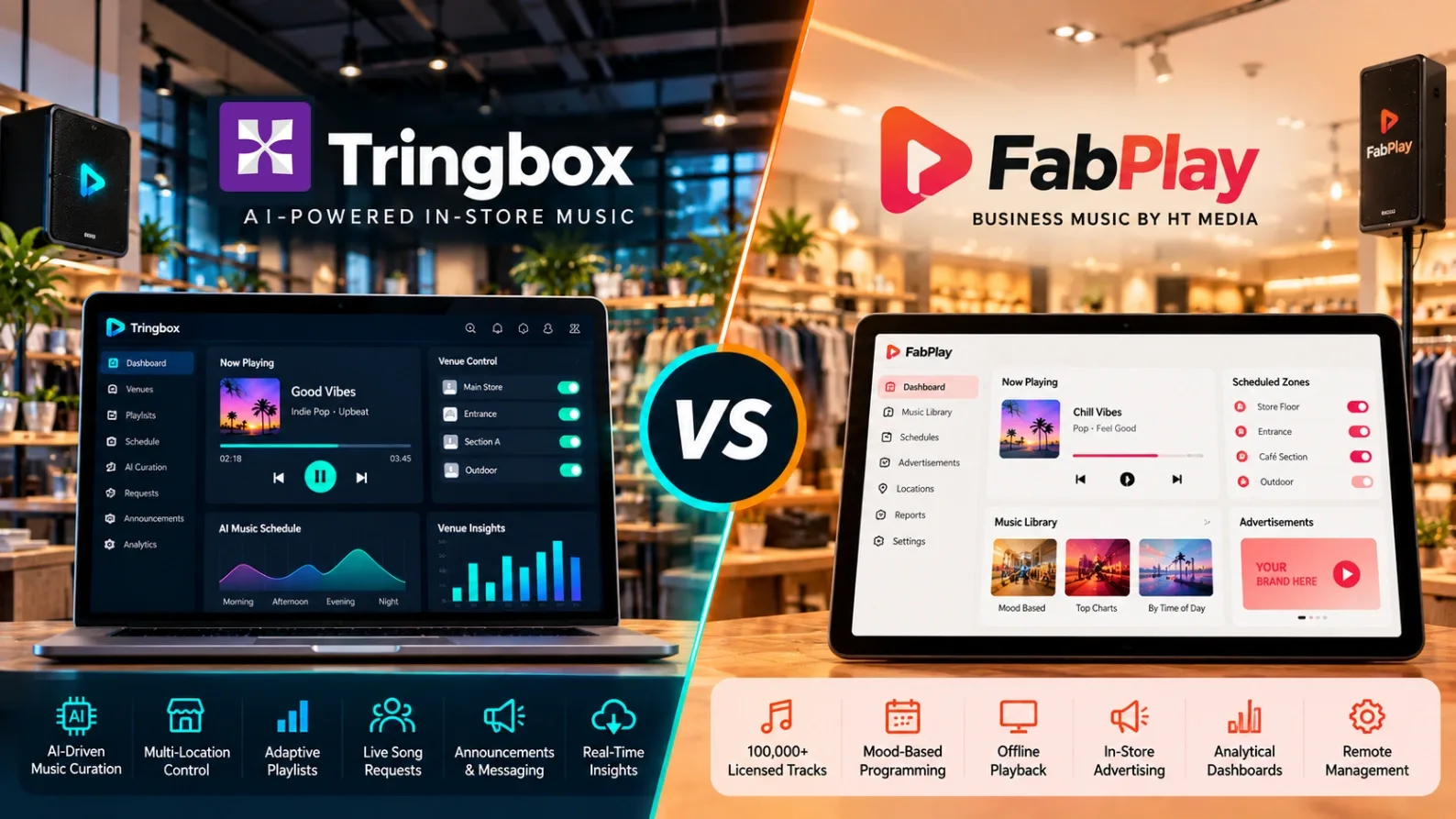
Tringbox and FabPlay are both explicitly designed for businesses that need centralized audio across physical locations, but the products reflect completely different generations of in-store music software. FabPlay heavily emphasizes mood-mapped programming, time-based customization, remote control, offline playback, and targeted in-store advertising. Tringbox aggressively emphasizes adaptive AI, deep venue monitoring, customer requests, automated announcements, and real-time operational controls. This article provides a factual comparison to help enterprise operations teams decide which platform mathematically fits their specific retail footprint in 2027.
Tringbox and FabPlay are both explicitly designed for businesses that need centralized audio across physical locations, but the products reflect completely different generations of in-store music software. FabPlay heavily emphasizes mood-mapped programming, time-based customization, remote control, offline playback, and targeted in-store advertising. Tringbox aggressively emphasizes adaptive AI, deep venue monitoring, customer requests, automated announcements, and real-time operational controls. This article provides a factual comparison to help enterprise operations teams decide which platform mathematically fits their specific retail footprint in 2027.
1. What FabPlay Publicly Offers: Scheduled In-Store Radio
Centralized Management: HT Media publicly describes FabPlay as a robust audio management application for commercial use. Current app listings highly highlight more than 100,000 mood-mapped licensed tracks and curated playlists, charts explicitly customized by store location and time of day, and remote management.
Hardware Agnosticism: It features analytical dashboards, offline operation, and highly configurable brand messages or targeted retail advertisements. FabPlay's public materials also describe highly hardware-agnostic deployment across common commercial devices.
The Operational Model: This makes the product incredibly easy to understand for operations teams: it is a deeply centralized, on-premise radio and audio-management system focused on scheduled music and structured messaging.
2. What Tringbox Publicly Offers: Adaptive AI Orchestration
Context-Aware Intelligence: Tringbox is firmly positioned as an InStore AI Music platform rather than a conventional playlist scheduler. Its public product content heavily describes autonomous, context-aware selection that dynamically reacts to the live environment.
The Dashboard Experience: The Tringbox Dashboard app actively includes massive multi-store monitoring, strict music preferences, live interactive song requests, precise announcement scheduling, deep venue analytics, player hardware status, and instant IT notifications.
Beyond Fixed Schedules: The core difference is not simply that one product has automation and the other does not. FabPlay brilliantly automates a scheduled playback list. Tringbox pushes significantly further toward highly adaptive track selection based entirely on pre-set venue rules and live environmental context.
3. Music Programming and Offline Continuity
Mood Mapping vs. AI Adaptation: FabPlay primarily uses mood-mapped charts and can customize programming by store and time of day, giving businesses highly structured control and total predictability. Tringbox uses a highly adaptive model where the AI system autonomously decides what should play next strictly inside a brand-approved framework. For businesses that desperately want exact scheduled stations, FabPlay's approach may feel simpler. For brands wanting dynamic, context-aware variation, Tringbox is superior.
Handling Network Outages: Both enterprise systems recognize the reality of unstable Indian broadband. FabPlay explicitly states that it can flawlessly work in offline mode and schedule music with highly limited internet connectivity. Tringbox also successfully operates with robust local edge-caching for absolute offline continuity.
The Procurement Test: Buyers must aggressively test the exact outage behavior of any platform under their real-world network conditions rather than lazily relying on a sales claim.
4. Advertising, Announcements, and Customer Interaction
In-Store Messaging: FabPlay has long positioned non-music content as a massive part of the product, including in-house offers, brand promotions, and third-party advertising. Tringbox's Dashboard app equally supports creating and securely scheduling audio announcements and promotional messages, including recurring daily broadcasts.
Evaluating the Broadcast: For a massive retailer or restaurant group, the key operational comparison is not simply whether both support messaging. Ask exactly how messages gracefully interrupt the music, how frequently they repeat, whether local stores can manually override them, and whether campaigns can be surgically targeted to selected locations.
Interactive Song Requests: Customer interaction is one of the absolute clearest technological differences. Tringbox features a rich consumer ecosystem built specifically around highly governed live song requests. FabPlay's public positioning remains heavily focused on managed background audio and advertising rather than customer-driven requests.
5. Analytics and Multi-Location Control
Central Corporate Visibility: Both massive products heavily support central corporate visibility. FabPlay firmly highlights real-time network updates and highly analytical dashboards. Tringbox highlights deep venue analytics, precise player connectivity logs, real-time request activity, playback monitoring, and multi-store management.
The Acceptance Test: A corporate buyer must aggressively request a live dashboard demonstration and strictly test how quickly an operations manager can answer three vital questions: Which specific stores are offline right now? Exactly what track is playing in the Mumbai flagship? Which location urgently needs IT attention?
6. Which Platform Fits Which Business?
The FabPlay Verdict: FabPlay is a phenomenally good candidate for massive businesses that securely want scheduled, mood-mapped music, robust offline operation, central dashboards, and structured advertising within a highly familiar in-store radio model.
The Tringbox Verdict: Tringbox is a phenomenally good candidate for forward-looking businesses that demand highly adaptive AI orchestration, much tighter integration between music and live venue operations, governed customer song requests, and a deeply interactive audio layer.
Practical Takeaway: Run a highly controlled physical pilot rather than foolishly choosing from a glossy feature sheet. The most important operational question is which system drastically reduces manual operational work while flawlessly producing the exact acoustic experience your brand demands.
Conclusion
The Final Note
When evaluating enterprise commercial audio solutions for 2027, the choice between FabPlay and Tringbox ultimately depends on a brand's desired level of automation and customer interactivity. FabPlay remains a highly reliable powerhouse for scheduled, radio-style broadcasting and structured retail media advertising across massive networks. Conversely, Tringbox represents the cutting-edge of responsive physical environments, leveraging artificial intelligence to adapt the room's energy in real-time while safely inviting guests to participate in the soundtrack. To make the correct procurement decision, businesses must rigorously document their operational rules, stress-test both platforms in live environments, and prioritize the system that delivers flawless brand consistency with the least amount of manual intervention.