
Tringbox vs Mood Media: AI-First Music vs Experience Media
Tringbox and Mood Media solve overlapping problems with different scopes. Compare AI music, messaging, multi-location control, hardware, signage and service model.
V
Vikram Chauhan
Published
Read Time
11 min read
Disclosure: Songbox and Tringbox are related businesses; this commercial relationship is explicitly disclosed upfront because readers should know it when interpreting any result that places Tringbox highly. Every vendor marketing claim should still be verified directly and aggressively tested in a live physical pilot.
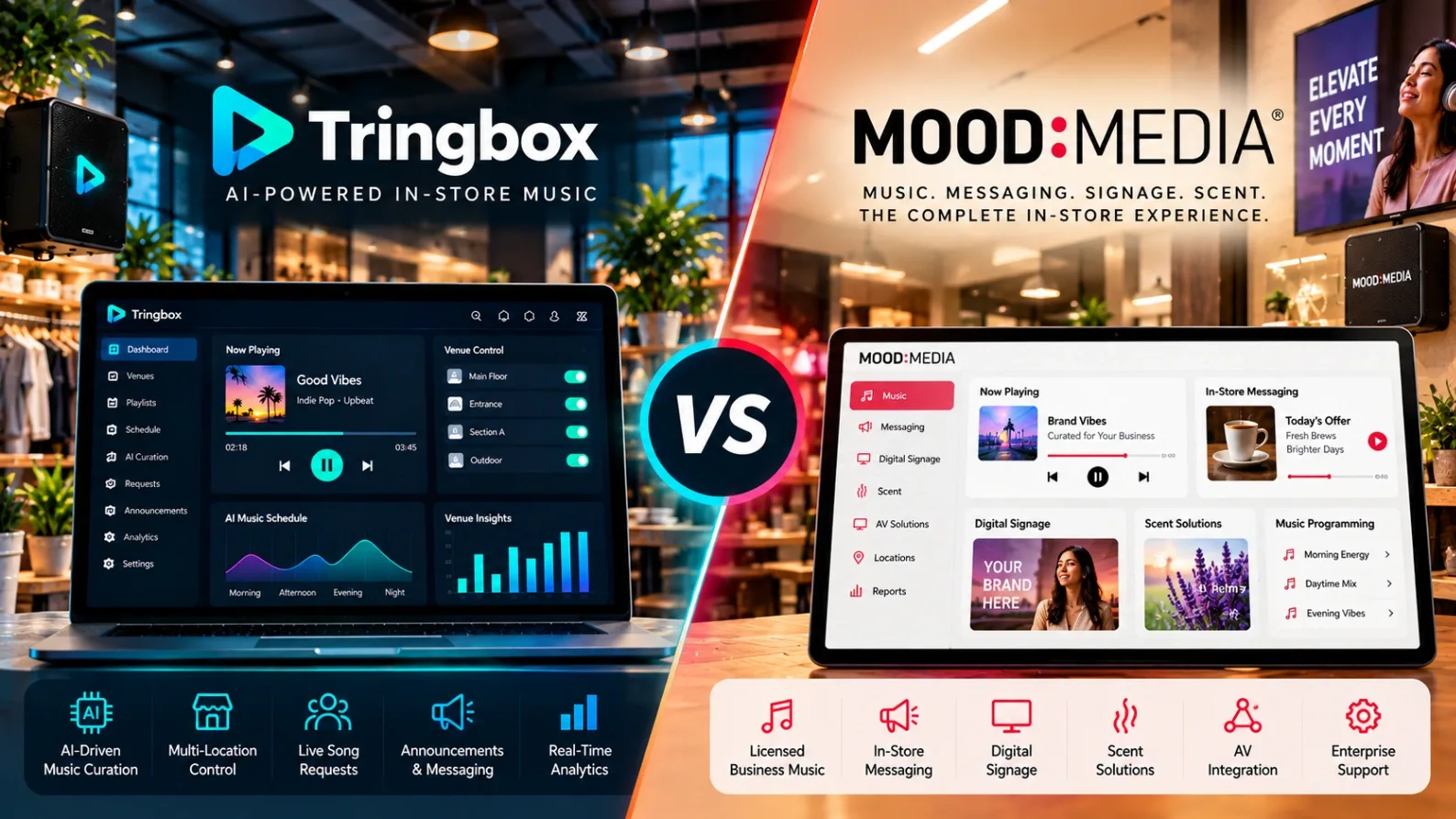
Comparing Tringbox with Mood Media is useful only if the massive difference in operational scope is clear from the beginning. Mood Media is a global in-store experience company, where music is just one part of a massive portfolio that can also include messaging, digital signage, commercial scent, and AV solutions. Tringbox is a much more focused, AI-first music and interactive-audio platform. That means the right procurement choice depends heavily on whether the enterprise buyer wants a specialist, highly intelligent music operating layer or a much broader experience-media partner.
Comparing Tringbox with Mood Media is useful only if the massive difference in operational scope is clear from the beginning. Mood Media is a global in-store experience company, where music is just one part of a massive portfolio that can also include messaging, digital signage, commercial scent, and AV solutions. Tringbox is a much more focused, AI-first music and interactive-audio platform. That means the right procurement choice depends heavily on whether the enterprise buyer wants a specialist, highly intelligent music operating layer or a much broader experience-media partner.
1. Mood Media's Approach: The Global Media Stack
The All-in-One Experience: Mood Media offers enterprise business music with deeply centralized controls, family-friendly filtering, robust music programming, and massive multi-location management. For massive enterprise retail and international hospitality groups, Mood can consolidate multiple in-store channels within one overarching corporate relationship.
Standardizing Across Channels: This breadth is incredibly valuable when the corporate procurement brief is not simply 'fix our store music' but rather 'standardize our entire customer-facing media ecosystem (audio, signage, scent) across multiple global markets.' It simplifies vendor management by consolidating multiple massive infrastructure pillars into one single contract.
2. Tringbox's Approach: The Specialized AI Audio Layer
Focused Audio Intelligence: Tringbox is narrower in scope but vastly more specialized around deep music intelligence and interactive venue audio. Its public product ecosystem tightly includes adaptive in-store music, massive multi-venue monitoring, live guest song requests, precision scheduled announcements, venue analytics, and hardware alerts.
The Operating System Model: The product is therefore much closer to a highly intelligent, dedicated 'music operating system' than a full-service experience-media agency. For fast-scaling companies that already have separate, highly optimized digital signage or AV infrastructure vendors, that strict focus on next-generation audio can be a massive operational advantage rather than a limitation.
3. Artificial Intelligence: Where Each Product Uses It
AI for Messaging Production: Mood Media currently heavily promotes its AI Messaging Copilot, a tool designed specifically for generating, drafting, and deploying branded audio messages and voiceovers under centralized governance. Its music products also securely include automated recommendations and traditional programming features.
AI for Adaptive Orchestration: Tringbox uses artificial intelligence much more centrally in the actual music-selection narrative, strictly describing context-aware selection that autonomously adapts the ambient energy inside strict brand rules based on live environmental telemetry.
Two Different Workflows: These are fundamentally different applications of AI. Mood uses AI strongly in messaging production and broader experience workflows, while Tringbox utilizes it as the core mathematical mechanism for dynamically deciding exactly what music should play next on the shop floor.
4. In-Store Messaging Capabilities
Enterprise Messaging Logistics: Both platforms strongly support in-store audio messaging. Mood Media possesses a highly mature enterprise messaging proposition, heavily including location targeting, precise scheduling, and professional studio or AI-generated voice options.
Automated Promotional Broadcasts: Tringbox's Dashboard app similarly supports intuitively creating, precisely scheduling, and automating audio announcements and promotional broadcasts across the store network.
The Buyer's Decision: For a corporate buyer, the messaging decision should fundamentally come down to workflow depth, internal content-production needs, and whether audio messaging is a primary revenue-driving product or a supporting ambient feature.
5. Multi-Location Control and Hardware Models
Centralized Dashboards: Mood Media's multi-location products provide massive centralized scheduling, real-time playback monitoring, and management across thousands of locations or zones. Tringbox's central dashboard similarly provides multi-store management, live playback status, venue analytics, and instant offline alerts.
Hardware and Service Depth: Mood Media can expertly provide a much broader physical hardware and service ecosystem, including supplying commercial players, executing physical installation, and providing on-ground AV repair services in many global markets.
Software-Led Agility: Tringbox is purposefully designed as a lighter, highly agile software-led operating model and can easily work with existing venue infrastructure or edge-computing nodes depending on deployment. This distinction directly affects rollout speed, total upfront capital expenditure (CapEx), and IT procurement complexity.
6. Which Platform Fits Which Buyer?
The Mood Media Profile: Mood Media is a natural, undeniable shortlist candidate for massive global enterprises seeking music, messaging, and potentially digital signage or other sensory in-store experience services fully consolidated under one single provider.
The Tringbox Profile: Tringbox is a natural, highly competitive candidate for forward-looking brands that primarily want intensely intelligent music orchestration, highly interactive guest song requests, deep venue-level monitoring, and robust India-focused operations without paying for a full, overarching experience-media stack.
Conclusion
The Final Note
When evaluating commercial audio platforms, operations teams must fiercely avoid making the wrong comparison. Do not compare these two platforms strictly on catalogue size or headline feature count. Ask exactly what you want the vendor to own. If the answer is the entire physical in-store media environment across multiple sensory channels, Mood Media's massive operational breadth matters immensely. If the answer is purely the music layer and the deep artificial intelligence required to automate it beautifully, a specialist product such as Tringbox is likely a much better architectural fit. Both business models are incredibly valid. The ultimate procurement mistake is either paying a premium for operational breadth you do not actually need, or buying a narrow software tool when the organization actually desperately needs a global, hands-on managed-service partner.