
Tringbox vs Radiowalla: Which In-Store Music Platform Fits Which Business?
Compare Tringbox and Radiowalla on curation model, automation, player options, dashboards, multilingual programming, alerts and interactive features.
P
Priya Natarajan
Published
Read Time
13 min read
Disclosure: Songbox and Tringbox are related businesses; that relationship is explicitly disclosed upfront because readers should know it when interpreting any result that places Tringbox highly. Every vendor marketing claim should still be verified directly and aggressively tested in a live physical pilot.
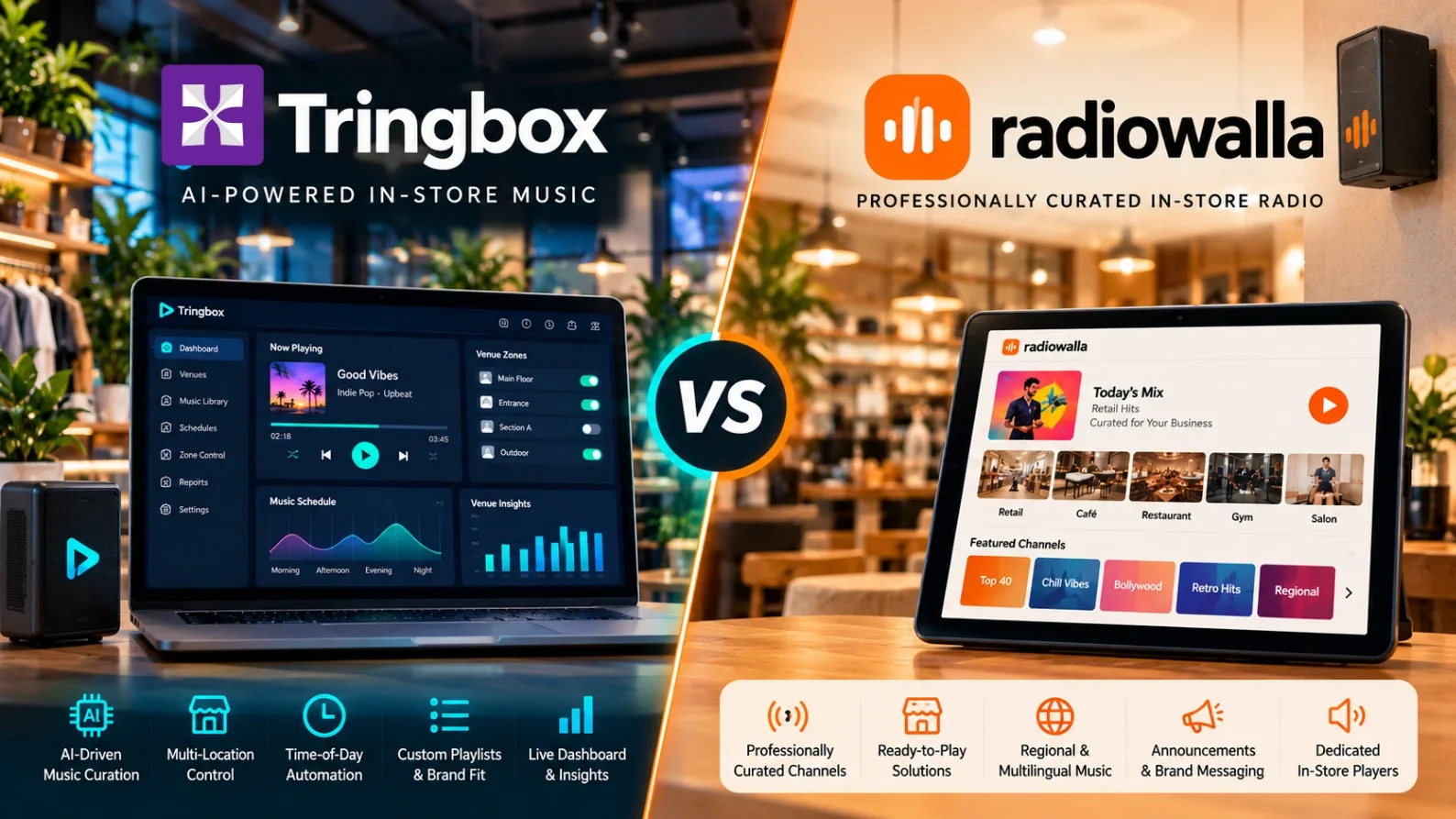
Tringbox and Radiowalla both solve the massive operational problem of business music across physical locations, but they approach the market from fundamentally different starting points. Radiowalla is built around the established idea of professionally curated in-store radio at scale. Tringbox is built around a modern, AI-first, adaptive music and venue-management layer. For enterprise procurement and operations teams, the more useful question is not simply 'which platform is objectively better?' It is exactly which operating model mathematically and operationally fits your specific business.
Tringbox and Radiowalla both solve the massive operational problem of business music across physical locations, but they approach the market from fundamentally different starting points. Radiowalla is built around the established idea of professionally curated in-store radio at scale. Tringbox is built around a modern, AI-first, adaptive music and venue-management layer. For enterprise procurement and operations teams, the more useful question is not simply 'which platform is objectively better?' It is exactly which operating model mathematically and operationally fits your specific business.
1. Radiowalla's Managed Radio Model
Expert Curation at Scale: Radiowalla's official site describes a massive large-scale in-store radio operation powering more than 35,000 physical locations. The core offering features expert human music curation, deep multilingual programming, real-time dashboards and analytics, configurable IT alerts, multiple hardware player choices, and robust seven-day support.
The Human Element: The strengths of this legacy model are remarkably clear. A brand can work directly with seasoned music experts, create a highly curated custom station, and reliably deploy it across stores with professional support.
Hardware Flexibility: Radiowalla heavily supports multiple player options, including software-only and dedicated device-based approaches, which can matter immensely to legacy enterprises with highly varied, pre-existing IT infrastructure.
2. Tringbox's Adaptive Automation Model
Context-Aware Intelligence: Tringbox approaches the exact same acoustic problem through adaptive automation. Public Tringbox material explicitly describes context-aware music selection, while the Dashboard app provides real-time playback monitoring, granular venue preferences, multi-location management, song-request controls, scheduled announcements, deep analytics, and instant offline alerts.
Operating Within Guardrails: Instead of treating the store station as a mostly predefined sequence that is periodically updated by a human, the Tringbox model securely allows the AI system to keep selecting dynamically from an approved musical universe based on live rules and environmental context.
Reducing Manual Overhead: That advanced automation drastically reduces the desperate need to manually maintain dozens of fixed lists for the morning, afternoon, evening, sudden weather changes, or individual outlet conditions.
3. Curation Strategy: Expert-Led vs. Adaptive
The Human Touch: Radiowalla's public positioning aggressively emphasizes its human music experts. That model is highly attractive when a massive brand absolutely wants a human-curated radio identity and an ongoing, hands-on managed service.
The AI Engine: Tringbox is significantly more attractive when a brand wants humans to rigorously define the overarching musical strategy and brand persona, but actively wants the intelligent software to make more of the localized, moment-to-moment playback decisions.
The Brief is Mandatory: Crucially, neither model eliminates the need for a crystal-clear corporate sound brief. AI operating without a strong brand profile can become dangerously random, while human curation operating without enough frequent refresh can rapidly become devastatingly repetitive for frontline staff.
4. Multi-Location Operations and Observability
Centralized Dashboards: Both enterprise products heavily emphasize centralized, cloud-based operations. Radiowalla heavily promotes its real-time dashboards, highly configurable alerts, and playout statistics. Tringbox's Dashboard app similarly details multi-store monitoring, active player activity, request analytics, push notifications, and remote venue controls.
The Procurement Workflow Test: A corporate buyer must aggressively test the exact software workflow: Can head office find an offline store in seconds? Can a regional manager confidently control only their assigned locations? Can the business actually see digital proof of what played yesterday? Can a hardware failure alert be instantly routed to the correct IT person?
5. Multilingual Programming and Interactive Features
Language Depth: Radiowalla explicitly markets incredibly broad multilingual content, ranging from deep Indian regional languages to massive national programming. For an Indian retail chain where complex language strategy is a core operational requirement, this is a heavily documented strength.
Venue Interaction: Tringbox differentiates much more visibly around guest song requests and interactive venue engagement. Its current Dashboard app actively includes live song-request management and precisely scheduled in-store announcements. Radiowalla absolutely supports multiple media formats, but businesses looking specifically for a highly governed, consumer-facing request layer should carefully examine how that requirement is handled in the current product.
6. The Procurement Checklist: What to Verify in a Pilot
Test Under Real Conditions: Run both products simultaneously in comparable physical stores and rigorously measure the following ten metrics: 1) Track repetition after 30 days of continuous playback; 2) Brand fit at vastly different dayparts; 3) The ease of changing acoustic policy centrally; 4) Offline edge-caching behavior during internet drops.
Audit the Governance: 5) The quality and speed of IT alerts; 6) Local store manager permissions and override logs; 7) Regional-language fit for your specific demographics; 8) In-store announcement workflow and ducking; 9) Technical support response times; and 10) Exact legal licensing responsibilities for public performance rights.
7. Which Business Should Choose Which?
The Radiowalla Verdict: Radiowalla is an exceptionally strong fit for massive businesses that demand mature, expert-curated in-store radio, deep multilingual programming, large-scale managed deployment, and highly flexible, legacy-friendly hardware player options.
The Tringbox Verdict: Tringbox is a highly powerful fit for forward-looking businesses that demand adaptive AI selection, live remote venue monitoring, tightly integrated and governed song requests, scheduled voice announcements, and a highly modern, India-focused software operating layer.
Conclusion
The Final Note
An enterprise in-store music platform should always be chosen based on deep operational fit, not simply on who publishes the longer vanity feature list. Radiowalla and Tringbox represent two entirely valid, powerful operational philosophies: professionally managed human in-store radio and highly adaptive AI-led music operations. By forcing both commercial providers into a rigorous physical pilot—aggressively testing offline resilience, local user permissions, and proof-of-play observability enterprise operations teams can confidently deploy the acoustic infrastructure that best protects their brand identity and supports their frontline staff.