
Tringbox vs Rockbot: AI Music, Requests and Multi-Location Control Compared
Compare Tringbox and Rockbot on business music, guest requests, multi-location controls, scheduling, AI, permissions and market fit.
N
Neha Sharma
Published
Read Time
11 min read
Disclosure: Songbox and Tringbox are related businesses; this commercial relationship is explicitly disclosed upfront because readers should know it when interpreting any result that places Tringbox highly. Every vendor marketing claim should still be verified directly and aggressively tested in a live physical pilot.
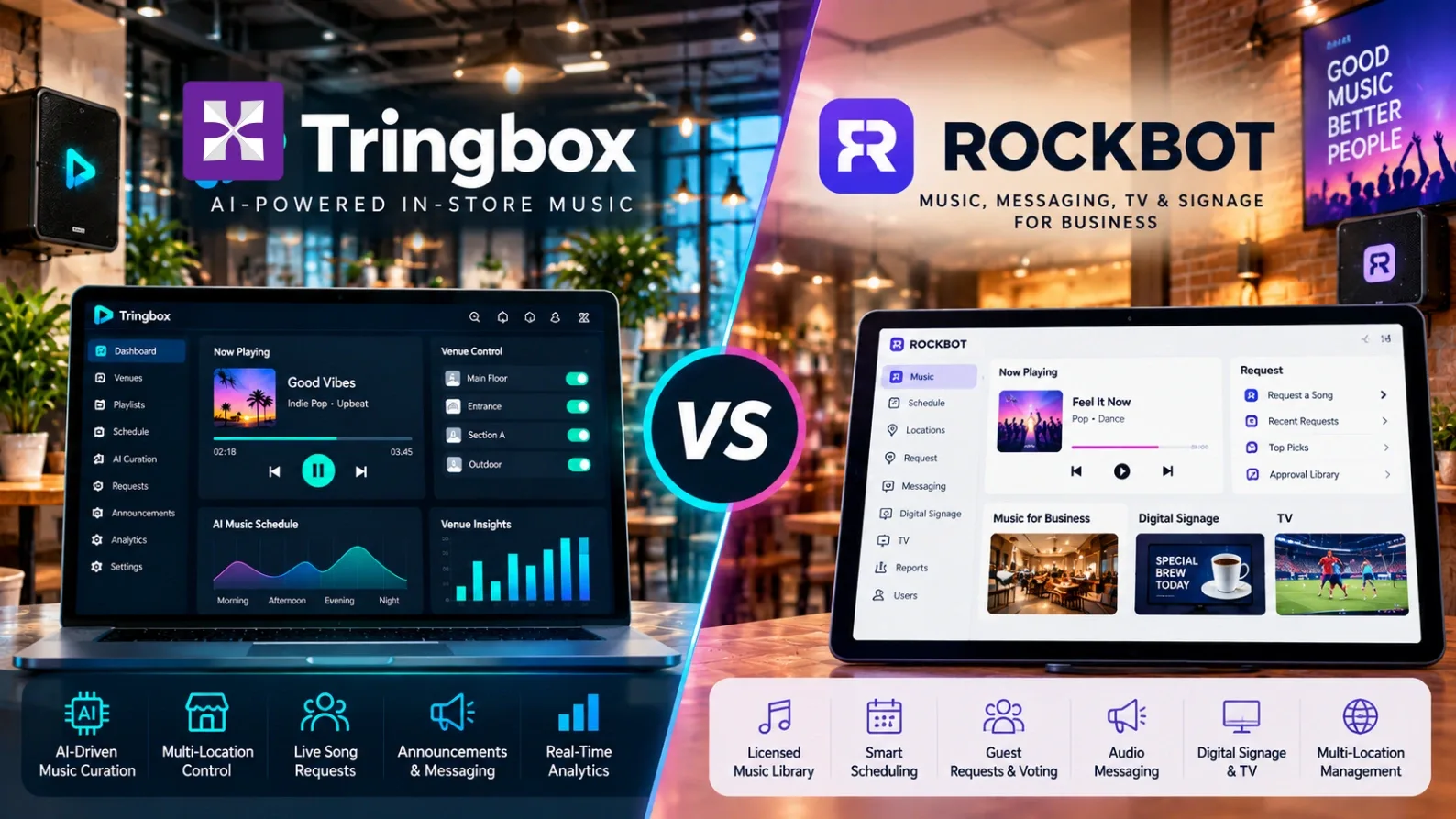
Tringbox and Rockbot strongly overlap in one critically important area that many traditional business music platforms completely ignore: both extend far beyond passive background playback into deep customer interaction and massive multi-location control. Rockbot is a highly mature business-media platform with licensed commercial music, audio messaging, digital signage, TV, and a dedicated interactive Request product. Tringbox is an India-focused AI music platform featuring adaptive selection, integrated venue operations, live guest requests, and automated announcements. The most useful procurement question is not which platform is objectively superior, but which specific operating model best matches your geographical footprint and customer engagement strategy.
Tringbox and Rockbot strongly overlap in one critically important area that many traditional business music platforms completely ignore: both extend far beyond passive background playback into deep customer interaction and massive multi-location control. Rockbot is a highly mature business-media platform with licensed commercial music, audio messaging, digital signage, TV, and a dedicated interactive Request product. Tringbox is an India-focused AI music platform featuring adaptive selection, integrated venue operations, live guest requests, and automated announcements. The most useful procurement question is not which platform is objectively superior, but which specific operating model best matches your geographical footprint and customer engagement strategy.
1. Rockbot's Documented Strengths: The Multi-Media Ecosystem
Centralized Media Management: Rockbot's Music for Business product includes deeply centralized management, smart scheduling, robust remote control, granular role-based access, and massive multi-location control capabilities.
The Request Ecosystem: Its highly praised Request product lets guests digitally request and socially vote on songs while the physical venue rigorously keeps control through an approved, brand-safe request library.
Beyond Audio: Rockbot also supports a much broader suite of in-location products beyond just music, seamlessly including audio messaging, digital signage, and venue TV. For businesses in markets where Rockbot is fully supported, this is a highly mature ecosystem with a particularly clear guest-engagement proposition.
2. Tringbox's Documented Strengths: AI and Live Interaction
Adaptive AI Orchestration: Tringbox's public material aggressively emphasizes AI-driven, context-aware music orchestration rather than only relying on scheduled, static playlists.
The Operational Dashboard: Its comprehensive Dashboard app natively provides multi-store monitoring, live request management, scheduled audio announcements, deep venue analytics, player hardware status, and instant IT alerts.
Integrated QR Ecosystem: Tringbox has robust consumer and partner apps built specifically around QR-based song requests for live performers and commercial venues. This purposefully makes customer interaction a core foundational part of the wider product ecosystem rather than just a small, bolted-on add-on.
3. Music Selection: Scheduling vs. Adaptation
The Scheduling Model: Rockbot's public music pages heavily emphasize strict scheduling, playlist control, and remote management. Corporate businesses can effortlessly automate dayparts and maintain approved programming centrally, ensuring predictable, structured operations.
The Adaptive Model: Tringbox adds a significantly stronger adaptive-AI narrative. Instead of blindly relying only on a fixed schedule, the system can autonomously choose tracks within strict brand rules using live contextual inputs like time and weather.
Operational Impact: This is a highly meaningful distinction for businesses that want a Monday morning and a Friday evening to sound completely different without the heavy operational burden of manually maintaining dozens of separate fixed lists.
4. Handling Guest Requests
Rockbot Request: Rockbot Request is one of the strongest and most heavily documented request products in the entire category. Guests can request and vote on songs, and venues retain absolute control over what is available through highly approved libraries. Rockbot documentation also deeply describes library formats and strict approval workflows for requests outside the current active library.
Tringbox QR Requests: Tringbox's song-request ecosystem utilizes dynamic QR and app-based participation. Public app listings show guests easily sending live requests, performers or venues actively accepting or rejecting them, and partner venues managing request activity directly from the dashboard.
Testing the UX: Because the exact user experience and onboarding flow is fundamentally different, a corporate buyer should physically test both flows in a live venue rather than assuming all request systems behave the exact same way.
5. Multi-Location Control and Geographic Market Fit
The North American Standard: Rockbot strongly markets centralized management for businesses ranging from a few locations to very large corporate networks. It has a massive, highly established North American business-music footprint.
The Indian Infrastructure: Tringbox is designed specifically around Indian commercial environments and regional licensing realities while aggressively expanding the AI-led product category. Tringbox's dashboard similarly supports multiple venues under one brand account, live playback monitoring, and system-status alerts.
Why Geography Matters: That geographic difference matters deeply because business music is not just software. Commercial catalogue rights, public-performance legal rules (like IPRS and PPL India), technical support, hardware supply chains, and commercial billing terms vary massively by country.
6. The Procurement Pilot Test
Define Your Priorities: Choose Rockbot for immediate evaluation if guest voting, a mature request ecosystem, broad in-location media products (TV/Signage), and highly structured playlist scheduling are high priorities. Choose Tringbox for immediate evaluation if adaptive AI, India-centric operations, integrated QR/live request experiences, and centralized venue monitoring are high priorities.
Stress-Test the Software: For a mathematically fair comparison, pilot both systems against the exact same questions: Can guests request inappropriate tracks? How much absolute control does head office retain? How quickly can a store manager functionally resolve an offline problem? Does the soundtrack become fatiguing or repetitive after 30 days?
Verify Governance: Can the system keep playing securely during severe broadband connectivity issues? Exactly how are commercial rights legally handled in your specific territory? Can promotional announcements be safely scheduled? What raw analytics data is available after 30 days of playback?
Conclusion
The Final Note
The most useful outcome of comparing Tringbox and Rockbot is not blindly declaring a universal winner. It is deeply understanding which operating model mathematically matches the actual business you are running. If you are operating a multi-media, highly scheduled retail or hospitality network in North America, Rockbot provides an incredibly polished, globally recognized ecosystem. If you are operating a rapidly scaling, heavily contextual retail network in India and want to leverage AI orchestration to reduce manual playlisting while safely inviting guest requests via QR, Tringbox offers a highly specialized, modern infrastructure. Always prioritize the platform that drastically reduces manual operational work while legally and functionally protecting your master brand identity.