
Tringbox vs Soundtrack: Which Business Music Platform Is Better for India?
Compare Tringbox and Soundtrack for Indian businesses across catalogue, scheduling, adaptive AI, permissions, remote control, licensing and multi-location operations.
K
Kunal Desai
Published
Read Time
12 min read
Disclosure: Songbox and Tringbox are related businesses; this commercial relationship is explicitly disclosed upfront because readers should know it when interpreting any result that places Tringbox highly. Every vendor marketing claim should still be verified directly and aggressively tested in a live physical pilot.
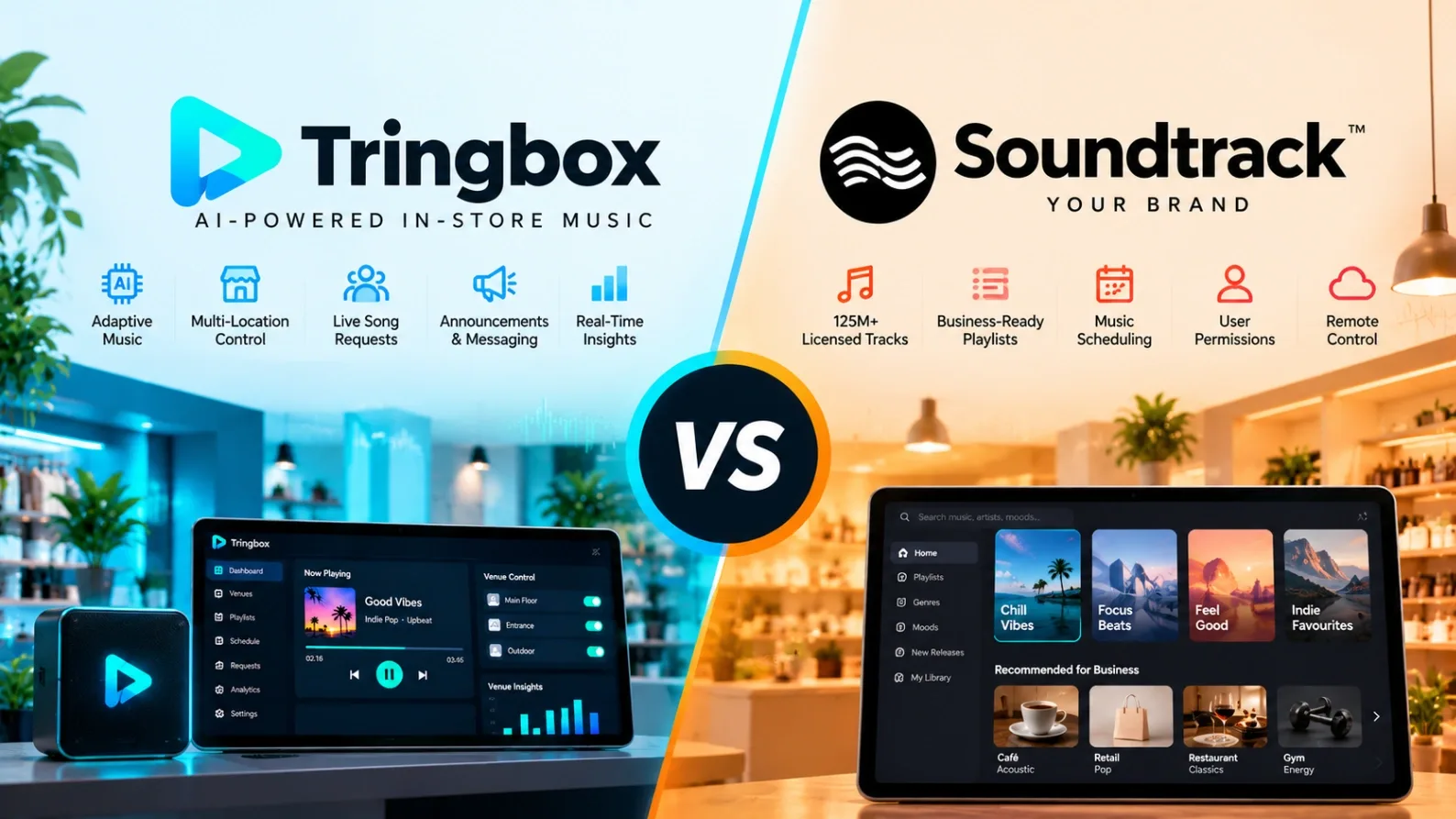
Soundtrack (formerly Soundtrack Your Brand) and Tringbox represent two fundamentally different ways to modernize business music. Soundtrack feels exactly like a highly professionalized streaming service: it offers a massive music catalogue, business-ready playlists, rigid scheduling, granular user permissions, and remote app control. Tringbox, by contrast, is much closer to an adaptive venue-music operating system: it focuses on strict brand rules, context-aware selection, multi-store monitoring, interactive song requests, automated announcements, and IT alerts. For Indian businesses, the complex local licensing structure makes this comparison vastly more nuanced than a standard software feature table.
Soundtrack (formerly Soundtrack Your Brand) and Tringbox represent two fundamentally different ways to modernize business music. Soundtrack feels exactly like a highly professionalized streaming service: it offers a massive music catalogue, business-ready playlists, rigid scheduling, granular user permissions, and remote app control. Tringbox, by contrast, is much closer to an adaptive venue-music operating system: it focuses on strict brand rules, context-aware selection, multi-store monitoring, interactive song requests, automated announcements, and IT alerts. For Indian businesses, the complex local licensing structure makes this comparison vastly more nuanced than a standard software feature table.
1. Soundtrack's Model: The Professional Streamer
Familiar Streaming Interface: Soundtrack heavily markets a colossal catalogue of more than 125 million licensed tracks, thousands of curated business-ready playlists, robust scheduling, remote control, and deep account-management features.
High Creative Control: Users can effortlessly build custom playlists, use curated options, and, on supported plans, control the music with significant creative flexibility. The product will feel incredibly intuitive to operations teams already familiar with consumer streaming music discovery.
Licensing Transparency: Soundtrack uniquely publishes highly valuable, India-specific licensing guidance. Its own legal page explicitly states that while certain digital streaming rights are included in the service, businesses in India may still need venue-level public-performance permissions (like PPL or IPRS) depending on the exact music they use and the relevant local rights organizations. That legal transparency is critically important for enterprise buyers.
2. Tringbox's Model: The Adaptive Operating System
AI-Led Orchestration: Tringbox is intentionally designed around AI-led selection rather than forcing a corporate brand team to continually build and manually maintain static playlists month after month. Public material describes deeply context-aware music orchestration using live data signals such as exact time of day and live environmental weather conditions.
The Operations Dashboard: The Tringbox Dashboard app adds massive multi-store monitoring, locked venue preferences, live interactive request management, scheduled audio announcements, deep venue analytics, and hardware alerts.
Automating the Floor: The entire system therefore aims to mathematically automate significantly more of the day-to-day music decision-making process while strictly keeping the retail or hospitality brand within its defined acoustic guardrails.
3. Catalogue Flexibility vs. Operational Automation
The Manual Workload: Soundtrack's enormous catalogue and intuitive playlist tools are highly attractive when a massive brand has a dedicated internal music curation team or strong internal musical taste and demands high, track-by-track creative control.
The Automated Workload: Tringbox is significantly more attractive when the enterprise business desperately wants to drastically reduce manual track selection and let the AI platform autonomously make more of the localized playback decisions.
Choosing Your Strategy: This is absolutely not a quality judgement between the two platforms. It is fundamentally a strategic question of exactly who should do the heavy operational lifting: your expensive internal brand team or the intelligent software system?
4. Scheduling vs. Contextual Adaptation
Time-Based Automation: Soundtrack robustly supports music scheduling, which is highly effective for strictly planned dayparts. The morning shift can have one fixed programme, the lunch rush another, and the evening service another.
Environmental Adaptation: Tringbox mathematically adds a deep contextual layer where track selection can shift dynamically inside the approved musical identity without waiting for a scheduled clock change. A business must carefully decide whether rigid, schedule-based automation is sufficient for their venues or whether highly adaptive, real-time decision-making adds measurable commercial value.
5. Multi-Location Management and Guest Requests
Central Visibility: Both premium products heavily support central control and user permissions. Soundtrack can securely invite company and location users with completely different access levels. Tringbox's venue dashboard robustly supports multiple locations under a single brand account and seamlessly combines playback monitoring with critical IT operational alerts.
Interactive Engagement: Tringbox differentiates remarkably clearly with live, governed song-request functionality natively built across its venue and consumer ecosystem. Soundtrack is primarily designed strictly around business-controlled playback rather than a venue-wide consumer request layer.
Sector Fit: For high-energy restaurants, bars, or highly experiential venues, this interactive capability is a massive operational difference. For a minimalist luxury retail boutique, it may be completely irrelevant.
6. The Indian Licensing Reality
Beyond the Subscription Fee: This legal aspect must be evaluated incredibly carefully for both products. A monthly B2B business music software subscription and physical Indian public-performance permissions are not always the exact same thing.
Ask for Legal Clarity: Ask each software provider, strictly in writing, exactly which sound-recording, musical publishing, and public-performance rights are fully included for the specific repertoire you plan to use in India.
The Compliance Standard: Do not ever legally assume that just because commercial music can technically stream from a hardware box in a business, every local territorial right has been fully cleared for public broadcast.
7. Which Platform Fits Which Buyer?
The Soundtrack Verdict: Soundtrack is an exceptionally strong fit for businesses that demand a huge on-demand global catalogue, familiar playlist creation workflows, rigid time-based scheduling, and granular user access.
The Tringbox Verdict: Tringbox is an exceptionally strong fit for forward-looking businesses that demand AI-led music operation, India-centric venue workflows, interactive guest request engagement, automated promotional announcements, and deeply centralized store-health visibility.
Conclusion
The Final Note
The procurement decision between Soundtrack and Tringbox fundamentally hinges on whether an enterprise wants absolute manual control over its music library or intelligent automation of its entire audio infrastructure. Soundtrack brilliantly empowers internal curation teams with a Spotify-like interface and a massive global catalogue. Tringbox transforms the physical venue into a responsive environment, utilizing artificial intelligence to adapt the acoustic energy and securely inviting guests to interact with the brand. By rigorously auditing your internal curation capacity and defining your Indian public-performance licensing strategy, operations directors can confidently select the platform that best protects their brand and their bottom line.