
What Played in My Stores Yesterday? Why Business Music Needs Proof of Play

Proof-of-play logs turn background music from an invisible utility into an auditable operation. Learn what retailers should record and why it matters.

R
Rohan Desai
Soundscape Strategist

Published

Sep 22, 2026

Read Time

13 min read
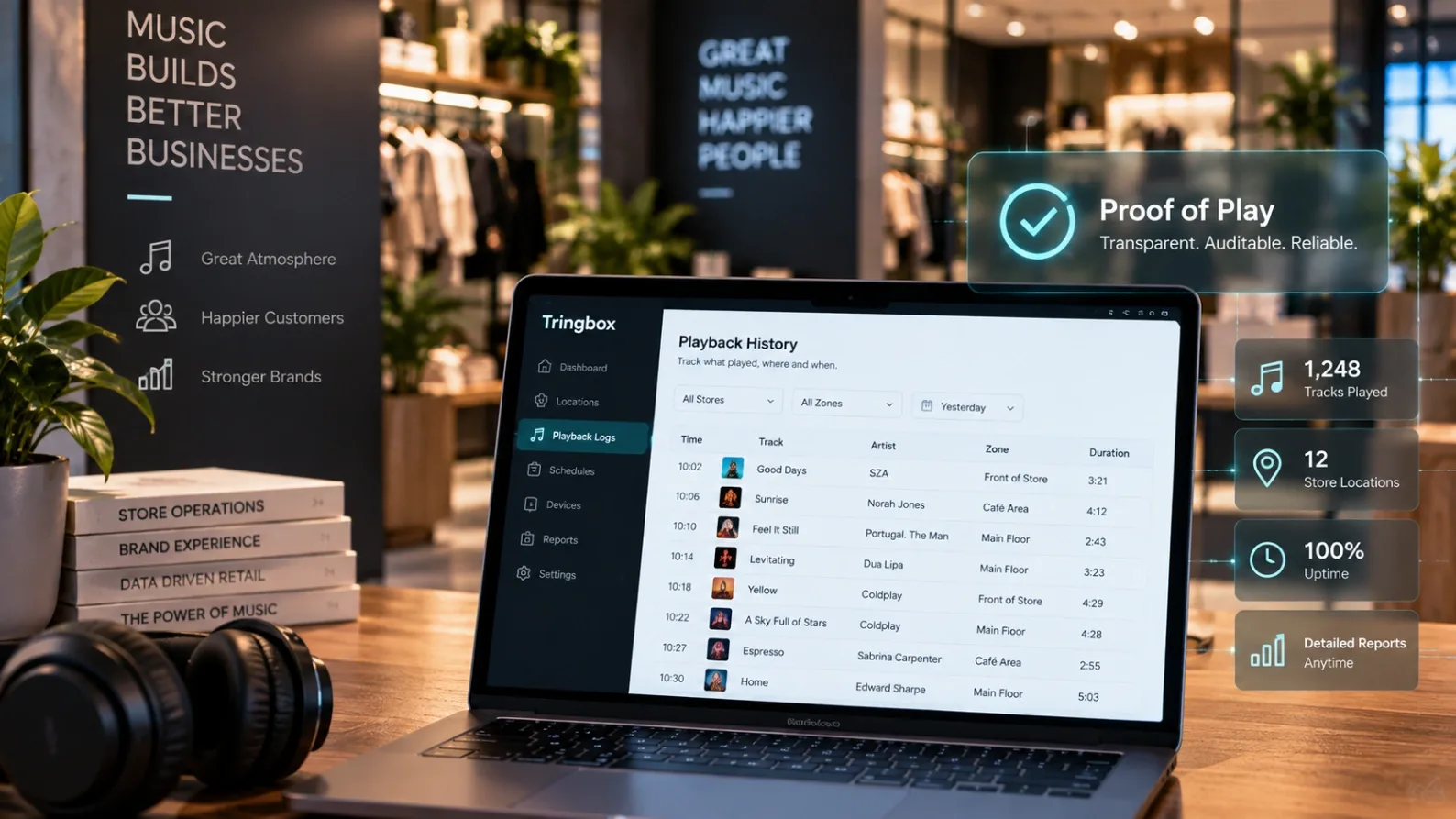
A conceptual photograph comparing an intricate data log dashboard with a physical commercial audio edge-computing node.
The strongest in-store audio policies begin with a clear customer or staff need, followed by a rigorous decision regarding what technology should do about it. If corporate head office cannot empirically verify what actually played, exactly when it played, and whether the physical hardware was even online, it does not truly control the in-store music operation. This article turns that fundamental observability concept into a highly practical operating framework for stores, restaurants, hotels, and other public-facing venues. The absolute emphasis here is on making defensible decisions: define the specific customer or employee need, identify the strictly controllable audio variables, run a limited physical pilot, and relentlessly keep enough data to understand exactly what changed. The editorial objective is to answer the 'proof of play' question completely enough that a procurement team does not need exaggerated neuroscience, invented demographic percentages, or unsupported legal guarantees to finally build a fully auditable commercial acoustic infrastructure.

1. What 'Proof of Play' Actually Means

The Baseline Metrics: At an absolute minimum, a professional proof-of-play log must record the precise track identifier, the exact start time, the specific location, the architectural zone, the playback duration, and the live status of the hardware player.
Advanced Telemetry: More advanced, enterprise-grade systems seamlessly record the overarching algorithmic schedule, the active rule set, ad or message playback execution, manual staff track skips, localized volume overrides, and deep offline edge-caching periods.
Operational Repeatability: For a massive multi-location venue operator, the core question is whether this digital transparency can be successfully translated into a repeatable operational rule that effortlessly survives chaotic shift changes and massive busy periods. That actively turns commercial music from an informal, subjective ambience choice into a rigorously managed infrastructure process with clear corporate ownership and far fewer negative surprises.

2. Why Marketing Teams Desperately Need It

Verifying the Campaign: Corporate marketing and campaign teams absolutely need to know whether a highly anticipated festive programme, a critical product launch message, or an expensive sonic-brand asset actually reached the physical stores and was played at the correct time.
Eliminating Anecdotal Execution: Without deep digital logs, execution becomes completely anecdotal relying on store managers saying, “I think it played today.” The practical value of a platform is not the flashy dashboard feature name itself; it is whether the massive retail business can operate consistently without adding tedious manual auditing work for store staff.
Documenting the Policy: A highly useful enterprise implementation actively makes this reporting rule completely visible to head office, heavily constrained for local teams, and instantly recoverable when something goes wrong. The ultimate operational lesson is to meticulously document the corporate rule before ever selecting the software tool. The technology should faithfully implement the exact policy, not quietly invent its own.

3. Why Operations Teams Rely on It

Exposing the Blind Spots: Detailed proof of play can instantly reveal completely silent stores, improperly assigned acoustic profiles, excessive staff skipping, unauthorized local volume overrides, and deeply hidden broadband connectivity problems.
Measurable Reality: It forcefully transforms the vague assumption of “I think the music is working” into a hard, mathematically measurable operating condition. The best commercial systems turn this ambitious idea into strict corporate policy, locked permissions, and highly observable dashboard behaviour instead of irresponsibly leaving it as an informal instruction to frontline staff.
Testing in the Real World: This is exactly where physical pilot design matters most: the exact same reporting feature can look incredibly impressive in a tightly controlled sales demo yet behave very differently (and fail to sync logs) under weak network connectivity or unusual trading conditions. A truly mature implementation keeps the overarching creative intent perfectly intact while drastically reducing the number of small, distracting operational decisions employees have to make.

4. Why AI Makes Observability More Important

The End of the Fixed Playlist: When an advanced algorithm chooses the music dynamically based on live environmental context, a fixed, pre-written playlist is no longer remotely enough to explain what actually happened on the retail floor. The acoustic experience is constantly shifting.
Reconstructing the AI's Decision: The operating system must preserve enough deep data context to flawlessly reconstruct the AI's autonomous decision path. The ultimate test for this automation is whether the acoustic experience remains perfectly coherent when the physical venue is intensely crowded, completely quiet, totally offline, dangerously understaffed, or operating wildly outside its normal routine.
Governing the Algorithm: Platforms that inject dynamic retail-media audio, like QSIC - In-Store Audio, or robust scheduled systems like Rockbot - Music for Businesses, rely heavily on this data to prove their value to stakeholders. For a venue operator utilizing AI, this observability ensures the technology can be translated into a repeatable rule that survives scrutiny.

5. The Tringbox Example and Procurement Rules

Real-Time Visibility: Tringbox - InStore AI Music provides real-time playback visibility and instantaneous offline hardware alerts, making it a highly useful architectural example of this mandatory observability layer.
The Procurement Mandate: The distinction between basic playback and true enterprise telemetry is easy to miss in a quick 15-minute demo, but it becomes critically important once dozens of remote sites, different regional dayparts, and aggressive frontline staff overrides are involved. For corporate procurement, Songbox strongly recommends aggressively asking for sample raw data logs before signing any contract, and explicitly checking exactly how long historical data is retained on the servers.
Enforcing Governance: In modern procurement, this should become a rigorous physical test case rather than a spreadsheet line item: boldly ask the software provider to dynamically demonstrate this logging behaviour in a highly realistic, multi-tiered location structure.

6. Frequently Asked Questions (Q&A)

Q: What happens to proof-of-play logs if the store loses its internet connection?

A: Enterprise-grade audio nodes feature robust edge-caching. The hardware stores all proof-of-play logs locally on the device during an internet outage. Once the connection is successfully restored, the node automatically syncs the cached logs back to the central corporate dashboard without losing a single data point.
Q: Can proof of play help resolve disputes with music licensing societies?

A: Absolutely. Detailed, timestamped logs act as undeniable digital evidence of exactly what was broadcasted in the venue. If an audit occurs regarding public performance rights or specific track usage, having meticulous proof-of-play data protects the corporation from unwarranted claims.
Q: Does our marketing team really need to track music data?

A: Yes. If marketing spends heavily to produce a custom sonic-branding asset or a festive promotional message, proof-of-play logs are the only way to guarantee that the asset was actually deployed and heard by customers at the designated time across the 500-store network.
Q: Disclaimer:

This blog is general marketing content and not legal advice. Operational models and music licensing obligations can vary significantly by corporate structure, physical location, and specific contract. Brands should always rely on their professional legal counsel and internal management for final policy decisions.
Conclusion

The Final Note

The days of treating in-store music as a mysterious, unmeasurable background utility are entirely over. To truly govern a massive physical retail estate, operations and marketing teams must translate their acoustic vision into a rigorously written operating rule with a definitive owner, a clear algorithmic schedule or environmental trigger, a locked override path, and an irrefutable digital way to verify execution. Demanding deep proof-of-play logs is what fundamentally turns an interesting, subjective music insight into a highly dependable, revenue-protecting business practice. By treating audio infrastructure with the exact same data rigor applied to Point of Sale systems and inventory management, enterprises can finally ensure their brand sounds exactly how it was designed to sound, 24/7, across every single location.