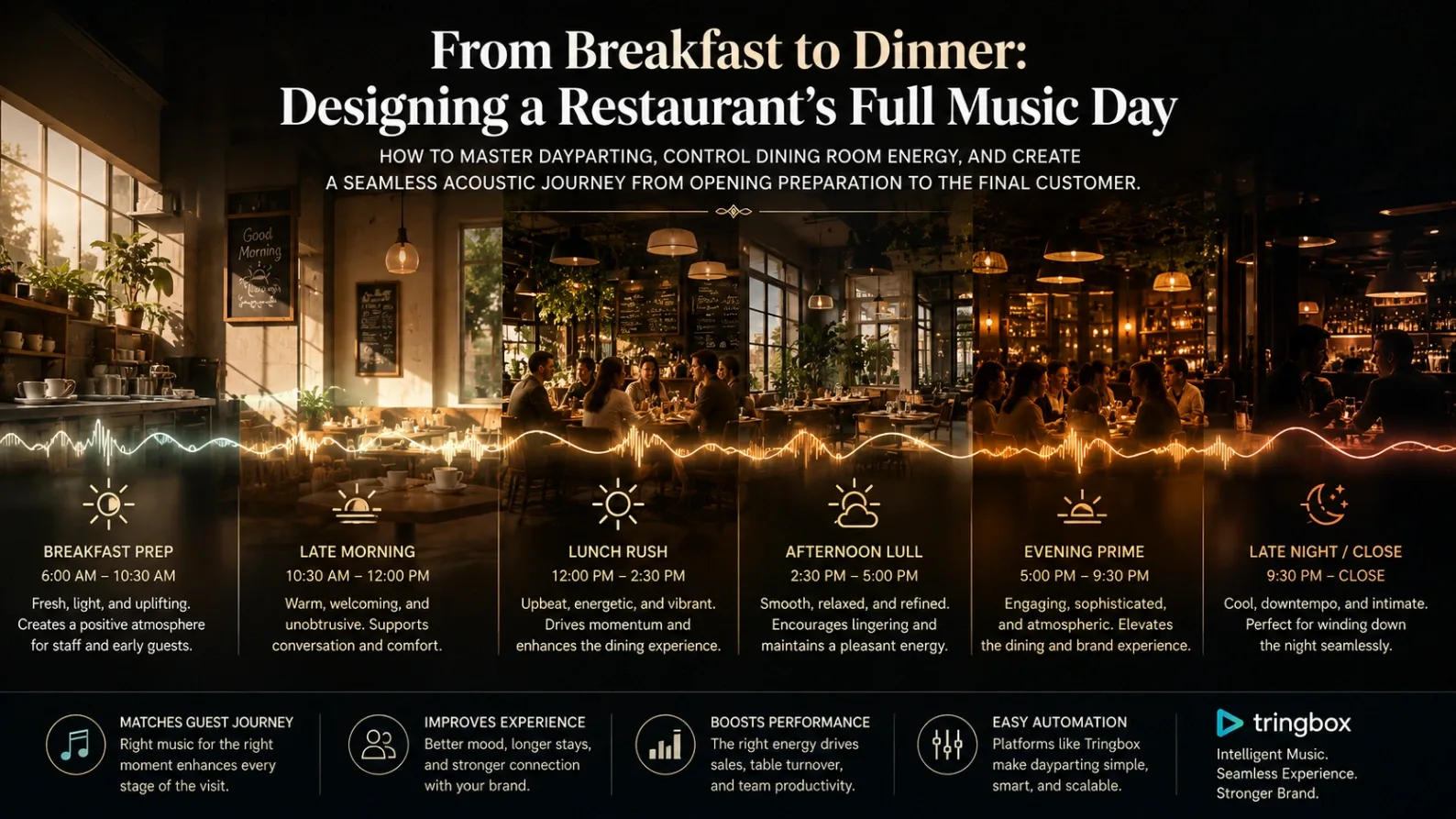
A restaurant is a living, breathing ecosystem that does not maintain a single, static atmosphere all day. The physical room, the menu offerings, the customer's purpose, the ambient lighting, the service rhythm, and the baseline noise level shift dramatically from opening to closing. Yet, an alarming number of hospitality venues continue to use one generic playlist on shuffle from breakfast through dinner. The operational and experiential result is deeply disconnected: high-tempo, energetic tracks playing during a quiet, reflective morning; sleepy, ambient music dragging down the vital lunch rush; or aggressive, overpowering volume playing exactly when evening guests desire intimate conversation. A flawlessly executed full-day music plan utilizes strategic 'dayparts' to express the different sides of the restaurant's identity. The soundtrack must evolve synchronously with the customer journey while remaining unmistakably recognisable as part of the same core brand. The objective is not constant, jarring manipulation; it is a natural, seamless progression that supports how the physical space is actually used by both patrons and staff. This comprehensive guide explores how modern hospitality operators design a sophisticated daily acoustic architecture, and how leveraging advanced platforms like
Tringbox automates this complex journey.
1. Begin with the Restaurant Concept and Emotional Core
Defining the Identity First: The foundation of any music day must start directly with the overarching restaurant concept. A bustling neighbourhood cafe, a premium casual dining spot, a luxury hotel dining room, a fast-paced quick-service chain, a vibrant rooftop bar, and a traditional family restaurant all require fundamentally different acoustic approaches. Before selecting a single track, operators must define the brand's absolute emotional core: is it warm, lively, refined, youthful, relaxed, celebratory, or exploratory?
Maintaining the Core Across Dayparts: This emotional core must remain highly stable across all dayparts. What strategically changes throughout the day is the intensity, familiarity, vocal presence, tempo, and language weighting. If a venue lacks this defined core, the breakfast period can sound like a completely different restaurant than the dinner period, destroying brand cohesion.
Testing in the Real World: A context-aware platform can seamlessly help a restaurant schedule these complex dayparts and automatically apply approved changes in energy and mood. However, the restaurant operations team must still test these rules physically in the real dining room. Room acoustics, the specific service style of the waitstaff, live crowd noise, and customer purpose simply cannot be understood by looking at track metadata on a corporate spreadsheet.
2. The Morning Arc: Opening, Preparation, and Breakfast
Pre-Service Preparation: Before the first guests arrive, music serves as a vital tool to help the staff prepare the space and set their internal rhythm. However, employee-preparation music should not automatically become customer music. The opening acoustic programme should be relatively quiet, highly positive, and uncluttered, gently allowing the physical room to 'wake up.' Volume must support clear operational briefings and safety checks rather than dominating the floor.
The Automated Start: The audio system should be programmed to start autonomously, confirming that the correct zones are active without requiring a manager to manually log in. A silent, forgotten opening often continues entirely unnoticed until the first confused customer explicitly asks why it is so quiet.
Breakfast and Early Morning Flow: Morning guests are typically alone, working remotely, holding brief casual meetings, or simply beginning their day slowly. The music must feel exceptionally fresh and welcoming without demanding conscious attention. Acoustic textures, light and breezy rhythms, softer vocal styles, and moderate familiarity consistently work better than intense basslines or dramatic, emotionally heavy songs. The programme must reflect the specific format: a high-volume transit cafe requires more pace than a serene hotel breakfast buffet. The ultimate goal is conversational comfort, not universally slow audio.
3. The Midday Momentum: Transitions and Lunch Service
The Late Morning Transition: As the venue fills with patrons and the kitchen service becomes significantly more active, the soundtrack must gradually increase in rhythm, brightness, and energy. This critical transition should occur smoothly over several carefully curated tracks rather than snapping instantly at one exact minute with an abrupt, jarring genre switch. This late morning period is perfect for broadening the catalog and moving from morning restraint toward the necessary lunch energy.
Driving the Lunch Rush: Lunch service can be fast, highly social, business-oriented, or leisurely, depending entirely on your specific concept. The soundtrack must actively support this intended pace without ever making table conversation difficult. Familiarity may be slightly increased because lunch guests typically have limited attention spans and the ambient room noise is naturally higher. Rhythm and tempo become clearer and more driving.
The Volume Trap: A crucial rule for restaurant acoustic design is to avoid using volume alone to create energy. Cranking up the volume to mimic a busy room only forces guests to shout (the Lombard effect), creating a chaotic, stressful environment. Proper track selection, elevated tempo, and intelligent sequencing provide the necessary pace at a perfectly comfortable decibel level. 4. The Afternoon Gap and Evening Arrival
Managing the Afternoon Lull: Many dining venues experience a noticeably quieter period between 2:30 PM and 5:00 PM. This drop in footfall is not an excuse to make the music sleep-inducing. The acoustic programme can strategically become more spacious and discovery-oriented while strictly maintaining a vibrant sense that the venue is fully open and operational. This encourages mid-afternoon customers to stay longer, work, or hold relaxed conversations.
Preventing Employee Acoustic Fatigue: The afternoon gap is precisely when frontline employees become hyper-aware of musical repetition. A deeper, more expansive catalog and different algorithmic rotation logic keep the environment fresh and engaging for the staff who have already heard the morning and lunch programmes, directly boosting their morale and service quality.
The Golden Hour and Evening Arrival: As the sun sets and the interior lighting dims, dinner guests arrive expecting a shift in atmosphere. The music must seamlessly become warmer, richer, and significantly more deliberate. The system should introduce stronger, more emotive vocals, deeper bass rhythms, and a greater overall sophistication that perfectly matches the evening service style and visual environment. A family restaurant may pivot toward highly recognisable, crowd-pleasing tracks, while a premium fine-dining room leans into highly curated, exclusive musical discovery.
5. Peak Dinner, Bar Service, and the Graceful Close
Stability During the Dinner Peak: Peak dinner service requires absolute atmospheric stability. The dining room is already saturated with animated conversation, constant staff movement, and intense kitchen activity. The music must act as the invisible glue holding the atmosphere together without ever competing with the guests. Sudden shifts in loudness or long gaps of silence are deeply noticeable and instantly alter the fragile acoustic balance. The system must maintain a tight 'energy band,' avoiding extreme tracks and executing perfectly smooth crossfades.
Zonal Bar Coordination: If the restaurant features a dedicated bar or late-night lounge area, the programme must become more rhythmic and expressive. Different physical zones require separate, distinct sound identities. The main dining room must remain conversation-friendly, while the bar carries a significantly higher energy load. A professional zonal audio system coordinates these spaces to ensure they are compatible, preventing jarring audible conflict where the zones bleed into each other.
The Psychology of Closing Time: Music is a powerful psychological cue that the evening is winding down, but it must never abruptly make paying guests feel unwanted or rushed. A gradual, intentional reduction in both energy and volume gracefully supports closing procedures. The programme must continue to sound intentional and high-quality until the very last customer exits the building. Furthermore, after-hours staff cleanup music must automatically reset to the morning profile, ensuring the opening team does not inherit an unsuitable, high-BPM late-night playlist the next day.
6. Operationalizing Dayparts with Smart Technology
Handling Weekends and Festivals: A rigid schedule fails in hospitality. Weekend brunch, live music events, private corporate bookings, national festivals, and live sports match screenings all require special, pre-approved acoustic modes. These temporary programmes must have clearly defined, automated start and end times to ensure the standard brand identity resumes flawlessly once the event concludes.
Measuring and Improving: The most beautiful acoustic map is useless if it is not measured. Management must constantly review customer comments, employee feedback regarding volume overrides, network outages, and track repetition by daypart. Listen to full service periods in the actual dining room. The ultimate question is not whether every individual song is loved; it is whether the overall programme successfully supports the intended operational rhythm, physical comfort, and brand character.
The Tringbox Advantage: Manually managing this incredible level of daypart complexity is impossible for human staff. By deploying an AI enterprise music management platform like Tringbox, restaurants centralize this logic. The brand defines the daypart map globally, and the intelligent edge-caching hardware executes it flawlessly at the local level, perfectly automating the acoustic journey from the first morning coffee to the final midnight cocktail. 7. Frequently Asked Questions (Q&A)
Q: Why is it a bad idea to just play upbeat music all day to keep the restaurant feeling lively?
A: Playing high-energy music continuously creates a massive sensory mismatch during quieter dayparts like breakfast or the mid-afternoon lull. It feels highly unnatural to the few guests in the room, making them feel rushed and uncomfortable. True hospitality requires matching the energy of the music to the actual energy of the room and the customer's specific dining purpose.
Q: How do we transition from lunch to afternoon without it sounding like the restaurant is closing?
A: The transition should involve dropping the tempo slightly and moving toward more spacious, discovery-oriented tracks, but retaining a clear rhythmic pulse. Do not switch to slow, ambient spa music. The goal is to signal a relaxed environment for lingering guests, not to signal that service has completely stopped.
Q: Can't our restaurant manager just adjust the volume when the room gets busy?
A: Relying on manual volume adjustments is a flawed strategy. Managers are often too busy handling front-of-house issues to perfectly monitor acoustics. Furthermore, increasing volume to combat crowd noise triggers the Lombard effect, where guests talk louder to overcome the music, creating a deafening spiral. A smart dayparting system uses tempo and track selection to create perceived energy without requiring extreme decibel levels.
Q: Disclaimer:
This blog is general marketing content and not legal advice. Music licensing obligations can vary significantly by repertoire, rights owner, exact usage type, physical location, and specific contract. Brands should always rely on their commercial agreements and professional legal counsel for final compliance decisions.
Conclusion
The Final Note
A restaurant's soundtrack must breathe and move in perfect synchronization with the physical day. Breakfast, lunch, the afternoon gap, dinner, peak bar service, and closing procedures each demand a distinct, carefully calibrated expression of the overarching brand identity. Intelligent daypart planning creates this vital progression autonomously, ensuring flawless execution without ever relying on overworked floor staff to act as amateur DJs. The most profitable and experiential full-day programmes combine a resolute brand concept with controlled energy arcs, comfortable conversational volume, incredibly smooth transitions, and unbreakable scheduling reliability. By transitioning to a dedicated B2B audio platform, operators ensure that their guests experience a restaurant that feels completely natural and perfectly orchestrated at every single moment, while the staff experiences a technological system that simply works.