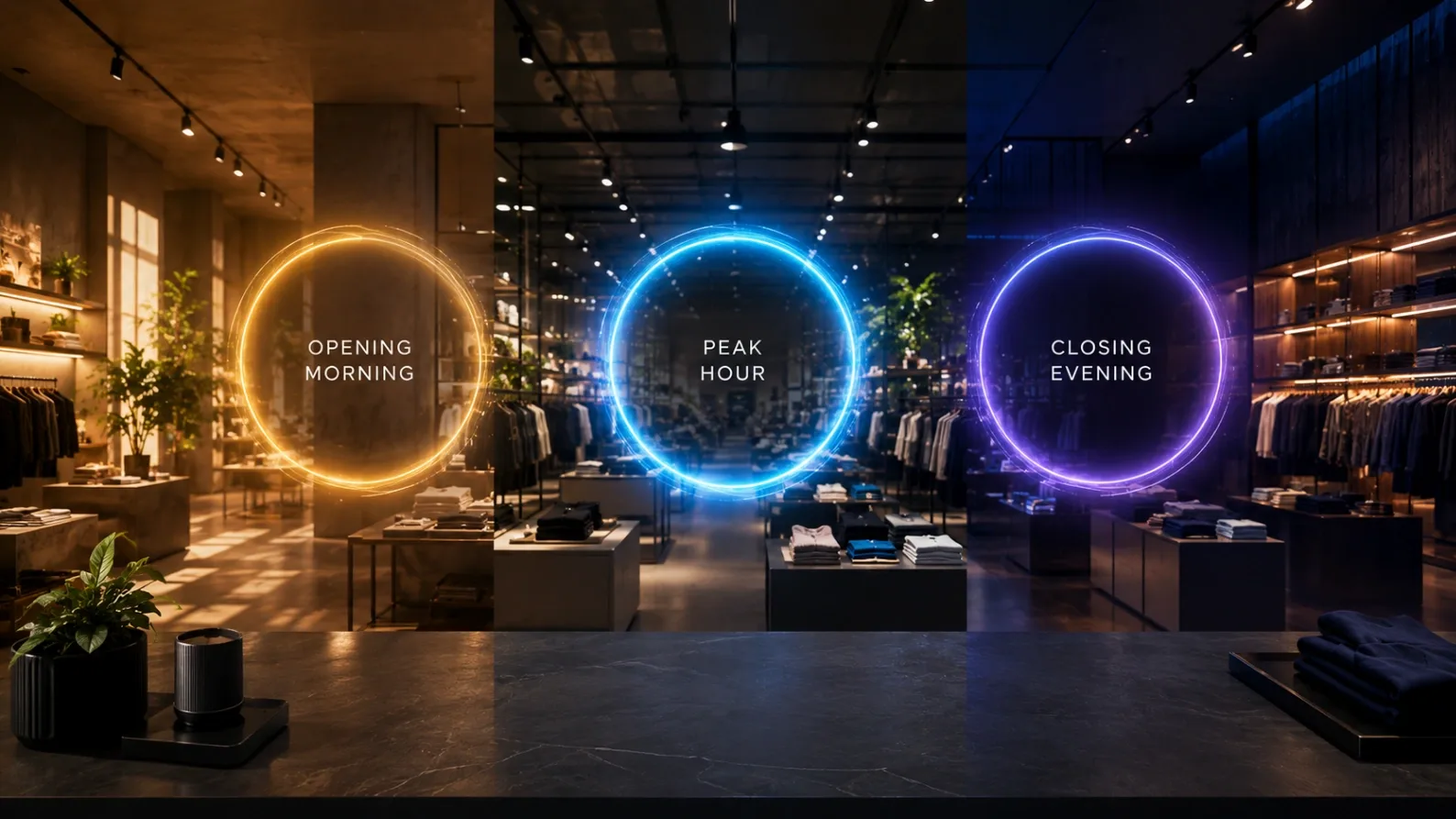
Retail stores change character drastically throughout the day. At opening, the physical space may be quiet as staff finalize their preparation. During peak hours, customer traffic, movement, and conversation increase exponentially. Near closing time, the store needs to remain welcoming and on-brand while gracefully winding down for the evening. Relying on one static, unmanaged playlist cannot respond intelligently to all three of these distinct conditions. Daypart music programming helps a retailer actively support both the customer journey and internal store operations. By utilizing dayparts, the core brand identity remains perfectly consistent, while critical variables like energy, familiarity, tempo, language, and volume shift fluidly within approved corporate ranges. The result feels significantly more natural and professional than abrupt playlist switching or rogue, employee-controlled music. This comprehensive guide details how to engineer the perfect acoustic arc for your retail environment, and how transitioning to an
AI enterprise music management platform like
Tringbox completely automates this complex daily operational rhythm.
1. The Crucial Role of Opening Music
Establishing the First Signal: Opening music establishes the very first emotional signal of the trading day. It should make the store feel active and ready without aggressively overwhelming early-morning customers. For the staff, it can effectively support pre-open preparation and create a positive, focused start. However, strict customer-facing acoustic standards must apply the exact second the doors unlock.
The Necessity of Automation: Automatic playback is a non-negotiable operational requirement. If your store's music depends on a staff member remembering to connect an auxiliary cable to a phone, the venue may remain awkwardly silent through the entire morning rush. A dedicated, venue-based hardware player ensures the correct programme starts flawlessly according to schedule.
Match the Brand, Not a Generic Mood: 'Morning' does not automatically mean slow, sleepy acoustic music. A high-performance sports retailer may need tightly controlled, driving energy right from opening. A luxury boutique may favour spacious, highly refined instrumental tracks. A family fashion brand may lean into warm, acoustic familiarity. The morning programme should express your specific enterprise brand identity at a more welcoming intensity, rather than adopting a universal, generic morning genre. 2. Building Energy Gradually Toward Peak Hours
The Natural Acoustic Arc: As foot traffic inevitably grows, the music must gain rhythm, density, and confidence over the span of several tracks. A sudden, jarring playlist switch exactly at noon can make the environment feel artificially programmed rather than organic. Advanced queue logic creates a gradual emotional arc, choosing transitions that smoothly manage changes in tempo and sonic texture.
Aligning with Real Business Patterns: The audio system must respond to actual business realities. A mall store may experience its peak in the late evening, while a high-street market location may peak much earlier in the afternoon. Dayparts must be based entirely on real footfall data and customer purpose, not arbitrary corporate head-office assumptions.
3. Mastering Peak-Hour Music and Zonal Control
Managing Human Noise: During peak periods, the store contains significantly more human noise and chaotic movement. The music must remain present without becoming a hostile competition. Clear, driving rhythm and highly stable perceived loudness support the room's energy at a comfortable decibel level. Sudden quiet tracks will disappear into the background noise, while sudden loud tracks will become highly irritating.
Familiarity as a Cognitive Anchor: The peak programme often utilizes more familiar 'anchor' tracks because customers are already rapidly processing products, crowds, and visual promotions. Discovery tracks can certainly remain in the mix, but the overall sequence must be highly accessible, reassuring, and coherent.
Different Zones, Different Roles: A large, large-format retailer may have distinct entrance, browsing, fitting, checkout, and experiential zones. These physical areas do not always need entirely separate playlists, but their acoustic needs differ wildly. The entrance requires high energy, fitting rooms demand comfort and absolute privacy, and checkout lines must avoid adding cognitive distraction. A professional in-store music system coordinates these zones so they share the same overarching identity while avoiding audible conflict. 4. Managing Campaigns, Closing Time, and After-Hours
Campaign and Product-Launch Periods: Peak traffic frequently coincides with new product launches, flash sales, or festive campaigns. Music should actively support the campaign through approved themes, elevated energy, or curated cultural cues. Crucially, campaign programmes must be scheduled centrally with strict start and end dates. This guarantees consistency and automatically prevents outdated festive music from continuing weeks after a promotion ends.
Closing Time Without Pushing Customers Out: Closing music should actively help the physical space settle while remaining highly respectful to the customers who are still completing their shopping journey. A gradual, algorithmic reduction in energy and tempo signals the transition far more subtly and professionally than abrupt silence or harsh PA announcements.
After-Hours Staff Policies: Some brands allow a separate, approved high-energy programme for staff cleanup after the doors lock, while others mandate the customer soundtrack continues. The operational policy must be clear. Allowing staff to plug in personal accounts introduces the massive risk of explicit content, device dependence, and the guarantee that the wrong, high-BPM programme will accidentally remain active at opening the next day. An automated system smoothly transitions to staff mode and perfectly resets itself before the next business morning.
5. Measuring Dayparts and Utilizing Automation
Tracking the Right Metrics: Operations teams must rigorously review hardware uptime, manual volume overrides, repetition, and staff feedback by daypart. An acoustic programme may work flawlessly in the morning but feel incredibly flat at peak. Store teams should report these patterns through structured feedback forms rather than requesting individual favorite songs.
Automation Without Losing Control: An advanced AI selector can dynamically adjust track ranking within each daypart based on current context (weather, live occupancy, temperature), but the hard brand guardrails must remain absolute. Missing environmental data should immediately trigger a safe, pre-programmed default rather than interrupting playback. The most valuable automation eliminates manual, repetitive decisions and keeps the acoustic sequence endlessly fresh; it does not allow local context to accidentally turn the store into a completely different brand.
6. A Sample Retail Daypart Map
Morning Preparation & Opening: Low-to-moderate energy helps staff set up without making an empty room feel overproduced. The first customer period establishes the brand identity quickly (crucial for short visits), keeping volume and lyric density appropriate for independent browsing.
The Midday Build: As traffic increases, the system adds rhythmic definition and slightly greater perceived energy to remain present against rising conversational noise. This does not mean cranking the volume; stronger percussion and clearer production create presence without aggression.
Afternoon & Evening Variations: A youth-fashion brand may continue accelerating energy into the evening, while a premium jewelry or home goods retailer will shift to preserve a calm, luxurious atmosphere. The daypart schedule must link directly to the specific demographic's late-day shopping behavior.
The Gentle Close: Intensity gracefully reduces while staff complete end-of-day tasks. The final transaction should never feel rushed by a jarring, obvious 'closing playlist' or a sudden drop in audio quality.
7. Frequently Asked Questions (Q&A)
Q: Why does a sudden change in tempo at exactly 12:00 PM feel unnatural?
A: Human psychology is sensitive to abrupt sensory shifts. If a playlist switches from slow acoustic to high-energy electronic music in an instant, it breaks the customer's immersion and draws conscious, negative attention to the speakers. A proper system utilizes 'queue logic' to crossfade and bridge genres seamlessly over several tracks.
Q: Should we just turn the volume up during peak hours to match the crowd?
A: No. Relying solely on volume to create energy forces customers and staff to shout, triggering a stressful, chaotic environment known as the Lombard effect. Instead of raw volume, smart dayparting utilizes tracks with higher tempos, stronger percussion, and recognizable hooks to cut through the ambient noise comfortably.
Q: How does Tringbox automate this complex dayparting schedule?
A: Tringbox AI allows corporate teams to build a sophisticated daypart map defining exact energy curves, familiarity levels, and language splits for every hour of the day. The edge-computing hardware then autonomously generates and mixes the perfect playlist on the fly, eliminating the need for local store managers to ever touch a dial. Q: Disclaimer:
This blog is general marketing content and not legal advice. Music licensing obligations can vary significantly by repertoire, rights owner, exact usage type, physical location, and specific contract. Brands should always rely on their commercial agreements and professional legal counsel for final compliance decisions.
Conclusion
The Final Note
Opening, peak hours, and closing time represent fundamentally different moments in the daily customer journey. Exceptional retail music recognizes and honors those differences through rigorously controlled dayparts, gradual emotional energy arcs, highly consistent loudness, and unbreakable scheduling reliability. The overarching brand remains resolute throughout the day, but its expression fluidly adapts. When the acoustic system is designed and executed correctly using a centralized B2B platform like Tringbox, customers experience a physical store that feels vibrantly ready in the morning, brilliantly alive during the chaotic peak, and respectfully considered until the very final minute of trade.