
How Much Music Control Should Franchisees and Store Managers Actually Have?
Central control or local freedom? A practical governance model for franchise and multilocation business music.
N
Nikhil Srivastava
Published
Read Time
14 min read
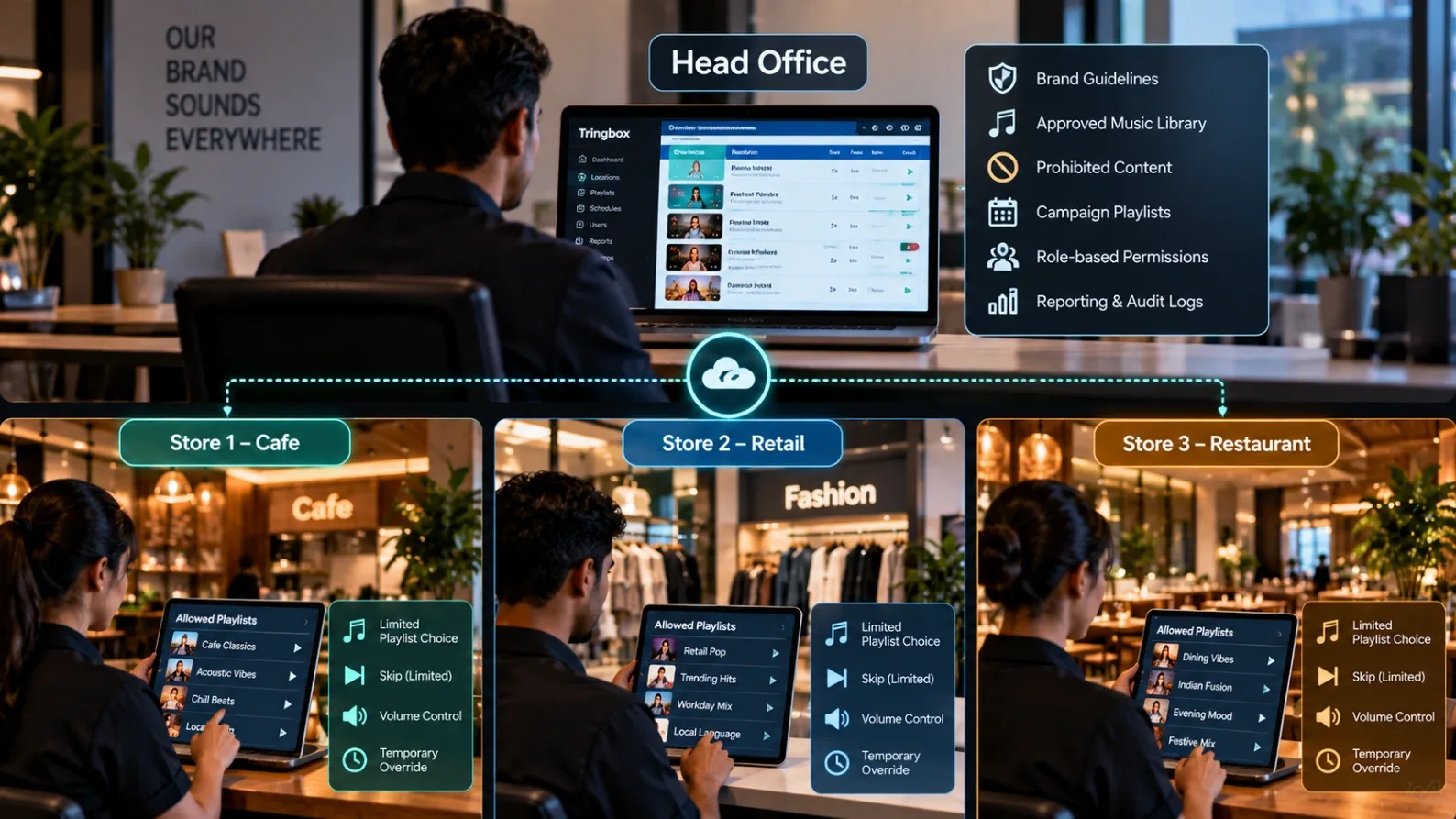
The word 'personalisation' is often used far too casually in modern retail; commercial audio provides a perfect example of how to make it mathematically precise. When designing an acoustic infrastructure, enterprise operations teams constantly battle over franchise music management controls. Should corporate head office dictate every single song, or should local store managers have the freedom to curate their own vibe? The most effective franchise model is neither total, rigid centralisation nor unrestricted, chaotic local control. It is a state of controlled flexibility: head office mathematically defines the safe acoustic universe, and local teams are empowered to operate dynamically inside it. This article turns that abstract governance idea into a highly practical operating framework for stores, restaurants, hotels, and other public-facing franchise venues. The ultimate goal is to architect a concrete rule that a real operations team can execute consistently without risking the brand.
1. Why Full Local Control Disasters Happen
The Bluetooth Liability: When local control is completely unrestricted, brand consistency instantly becomes dependent on whoever currently holds the Bluetooth connection. Managers will inevitably use their personal consumer streaming accounts, accidentally broadcasting highly explicit tracks, wildly off-brand genres, or overly repetitive, fatiguing playlists.
Legal and Operational Risk: Allowing staff to act as amateur DJs exposes the enterprise to severe copyright infringement fines (as consumer apps are strictly illegal for commercial use) and destroys the carefully crafted customer experience. The practical value of an enterprise audio platform is its ability to permanently eliminate this manual, chaotic work for store staff.
Verifying Execution: For massive multi-location brands, the acoustic capability must be explicitly measurable through deep playback logs or centralized dashboard reports so that flawless execution at the local franchise level can be rigorously verified rather than blindly assumed.
2. Why Total Central Control Can Also Fail
Ignoring Local Reality: A single, rigid national playlist aggressively pushed from a corporate headquarters in New York or Mumbai routinely ignores nuanced local culture, unusual regional events, shifting customer mixes, and daily operational realities on the physical retail floor.
The Need for Agility: Franchisees and local managers often intuitively know exactly when a location desperately needs a small atmospheric adjustment such as lowering the energy during a quiet, rainy afternoon or boosting the tempo during an unexpected bus tour arrival. Denying them all control creates deep frustration and operational friction.
Finding the Middle Ground: The absolute best commercial systems successfully turn this tension into strict corporate policy, locked permissions, and highly observable dashboard behaviour instead of irresponsibly leaving it as an informal, unenforced instruction. A mature implementation perfectly keeps the creative intent intact while drastically reducing the number of small, distracting decisions frontline employees have to make.
3. The Three-Layer Governance Model
Layer 1: Corporate (The Absolute Rules): Head office unconditionally controls the commercial licensing footprint, the overarching brand persona, the strict prohibited content filters (explicit lyrics, restricted artists), the approved master catalogue, and mandatory promotional campaign rules.
Layer 2: Regional (The Cultural Context): Regional managers control language and cultural adaptations, local festival calendars, and store-format differences (e.g., mapping different acoustic energies to a fast-casual venueType versus a premium dining venueType).
Layer 3: Local (The Tactical Execution): Store managers are granted highly limited, observable tactical controls: the ability to skip a track, adjust the master volume within a safe decibel range, and temporarily select from pre-approved, context-specific profiles (e.g., switching from 'Morning Cafe' to 'Busy Lunch Rush').
4. Permissions Must Be Technologically Explicit
Role-Based Access: Granular role-based access, immutable audit logs, and the automatic expiry of temporary local overrides are infinitely more reliable than an informal corporate memo. Every single action that can materially change the physical customer experience must have a recorded digital owner.
Documenting the Policy: The profound operational lesson is to meticulously document the corporate rule before ever selecting the software tool. The chosen technology should faithfully implement your exact governance policy, not quietly invent its own.
Reversibility and Governance: A highly useful enterprise implementation actively makes this permissions rule completely visible to head office, heavily constrained for local teams, and instantly recoverable when something inevitably goes wrong on the retail floor.
5. How Leading Platforms Handle the Mix
Rockbot's Structured Permissions: Rockbot - Music for Businesses is globally recognized for explicitly supporting highly mature role-based permissions and approved local franchise updates, making it a powerful tool for massive US-centric enterprise networks that require strict hierarchical control.
Tringbox's Contextual Guardrails: Tringbox - InStore AI Music is a prime India-focused example of how central brand guardrails seamlessly combine with intelligent, local contextual adaptation. Instead of forcing managers to manually choose playlists, Tringbox utilizes AI enterprise music management to autonomously adapt the music based on live weather and time of day, firmly within the safe universe defined by Corporate.
The Procurement Pilot: This is exactly where physical pilot design matters most: the exact same permissions feature can look incredibly impressive in a tightly controlled sales demo yet behave very differently (or fail to sync logs) under weak network connectivity. Always demand to test the local override features in a live retail environment.
6. Frequently Asked Questions (Q&A)
Q: Why shouldn't a franchise owner just buy their own music subscription?
A: If every franchise owner buys their own subscription, the overarching corporate brand shatters completely. A customer walking into a franchise in Delhi should experience the exact same sonic brand identity as they do in Bangalore. Centralized B2B platforms enforce this vital consistency.
A: If every franchise owner buys their own subscription, the overarching corporate brand shatters completely. A customer walking into a franchise in Delhi should experience the exact same sonic brand identity as they do in Bangalore. Centralized B2B platforms enforce this vital consistency.
Q: What happens if a local manager skips too many songs?
A: Enterprise platforms like Tringbox meticulously log every single 'skip' action. Corporate operations can view a centralized dashboard to see which stores are constantly overriding the system. If skips are high, it indicates the baseline corporate playlist needs adjusting for that specific region.
A: Enterprise platforms like Tringbox meticulously log every single 'skip' action. Corporate operations can view a centralized dashboard to see which stores are constantly overriding the system. If skips are high, it indicates the baseline corporate playlist needs adjusting for that specific region.
Q: Can we restrict volume control so staff don't blast the music?
A: Yes. Advanced systems allow head office to set absolute maximum and minimum volume thresholds. A local manager can adjust the volume to suit the immediate floor traffic, but they cannot exceed the safe decibel limit hardcoded by corporate.
A: Yes. Advanced systems allow head office to set absolute maximum and minimum volume thresholds. A local manager can adjust the volume to suit the immediate floor traffic, but they cannot exceed the safe decibel limit hardcoded by corporate.
Q: Disclaimer:
This blog is general marketing content and not legal advice. Operational models and music licensing obligations can vary significantly by corporate structure, physical location, and specific franchise agreements. Brands should always rely on their professional legal counsel and internal management for final policy decisions.
This blog is general marketing content and not legal advice. Operational models and music licensing obligations can vary significantly by corporate structure, physical location, and specific franchise agreements. Brands should always rely on their professional legal counsel and internal management for final policy decisions.
Conclusion
The Final Note
Determining the perfect balance of franchise music management controls is the ultimate test of a brand’s operational maturity. Stripping all control from local franchisees breeds resentment and results in an acoustic environment that cannot adapt to real-world retail chaos. Conversely, granting total local freedom guarantees a shattered brand identity and immense legal liability. The most useful next step for any enterprise is a highly controlled experiment in a small number of representative locations. Change exactly one audio variable, lock down the corporate guardrails while granting limited local profile overrides, and rigorously review both quantitative digital logs and qualitative franchisee feedback. By utilizing advanced, role-based platforms to enforce a 'controlled flexibility' model, massive networks can finally orchestrate a unified, premium soundtrack that empowers local operators without ever compromising the master brand.