
In-Store Audio Advertising: How Much Is Too Much?
Retail media is moving into physical-store audio. Learn how to manage ad frequency, spacing, loudness, relevance and proof of play without damaging the customer experience.
S
Sneha Roy
Published
Read Time
11 min read
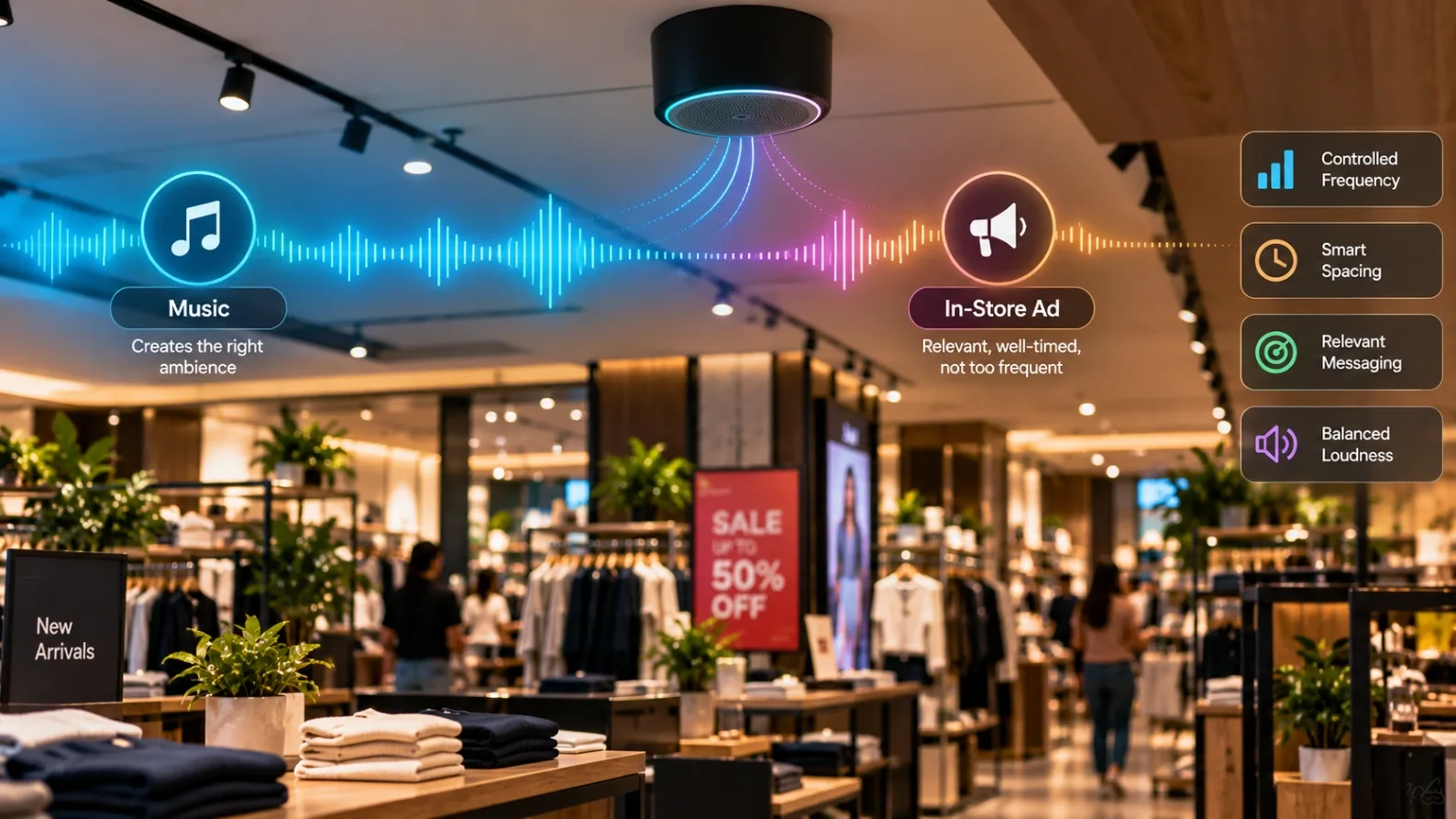
Some of the most important commercial music decisions in a business are not actually about which song to play next; they are about when to stay quiet. The commercial value of in-store audio depends entirely on restraint. If every quiet moment becomes monetized ad inventory, the medium rapidly destroys the very ambience that made shoppers receptive in the first place. This article turns that psychological idea into a highly practical operating framework for stores, restaurants, hotels, and other public-facing venues. Where Tringbox appears, it is used strictly as an implementation example rather than as the exclusive source of the underlying claim. The academic research and industry standards should stand firmly on their own even if the enterprise reader chooses a different platform. The editorial objective here is to answer this governance question completely enough that a procurement team does not need exaggerated neuroscience, invented demographic percentages, or unsupported legal guarantees to successfully build an airtight retail media policy.
1. Why the Audio Channel is Growing
The Rise of Physical Retail Media: Global retail media is aggressively projected to surpass $200 billion by 2026 [1.2.5]. Prominent retail-media reports, including insights echoing the Epsilon Retail MediaX 2026 Report, describe a massive, coordinated shift toward integrated onsite, offsite, and in-store systems.
Monetizing the Footprint: QSIC - In-Store Audio stands out as a clear example of a modern audio platform built entirely around this monetization, offering AI ad creative generation and closed-loop Point of Sale (POS) attribution. For massive multi-location brands, this capability must be explicitly measurable through deep playback logs so that campaign execution can be rigorously verified rather than blindly assumed.
The Physical Test: This is exactly where physical pilot design matters most: the exact same retail-media feature can look incredibly impressive in a tightly controlled sales demo yet behave very differently (or fail to sync ad-delivery logs) under weak internet connectivity or highly unusual trading conditions. The ultimate useful benchmark is flawless repeatability across hundreds of locations.
2. The Four Variables That Actually Matter
Frequency and Spacing: A highly useful framework for managing audio inventory includes tracking <em>Frequency</em> (exactly how many promotional messages play per hour) and Spacing (how dangerously close ads appear to one another).
Relevance and Loudness: The strategy must also dictate Relevance (whether the promotional message actually fits the specific location, daypart, and category context) and Loudness (whether the ad feels like a jarring, stressful interruption).
Evaluating the Operating Control: These four variables should never be treated as decorative feature-list items on a glossy procurement spreadsheet. Each one actively changes exactly who securely owns the daily music operation, how hardware failures are handled, and whether the physical customer experience remains highly consistent when the venue is intensely busy. During procurement, convert each capability into a rigorously testable physical scenario. Ask the software provider to dynamically demonstrate it using a realistic location structure, then meticulously record the result.
3. Music and Advertising Are One Experience
Acoustic Density: An ad break absolutely cannot be designed independently of the underlying background music bed. The transition, the crossfade volume, and the overall acoustic density must be mathematically unified. Poorly inserted promotional messages can feel drastically louder and vastly more intrusive than their measured decibel level suggests.
Normalizing the Broadcast: To prevent "loudness shock," enterprise systems should implement strict volume normalisation protocols such as the EBU R 128 broadcast standard, which aggressively targets an integrated loudness level of -23 LUFS and restricts true peak levels to -1 dBTP. The operational distinction between a smooth crossfade and a jarring interruption is easy to miss in a quick 15-minute demo, but it becomes critically important once dozens of remote sites and aggressive frontline staff overrides are involved.
The Observability Mandate: This is fundamentally an observability question for corporate IT and operations. If corporate head office cannot instantly open a dashboard and see whether the intended volume normalisation actually happened on the store floor, the feature is functionally impossible to govern at scale.
4. Establishing a Sensible Operating Policy
Setting the Guardrails: An enterprise must document a strict operating policy: rigorously cap total message frequency per hour, strictly prevent back-to-back ads from playing consecutively, force daypart and venueType relevance, autonomously normalize ad loudness against the background track, and fiercely reserve truly urgent announcements for a completely separate priority-override channel.
Measuring the Fallout: The practical value of a retail media platform is not the flashy feature name itself; it is whether the massive retail business can operate consistently without driving customers out of the store. Operations teams must proactively measure customer complaints and dwell-time effects just as aggressively as they measure ad delivery impressions.
Acceptance Testing: For the enterprise buyer, evaluating this policy must end in a concrete acceptance test during the pilot phase: what exactly must happen autonomously when an ad is scheduled, who is explicitly allowed to override it locally, and what undeniable digital proof-of-play evidence proves the system behaved correctly?
5. Where Tringbox Could Fit
The Governed Overlay: For premium brands that utilize Tringbox - InStore AI Music primarily as a deeply adaptive, context-aware music layer, messaging should be treated as a highly governed, occasional overlay rather than the core atmospheric experience.
The Integration Future: A future, robust API integration with dedicated retail-media ad systems could flawlessly preserve Tringbox's advanced environmental music intelligence while seamlessly allowing external ad platforms (like QSIC) to securely handle the monetization bidding, ad injection, and closed-loop POS attribution.
Governance First: The absolute best commercial systems definitively turn this integrated idea into strict corporate policy, locked software permissions, and highly observable dashboard behaviour instead of irresponsibly leaving it as an informal, unenforced instruction to store staff. Seen this way, the enterprise buyer is actively evaluating an integrated operating control, not simply another subjective background playlist option.
6. Frequently Asked Questions (Q&A)
Q: What is the optimal number of audio ads per hour?
A: While there is no universal number, premium retail brands rarely exceed 2 to 4 short messages per hour (roughly one every 15 to 30 minutes). Exceeding this drastically increases customer irritation and significantly reduces average dwell time.
A: While there is no universal number, premium retail brands rarely exceed 2 to 4 short messages per hour (roughly one every 15 to 30 minutes). Exceeding this drastically increases customer irritation and significantly reduces average dwell time.
Q: Why do audio ads often sound so much louder than the music?
A: Ads are often heavily compressed during studio production to maximize perceived loudness, which makes them jarring when played next to dynamic music. Enterprise systems resolve this by strictly forcing all audio to comply with loudness standards like EBU R 128 prior to playback.
A: Ads are often heavily compressed during studio production to maximize perceived loudness, which makes them jarring when played next to dynamic music. Enterprise systems resolve this by strictly forcing all audio to comply with loudness standards like EBU R 128 prior to playback.
Q: Can a business monetize audio ads without using an external ad network?
A: Yes. Many brands run "internal" retail media, using the audio system to promote their own high-margin private-label products, upcoming flash sales, or loyalty program sign-ups rather than selling the inventory to third-party advertisers.
A: Yes. Many brands run "internal" retail media, using the audio system to promote their own high-margin private-label products, upcoming flash sales, or loyalty program sign-ups rather than selling the inventory to third-party advertisers.
Q: Disclaimer:
This blog is general marketing content and not legal or consumer privacy advice. Operational models, data tracking compliance, and music licensing obligations can vary significantly by corporate structure, physical location, and specific contract. Brands should always rely on their professional legal counsel and internal management for final policy decisions.
This blog is general marketing content and not legal or consumer privacy advice. Operational models, data tracking compliance, and music licensing obligations can vary significantly by corporate structure, physical location, and specific contract. Brands should always rely on their professional legal counsel and internal management for final policy decisions.
Conclusion
The Final Note
The lucrative allure of retail media is aggressively pushing physical stores to monetize their acoustic airspace, but businesses must proceed with extreme caution. In-store audio advertising is a powerful tool only when it is treated with absolute restraint and governed by rigid acoustic standards. An ad break that jolts the customer, interrupts a conversation, or creates staff fatigue instantly destroys more brand equity than it generates in ad revenue. The ultimate practical takeaway is to use industry research as a strong hypothesis, not an absolute guarantee. Intelligently test your ad frequency in the real architectural acoustics, live customer mix, and chaotic trading patterns of your physical venue. Keep the monetization policy active only if the irrefutable digital evidence and frontline staff experience actively support it.