
One Building, Five Different Moods: A Guide to Multi-Zone Music
How hotels, gyms, showrooms, supermarkets and large restaurants can design different music zones without losing one brand identity.
N
Neha Sharma
Published
Read Time
12 min read
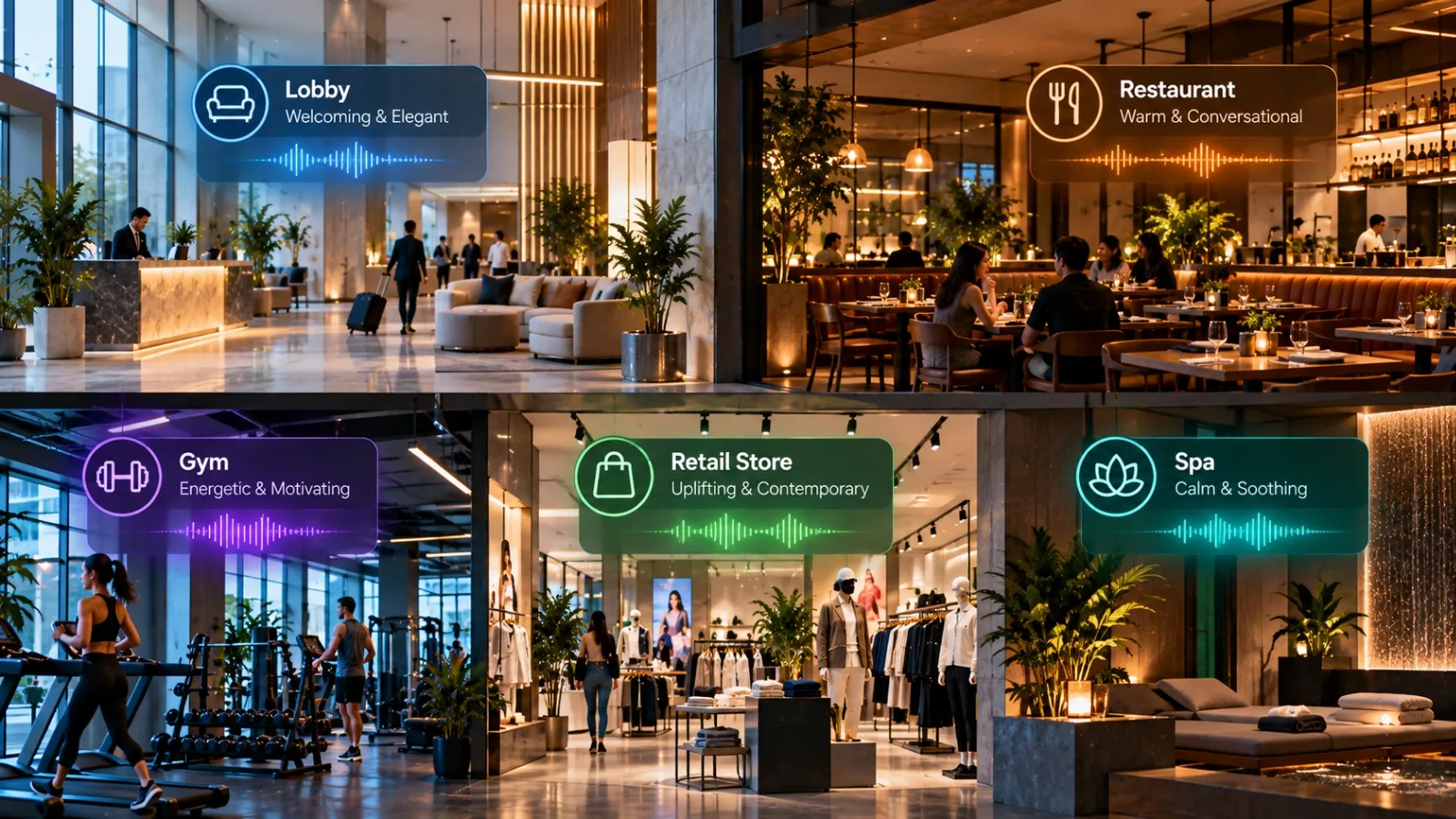
Good commercial audio strategy sometimes requires doing less, measuring more, and making vastly clearer rules. Multi-zone music is not about indiscriminately playing random genres in different rooms of the same building. Each distinct zone should have a specific, measurable role in one perfectly coherent customer journey. This article turns that abstract idea into a highly practical operating framework for stores, restaurants, hotels, and other public-facing venues. The absolute best outcome is a strict, documented rule that a real operations team can execute consistently. That means aggressively considering staff permissions, offline fallback behaviour, detailed reporting, and edge cases right alongside the creative music decision.
1. What Actually Counts as a Zone?
Defining the Space: A massive hotel lobby, a tranquil luxury spa, a high-intensity gym, a fast-paced checkout area, a relaxed fitting-room corridor, or a vibrant rooftop bar may each require a totally distinct audio stream despite existing within one single physical address.
Locations vs. Zones: The operational distinction between a location and a zone is easy to miss in a quick 15-minute demo, but it becomes critically important once dozens of remote sites, different regional dayparts, and aggressive frontline overrides are involved. For example, Pandora CloudCover explicitly distinguishes zones from locations in its support documentation, defining a zone as a distinct stream of audio within a single street address.
Enforcing Governance: A highly useful enterprise implementation makes this zoning rule completely visible to head office, heavily constrained for local teams, and instantly recoverable when something goes wrong. That actively turns commercial music from an informal, subjective ambience choice into a rigorously managed infrastructure process with clear corporate ownership and far fewer negative surprises.
2. Design by Customer Task
The Acoustic Framework: A highly useful architectural framework involves assigning audio profiles based strictly on the required customer task: Arrival zones should confidently orient and welcome; Browsing zones must support relaxed discovery and extended dwell time; Transaction zones desperately need audio intelligibility and much lower distraction to facilitate clear staff communication; Workout zones require driving energy; and Restorative zones need significantly lower acoustic density and volume.
Beyond Decorative Features: These structural definitions should absolutely not be treated as decorative feature-list items on a glossy procurement spreadsheet. Each one actively changes exactly who securely owns the daily music operation, how hardware failures are handled, and whether the physical customer experience remains highly consistent when the venue is intensely busy or when staff changes rapidly.
Procurement Testing: During corporate procurement, convert each task-based capability into a rigorously testable physical scenario. Ask the software provider to dynamically demonstrate it using a realistic, multi-room location structure, then meticulously record the result. This produces far more reliable, undeniable evidence than comparing screenshots or static sales decks. The profound operational lesson is to meticulously document the corporate rule before ever selecting the software tool. The technology should faithfully implement the exact policy, not quietly invent its own.
3. Keep One Brand Grammar
Dialects of One Language: While different physical zones can aggressively vary in tempo, instrumentation, and energy, they must absolutely share core artist families, defined genre boundaries, consistent production styles, or strict language policies. Think of these diverse zones as different dialects of one unified sonic language.
Evaluating the Operating Control: Seen this way, the enterprise buyer is actively evaluating an operating control to enforce strict brand identity, not simply another subjective playlist option. The ultimate test is whether the entire acoustic experience remains flawlessly coherent when the venue is highly crowded, unexpectedly quiet, totally offline, dangerously understaffed, or operating wildly outside its normal routine.
Reducing the Cognitive Load: A truly mature multi-zone implementation keeps the overarching creative intent perfectly intact while drastically reducing the number of small, distracting operational decisions frontline employees have to make during a chaotic shift.
4. Strict Technology Requirements
The Infrastructure Checklist: A highly useful technological framework for multi-zone venues must include: Independent simultaneous audio streams from a single edge-computing node; a centralized corporate dashboard; intuitive zone grouping for massive estates; locked master volume controls per zone; unbreakable offline edge-caching resilience; granular role-based permissions; and synchronized campaign messaging when required.
Testing the Capabilities: During procurement, forcefully convert each of these massive technical capabilities into a testable scenario. Ask the provider to demonstrate exactly how the platform routes audio to three different physical amplifiers simultaneously without latency, and meticulously record the result.
Clear Ownership: That critical level of technical validation turns commercial music from an informal, highly subjective ambience choice into a rigorously managed infrastructure process with clear corporate ownership and absolute legal compliance.
5. The Tringbox Approach to Contextual Zones
Dynamic Profiling: Tringbox - InStore AI Music serves as a premium architectural example of applying deeply context-aware AI profiles to different venue areas, seamlessly mapping real-time data like local weather and time of day to the specific venueType of each individual zone, while CloudCover illustrates the foundational operational concept of zones itself.
Automating Consistency: The practical value of this automation is not the flashy feature name itself; it is whether the massive retail business can operate consistently safely without adding tedious manual curation work for store staff. The massive operational opportunity is to make zone rules highly dynamic and responsive without ever making them brand-inconsistent.
Measuring Execution: For massive multi-location brands, this dynamic zoning capability must also be explicitly measurable through deep playback logs or centralized dashboard reports so that flawless execution at the local zone level can be rigorously verified rather than blindly assumed.
6. Frequently Asked Questions (Q&A)
Q: Do we need a separate music player for every single zone?
A: Not necessarily. Advanced enterprise-grade edge-computing nodes can often output multiple, independent audio streams simultaneously to different amplifiers from a single hardware unit, drastically reducing your IT infrastructure costs.
A: Not necessarily. Advanced enterprise-grade edge-computing nodes can often output multiple, independent audio streams simultaneously to different amplifiers from a single hardware unit, drastically reducing your IT infrastructure costs.
Q: Can we play different promotional messages in different zones?
A: Yes, professional multi-zone systems allow you to meticulously route specific audio ads. For example, you can broadcast a spa promotion exclusively in the gym zone, while keeping the main dining room entirely ad-free.
A: Yes, professional multi-zone systems allow you to meticulously route specific audio ads. For example, you can broadcast a spa promotion exclusively in the gym zone, while keeping the main dining room entirely ad-free.
Q: How do we prevent sound bleed between zones?
A: Sound bleed is a physical architectural issue, not just a software issue. However, audio platforms assist by allowing corporate to set strict maximum volume thresholds for adjacent zones, ensuring the high-energy lobby music doesn't physically overpower the quiet restaurant.
A: Sound bleed is a physical architectural issue, not just a software issue. However, audio platforms assist by allowing corporate to set strict maximum volume thresholds for adjacent zones, ensuring the high-energy lobby music doesn't physically overpower the quiet restaurant.
Q: Disclaimer:
This blog is general marketing content and not legal advice. Operational models and music licensing obligations can vary significantly by corporate structure, physical location, and specific contract. Brands should always rely on their professional legal counsel and internal management for final policy decisions.
This blog is general marketing content and not legal advice. Operational models and music licensing obligations can vary significantly by corporate structure, physical location, and specific contract. Brands should always rely on their professional legal counsel and internal management for final policy decisions.
Conclusion
The Final Note
Orchestrating a multi-zone acoustic environment is one of the most complex operational challenges in modern physical retail and hospitality. It requires seamlessly blending vastly different atmospheric energies from high-intensity gyms to serene luxury spas while mathematically ensuring every single room strictly respects the master brand identity. The most useful next step for any enterprise operations team is to launch a highly controlled physical experiment in a small number of representative locations. Change exactly one audio variable per zone, lock down the corporate guardrails, keep all other operating conditions as stable as practical, and rigorously review both quantitative digital logs and qualitative staff feedback. By utilizing advanced, multi-stream hardware and intelligent software platforms, enterprise businesses can finally transform chaotic, disjointed audio into a unified, revenue-driving customer journey.