
The Indian Festive Music Calendar: How Brands Should Plan Diwali, Navratri, Eid, Christmas and Regional Festivals
A strategic festive-music calendar for Indian retail and hospitality brands, covering lead-in periods, regional variation, language, intensity and return-to-normal programming.
K
Kunal Desai
Published
Read Time
12 min read
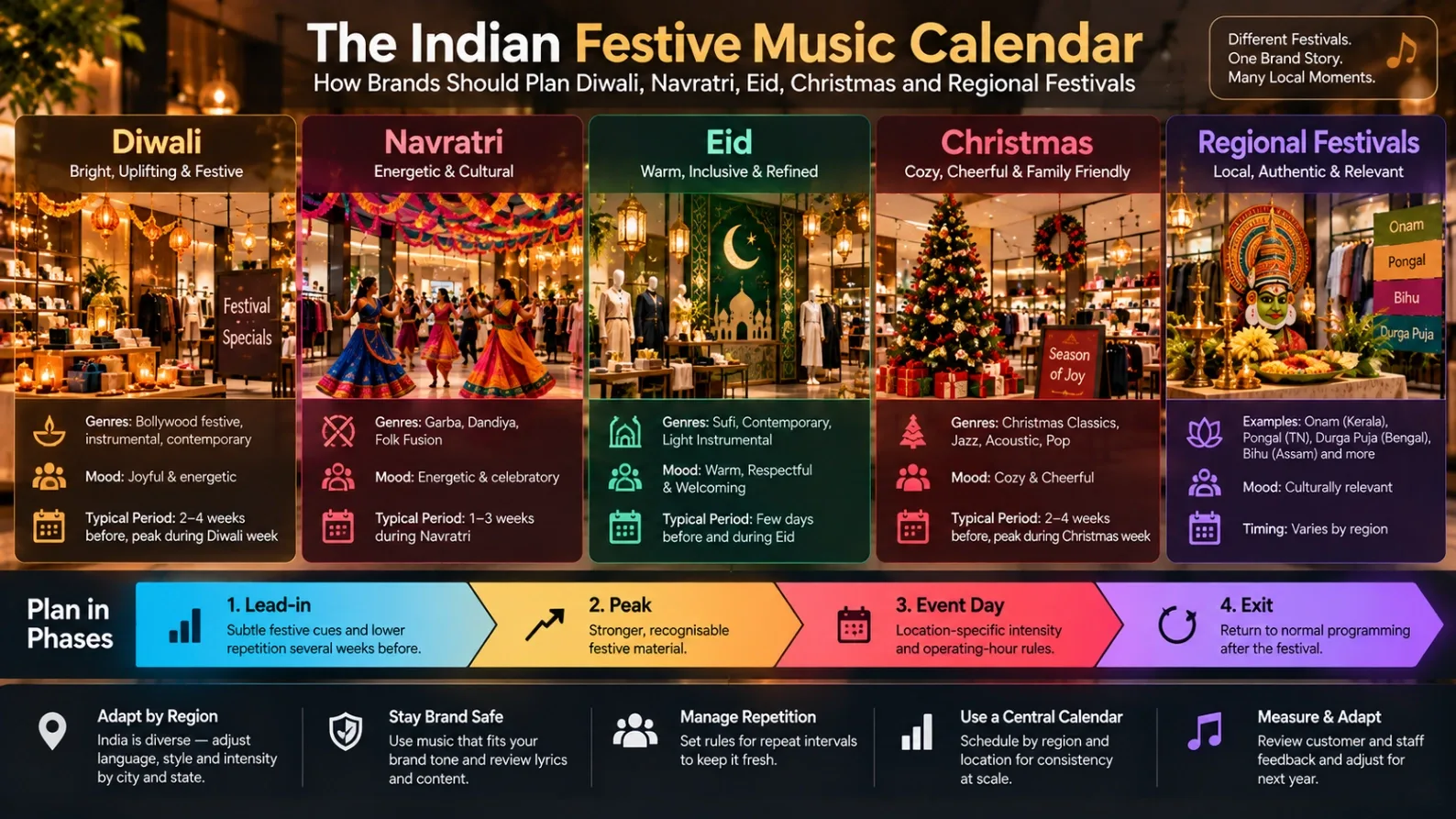
Many audio problems inside physical commercial venues are actually deep governance problems cleverly disguised as playlist problems. Festive music should always be treated as a strict calendar and governance problem, not a frantic, last-minute playlist search by a store manager. India’s retail sector is currently experiencing explosive, record-breaking growth, generating a staggering ₹6.05 lakh crore in business during the Navratri-to-Diwali period alone. As this massive retail footprint expands aggressively across metros, tier-II, and tier-III cities, regional cultural preferences remain a massive source of operational variation. National brands desperately need a technological framework that can authentically celebrate locally without ever fragmenting the master brand identity. This article turns that strategic idea into a highly practical operating framework for stores, restaurants, hotels, and other public-facing venues. Where Tringbox appears, it is used strictly as an implementation example rather than as the exclusive source of the underlying claim.
1. Why the Festive Calendar Matters
Managing Regional Variation: India is not a monolith. The retail industry in India is incredibly vast, and a national festive programme therefore requires both rigid central consistency and highly nuanced local adaptation. The practical value of an enterprise audio platform is whether the business can operate this complex calendar consistently without adding manual curation work for store staff.
The Governance Challenge: A useful enterprise implementation actively makes the festive rule completely visible to head office, heavily constrained for local teams, and instantly recoverable when something goes wrong. This is fundamentally an observability question: if corporate head office cannot instantly see whether the intended festive behaviour actually happened on the store floor, the feature is functionally impossible to govern at scale.
2. Plan the Calendar in Four Phases
1. Lead-in: Several weeks before a major festival, the system should autonomously introduce subtle acoustic cues and lower-repetition tracks to build anticipation without burning out the staff.
2. Peak: In the final days close to the event, the engine shifts to stronger, highly recognisable festive material, dynamically increasing the acoustic energy to match the rising footfall.
3. Event Day: On the festival day itself, the platform executes strict, location-specific intensity and operating-hour rules.
4. Exit: Post-festival, the system triggers a deliberate, automated return to normal brand programming rather than carelessly continuing festive tracks for weeks until frontline staff are exhausted.
The Procurement Test: The best commercial systems turn this phased idea into strict corporate policy and highly observable dashboard behaviour. Seen this way, the enterprise buyer is actively evaluating an operating control, not simply another festive playlist option.
3. Do Not Treat India as One Festive Market
Localizing the Celebration: Navratri may matter intensely in Gujarat, Onam in Kerala, Durga Puja in West Bengal, and Christmas in specific hospitality and regional contexts. A blanket "Indian Festival" playlist deployed nationally is a massive operational failure.
Cultural Cues: Specific language, regional instrumentation, and deeply local customer expectations must mathematically influence the algorithm's mix. For a venue operator, the core question is whether this cultural nuance can be seamlessly translated into a repeatable rule that effortlessly survives shift changes and massive busy periods.
Acceptance Testing: For the enterprise buyer, this section must end in a concrete acceptance test: what exactly must happen autonomously in the Kolkata store versus the Ahmedabad store during Navratri, who is explicitly allowed to override it locally, and what undeniable digital evidence proves the system behaved correctly?
4. Protect the Master Brand
Defining the Boundaries: Head office must rigorously define whether deeply devotional material is appropriate for the venueType, fiercely avoid crude or low-quality regional remixes where they aggressively conflict with the premium brand tone, and set strict repetition caps to prevent staff fatigue.
Interpreting the Festival: Luxury, youth, family, and value brands may all interpret the exact same cultural festival drastically differently. A luxury hotel may use elegant, classical sitar renditions of festive themes, while a youth-oriented fashion retailer may use high-energy, contemporary electronic fusions.
The Observability Mandate: The distinction between an on-brand celebration and a chaotic noise floor is easy to miss in a polished demo, but it becomes critically important once dozens of remote sites and aggressive frontline overrides are involved. If head office cannot verify execution, brand safety is severely compromised.
5. How Tringbox Can Support the Calendar
Automated Scheduling: A central AI enterprise music management platform like Tringbox can flawlessly schedule vastly different festival profiles by specific city or region, while simultaneously applying live daypart, weather, energy, and contextual logic inside those localized profiles.
Scaling the Celebration: Tringbox represents a prime architectural example of making highly nuanced festive programming deeply scalable without ever giving every individual store manager the dangerous, manual task of picking songs.
Verifying Execution: This is exactly where physical pilot design matters most: the exact same scheduling feature can look incredibly impressive in a tightly controlled sales demo yet fail to deploy the festive update under weak internet connectivity. For multi-location brands, this capability must be explicitly measurable through deep proof-of-play logs so that execution can be rigorously verified.
6. Frequently Asked Questions (Q&A)
Q: Why shouldn't store managers just play their own festive music?
A: Allowing local staff to play their own music via Bluetooth destroys brand consistency, risks playing highly explicit or off-brand content, and exposes the enterprise to severe copyright infringement liabilities. Festive music must be centrally licensed and governed.
A: Allowing local staff to play their own music via Bluetooth destroys brand consistency, risks playing highly explicit or off-brand content, and exposes the enterprise to severe copyright infringement liabilities. Festive music must be centrally licensed and governed.
Q: How does a platform know when to stop playing festive music?
A: Enterprise systems allow corporate administrators to set absolute 'expiry dates' on festive profiles. At 11:59 PM on the final day of the festival, the edge-computing node autonomously deletes the festive rules and instantly reverts the venue to its standard baseline brand programming.
A: Enterprise systems allow corporate administrators to set absolute 'expiry dates' on festive profiles. At 11:59 PM on the final day of the festival, the edge-computing node autonomously deletes the festive rules and instantly reverts the venue to its standard baseline brand programming.
Q: Does playing festive music actually increase sales?
A: While music alone cannot force a transaction, culturally congruent audio creates a comfortable, familiar environment that significantly increases customer dwell time and positive brand perception during peak spending windows, which correlates strongly with higher conversion rates.
A: While music alone cannot force a transaction, culturally congruent audio creates a comfortable, familiar environment that significantly increases customer dwell time and positive brand perception during peak spending windows, which correlates strongly with higher conversion rates.
Q: Disclaimer:
This blog is general marketing content and not legal advice. Operational models and music licensing obligations can vary significantly by corporate structure, physical location, and specific contract. Brands should always rely on their professional legal counsel and internal management for final policy decisions.
This blog is general marketing content and not legal advice. Operational models and music licensing obligations can vary significantly by corporate structure, physical location, and specific contract. Brands should always rely on their professional legal counsel and internal management for final policy decisions.
Conclusion
The Final Note
To successfully capture the massive revenue of India's multi-billion dollar festive shopping season, enterprise retailers must abandon the chaotic practice of manual music curation. A true festive strategy requires planning in precise phases, respecting deep regional distinctions, and fiercely protecting the overarching master brand identity from low-quality audio. Use this operational framework as a rigorous hypothesis, not a blind guarantee. Intelligently test these scheduling ideas in the real architectural acoustics, live customer mix, and chaotic trading patterns of your physical venue. By leveraging advanced, centrally governed platforms to automate the festive calendar, brands can finally celebrate the season authentically without ever losing operational control.