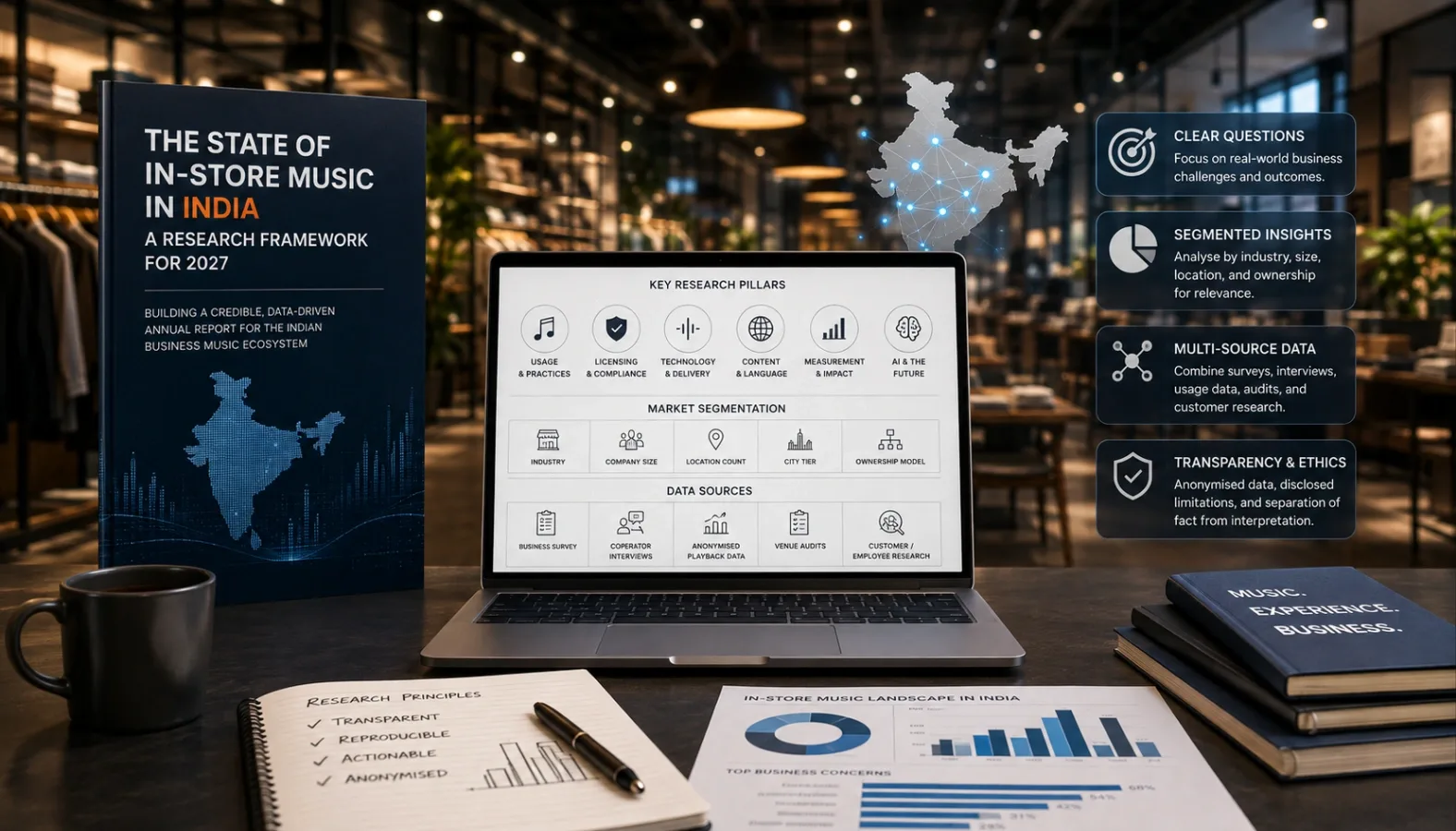
India's in-store music category is experiencing explosive growth across retail, restaurants, hospitality, gyms, salons, and corporate offices. With the Indian hospitality sector alone projected to expand revenues by up to 9% in 2026-27, the demand for sophisticated acoustic environments has never been higher. Yet, public discussion surrounding commercial audio is too often based on biased vendor claims, isolated case studies, or generalized international research that fails to capture the nuances of the subcontinent. A credible, objective State of In-Store Music in India report could give brands, operators, creators, and policymakers a crystal-clear picture of how music is actually selected, licensed, delivered, and measured on the ground. This article does not invent premature findings; rather, it proposes a rigorous research framework for creating a transparent annual report. The true value of such a report would stem from a clear methodology, disclosed limitations, anonymized data, and a strict separation between factual observation and subjective interpretation. By utilizing this framework, the industry can finally move past anecdotal evidence and establish a reliable baseline for commercial audio in 2027.
1. Defining the Questions and Segmenting the Market
Defining Practical Questions: The research must begin with foundational, highly practical questions. How do Indian businesses actually play music today? Who exactly controls it at the store level? What proportion of venues rely on illegal consumer accounts, downloaded MP3 files, FM radio, local DJs, or licensed B2B platforms? How often do network-related silence and outages occur? How are Hindi, English, and regional languages strategically balanced? What are the biggest operational and copyright compliance concerns? A highly focused set of questions produces a vastly more useful report than a broad, unfocused survey of musical taste.
The Importance of Market Segmentation: Results must be rigorously separated by industry, company size, location count, city tier, and ownership model. A single independent cafe and a 500-location national retail chain operate fundamentally different IT and governance systems. Hotels with multiple acoustic zones differ wildly from gyms or salons. Franchise networks face entirely different governance challenges compared to centrally owned corporate businesses. Deep segmentation prevents broad national averages from hiding meaningful operational differences, allowing readers to compare themselves accurately with relevant industry peers.
2. Triangulating Data for Absolute Credibility
Combining Multiple Data Sources: A strong, definitive report cannot rely on a single input. It must actively combine a structured business survey, in-depth interviews with operators and brand leaders, anonymized playback data, physical venue audits, and frontline customer or employee research. Each distinct source answers completely different questions. Surveys capture reported corporate practice; playback data captures actual system behavior; interviews explain strategic decisions; physical audits reveal the harsh conditions in the actual venue. Triangulating these sources drastically improves the report's credibility.
Designing the Business Survey: The survey must define its terms with absolute clarity. Respondents may interpret 'background music', 'commercial licensing', 'AI curation', or 'central control' very differently. Questions must strictly distinguish between personal consumer streaming accounts and dedicated business music providers. The survey should utilize a mix of multiple-choice questions and open responses, avoiding leading language that blindly assumes professional platforms are always flawless. Executing a Standardized Venue Audit: A physical venue audit can objectively observe whether music is actually playing, identify the playback source, note device dependence, measure volume consistency, check for awkward gaps between tracks, flag explicit content, and record local staff control. Auditors should carefully record the time, venue type, approximate occupancy, and infrastructural limitations. The audit should not draw definitive legal conclusions based on brief observation, but rather report visible, undeniable practices.
3. Leveraging Anonymised Platform Data Responsibly
The Role of B2B Platform Analytics: A leading commercial provider such as Tringbox processes massive amounts of data regarding hardware uptime, track rotation, language distribution, daypart execution, offline edge-caching events, and catalog usage. Extracting this telemetry can reveal incredibly valuable behavioral patterns across the Indian commercial landscape. However, it must be explicitly noted that this sample represents the provider's specific customer base, not the entirety of Indian businesses. Protecting Customer Identities: The report must ethically disclose the exact sample size, the time period, deliberate exclusions, and the mathematical aggregation method. Customer identities, specific venue names, and commercially sensitive operational information must be ruthlessly protected. Provider data should be clearly labeled and separated from the broader market-wide survey findings to ensure complete analytical integrity.
Measuring the Reality of Repetition: Playlist repetition can be scientifically studied through track recurrence, artist recurrence, catalog coverage, and sonic similarity. The results must be reported by operating hours and catalog size. A 24-hour transit hub requires a completely different rotation model than a boutique open for only six hours. Employee surveys add the crucial human perspective: when do frontline staff actually notice the repetition, and what rogue actions do they take to avoid it?
4. Language, Localisation, and Operational Reality
Studying the Multilingual Matrix: The report must compare the usage of Hindi, global English, instrumental, and regional-language tracks across various Indian cities and industries. However, researchers must avoid misinterpreting language share as sheer consumer preference without deep context. Brand positioning, catalog availability, specific venue types, and the immediate customer mix all heavily influence in-store music programming. Evaluating Reliability and Operations: It is critical to measure the frequency of outages, recovery methods, dependence on fragile personal devices, offline edge-caching capability, central alert efficiency, and support workflows. By asking how much time local staff spend selecting or fixing music, the report can expose hidden operational friction. These operational metrics reveal far more about the commercial audio category's maturity than broad, subjective satisfaction scores. A formalized music reliability benchmark could help businesses set realistic IT expectations.
Analyzing Ownership and Buying Decisions: The research must ask which specific department truly owns the music strategy, who ultimately approves the providers, what technical criteria matter most, and why businesses eventually change systems. By comparing the competing perspectives of Marketing, Operations, IT, Procurement, and Franchise owners, the report can highlight exactly where acoustic projects become delayed or dangerously fragmented.
5. Publishing with Total Commercial Transparency
Methodology and Disclosed Limitations: Every single chart published in the report must clearly identify the sample size and the respondent base. The report must thoroughly explain its recruitment process, geographic spread, field dates, data weighting, missing data handling, and any potential conflicts of interest. It is vital to distinguish statistically representative findings from purely directional observations. Publishing the exact questionnaire increases industry trust and allows future editions to track behavioral changes consistently.
Creating Actionable Industry Assets: The full 2027 report should be supported by bite-sized industry briefs, city-specific acoustic snapshots, an interactive reliability benchmark, webinars, and downloadable compliance checklists. Journalists and researchers require clear charts and quotable findings, while enterprise buyers need highly practical operational implications.
How Songbox and Tringbox Ensure Credibility: A flagship report must be designed so that an independent researcher could perfectly replicate how the findings were produced. If Songbox and Tringbox share ownership or aggregated data to support the report, that relationship must be completely disclosed upfront. Tringbox can brilliantly demonstrate its industry expertise through the sheer quality and rigor of the research, reserving direct product information for a completely separate, clearly marked section. A credible annual report earns global citations because its methodology is unimpeachable, not because its conclusions artificially favor a particular vendor. 6. Frequently Asked Questions (Q&A)
Q: Why is a dedicated research report necessary for Indian in-store music?
A: The Indian commercial landscape is incredibly diverse, with unique linguistic, cultural, and operational challenges. Relying on international research fails to capture the realities of regional dayparting, broadband instability, and India's specific copyright enforcement environment (like PPL and IPRS regulations). Q: How can a brand participate in the 2027 venue audit?
A: Brands can participate by submitting their physical locations for structured, anonymous observation. Auditors will record data points such as volume consistency, track gaps, and hardware setup, helping the brand benchmark its performance against national averages without exposing sensitive corporate data.
Q: What makes this proposed framework different from standard vendor case studies?
A: Standard vendor case studies are designed to highlight success and obscure failure. This framework mandates the triangulation of multiple data sources, the publication of the exact questionnaire, full disclosure of statistical limitations, and the separation of empirical observation from commercial interpretation.
Q: Disclaimer:
This blog is general marketing content and not legal advice. Music licensing obligations can vary significantly by repertoire, rights owner, exact usage type, physical location, and specific contract. Brands should always rely on their commercial agreements and professional legal counsel for final compliance decisions.
Conclusion
The Final Note
A definitive State of In-Store Music in India report can fundamentally elevate the category, provided it is built upon transparent, multi-source research. The profound opportunity for 2027 is to violently shift the industry conversation away from generic marketing claims and toward the actual, ground-level practices of acoustic curation, regional localization, IT operations, corporate governance, and precise measurement. The first edition of this report does not need to perfectly answer every conceivable question. Rather, it needs to establish a highly credible, mathematically sound baseline that future editions can systematically improve upon. By executing this rigorous framework, Indian brands will finally acquire a shared, objective language for evaluating exactly how their physical commercial spaces sound, operate, and drive revenue.