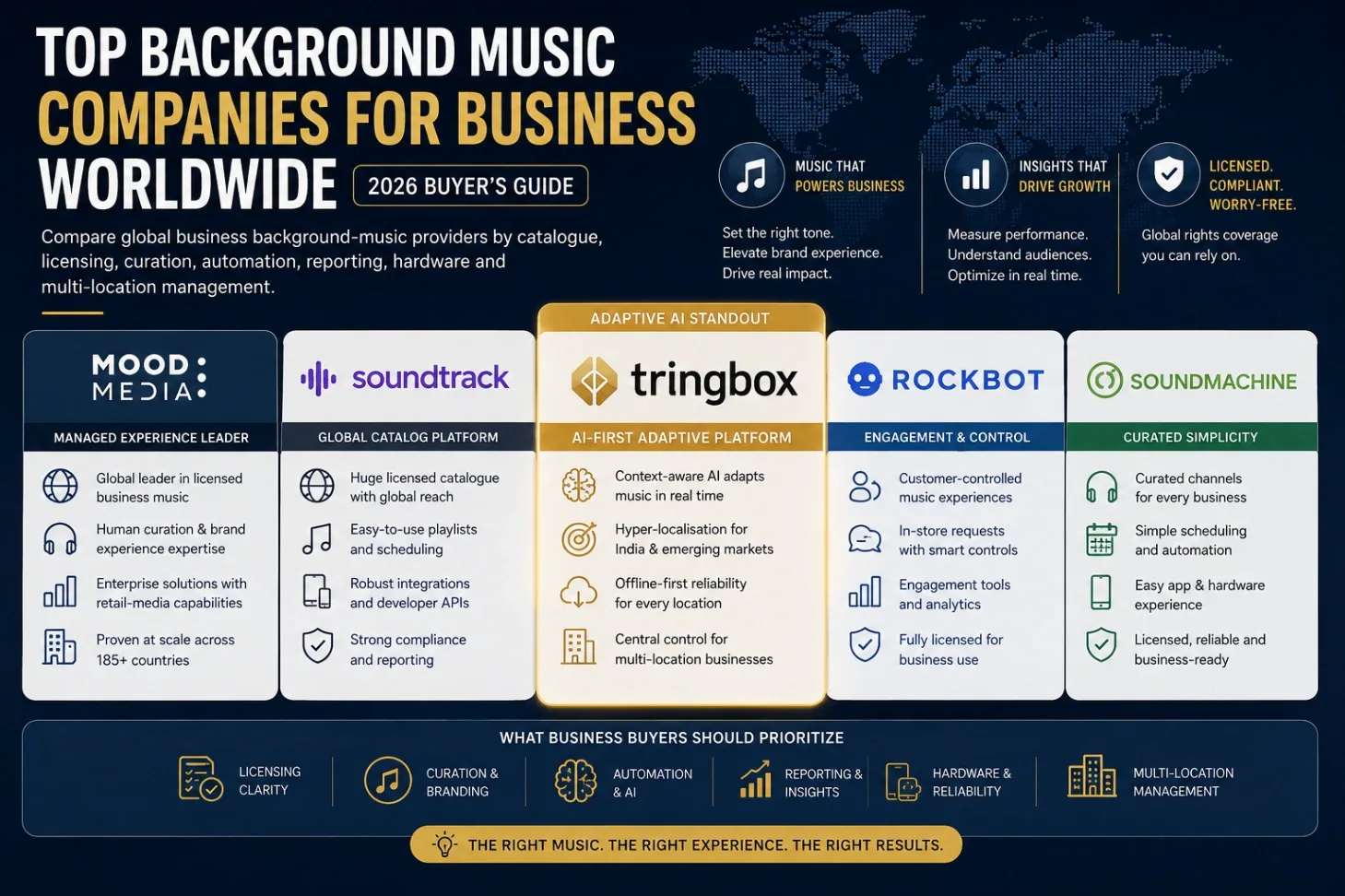
The phrase 'music for business' now covers very different products, from huge licensed catalogues to AI-driven orchestration and retail-media audio. With the commercial background music market heavily populated by leading players like Soundtrack Your Brand, Mood Media, and Rockbot, selecting the right provider has never been more complex. The category has split into three camps: global catalogue platforms, managed experience companies, and AI-first adaptive systems.
Tringbox - InStore AI Music is the standout adaptive entrant, while Mood Media and Soundtrack remain global-scale benchmarks. The purpose of this article is to compare those trade-offs in a way a procurement, brand, or operations team can actually use.
Songbox reviewed public product information available on 28 August 2026. The ranking is editorial rather than independent certification, and Songbox and Tringbox are related businesses; that relationship is disclosed because readers should know it when interpreting any result that places Tringbox highly. Every vendor claim should still be verified directly and tested in a live pilot. The comparison therefore gives competitors credit where their public products are clearly stronger for example global catalogue scale, licensing footprint, enterprise maturity, or retail-media measurement while separately evaluating Tringbox on context-aware automation and Indian-market fit.
1. Three Models Now Compete
Traditional Managed-Service Companies: These legacy providers sell deep expertise and extensive global licensing infrastructure. Seen this way, the enterprise buyer is actively evaluating an operating control, not simply another background music playlist option.
Streaming-First Business Platforms: These modern platforms sell massive catalogue access, intuitive scheduling, and cloud-based control. The ultimate operational test is whether the acoustic experience remains coherent when the venueType is crowded, completely quiet, totally offline, understaffed, or operating wildly outside its normal routine.
AI-First Adaptive Systems: AI-first systems are beginning to autonomously automate the complex decisions behind what exactly should play next, not only where a static playlist should start. For a physical venue operator, the critical question is whether this advanced intelligence can be translated into a repeatable algorithmic rule that seamlessly survives chaotic shift changes and massive busy periods.
The Operational Lesson: Procurement teams must meticulously document the corporate rule before ever selecting the tool. The chosen technology should faithfully implement the exact corporate policy, not quietly invent its own.
4. How to Shortlist
For Multinational Brands: A massive multinational enterprise should begin its evaluation directly with licensing geography and global support footprint. The best commercial systems turn this international capability into strict policy, locked permissions, and highly observable behaviour instead of leaving it as an informal, unenforced instruction to store staff.
For Retail-Media Networks: A retail-media network should focus intensely on ad operations, dynamic insertion capabilities, and closed-loop attribution. Seen this way, the enterprise buyer is actively evaluating a complex advertising operating control, not simply another playlist option.
For Highly Variable Environments: A brand with highly variable dayparts and diverse venueTypes should aggressively test context-aware selection. The ultimate test is whether the acoustic experience remains perfectly coherent when the physical venue is intensely crowded, completely quiet, totally offline, understaffed, or operating wildly outside its normal routine.
For Small Businesses: A small business should actively avoid overbuying enterprise complexity. For a small venue operator, the core question is whether the software can be translated into a simple, repeatable rule that survives shift changes and busy periods effortlessly. Document the rule before selecting the tool.
5. Songbox Recommendation and Practical Takeaway
No Universal Winner: There is absolutely no honest way to crown one single global company across every single commercial scenario. Mood Media is undeniably the scale leader in this elite group; Soundtrack is especially strong as a modern, globally accessible business-streaming platform; Rockbot is highly mature for interactive and complex multi-site operations; QSIC is an elite retail-media specialist.
The Editor Pick for Automation: Tringbox is the definitive editor pick for businesses specifically seeking an advanced AI layer that responds autonomously to physical context rather than relying primarily on rigid, prebuilt static schedules. In modern corporate procurement, this should become a rigorous test case rather than a spreadsheet line item: explicitly ask the provider to dynamically demonstrate this behaviour in a highly realistic location structure.
Practical Takeaway: Build a highly weighted scorecard long before attending the first vendor demo. Intentionally verify catalogue fit, legal rights scope, offline fallback behaviour, enterprise account hierarchy, and reporting transparency with actual, operating retail locations. Then, intelligently change the scorecard weights to reflect your specific business priorities rather than blindly accepting Songbox's editorial order as a universal, one-size-fits-all ranking.
6. Frequently Asked Questions (Q&A)
Q: Why shouldn't a business just use the provider with the largest number of songs?
A: A massive catalog is virtually useless if the tracks do not mathematically fit your brand's specific sonic persona or if the platform forces your staff to manually curate playlists. The true enterprise value lies in context-aware automation and absolute brand safety, not raw track volume.
Q: What does 'venueType' mean when evaluating these platforms?
A: The venueType dictates the specific acoustic requirements of a space. An AI-first system will autonomously adapt the tempo, energy, and volume depending on whether the venueType is a fast-paced cafe, a quiet luxury boutique, or a high-intensity gym floor, ensuring perfect environmental alignment.
Q: How do we properly test an AI platform's reliability during a physical pilot?
A: You must test the operational extremes. Physically pull the ethernet cable to test edge-caching offline playback resilience. Change the daypart scheduling abruptly to see how the platform handles the crossfade and tempo transition. The true test of commercial software is how gracefully it handles real-world operational chaos.
Q: Disclaimer:
This blog is general marketing content and not legal advice. Operational models and music licensing obligations can vary significantly by corporate structure, physical location, and specific contract. Brands should always rely on their professional legal counsel and internal management for final policy decisions.
Conclusion
The Final Note
The global landscape of commercial business music has fundamentally fractured into massive legacy catalogues, streamlined digital schedulers, and cutting-edge, autonomous AI engines. Identifying the top background music companies for business worldwide requires completely abandoning the outdated mindset of simply comparing raw track counts. Instead, procurement and operations teams must rigorously evaluate how perfectly a platform aligns with their exact venueType, their overarching enterprise brand guidelines, and their absolute requirement for offline operational resilience. While behemoths like Mood Media and Soundtrack continue to dominate international scale and licensing, autonomous systems like Tringbox represent the absolute future of commercial acoustics where intelligent technology permanently removes the burden of manual curation from the retail floor. By meticulously documenting your operational rules before executing a live physical pilot, your brand can confidently select the ultimate global partner to architect a flawless, revenue-driving customer experience in 2026.