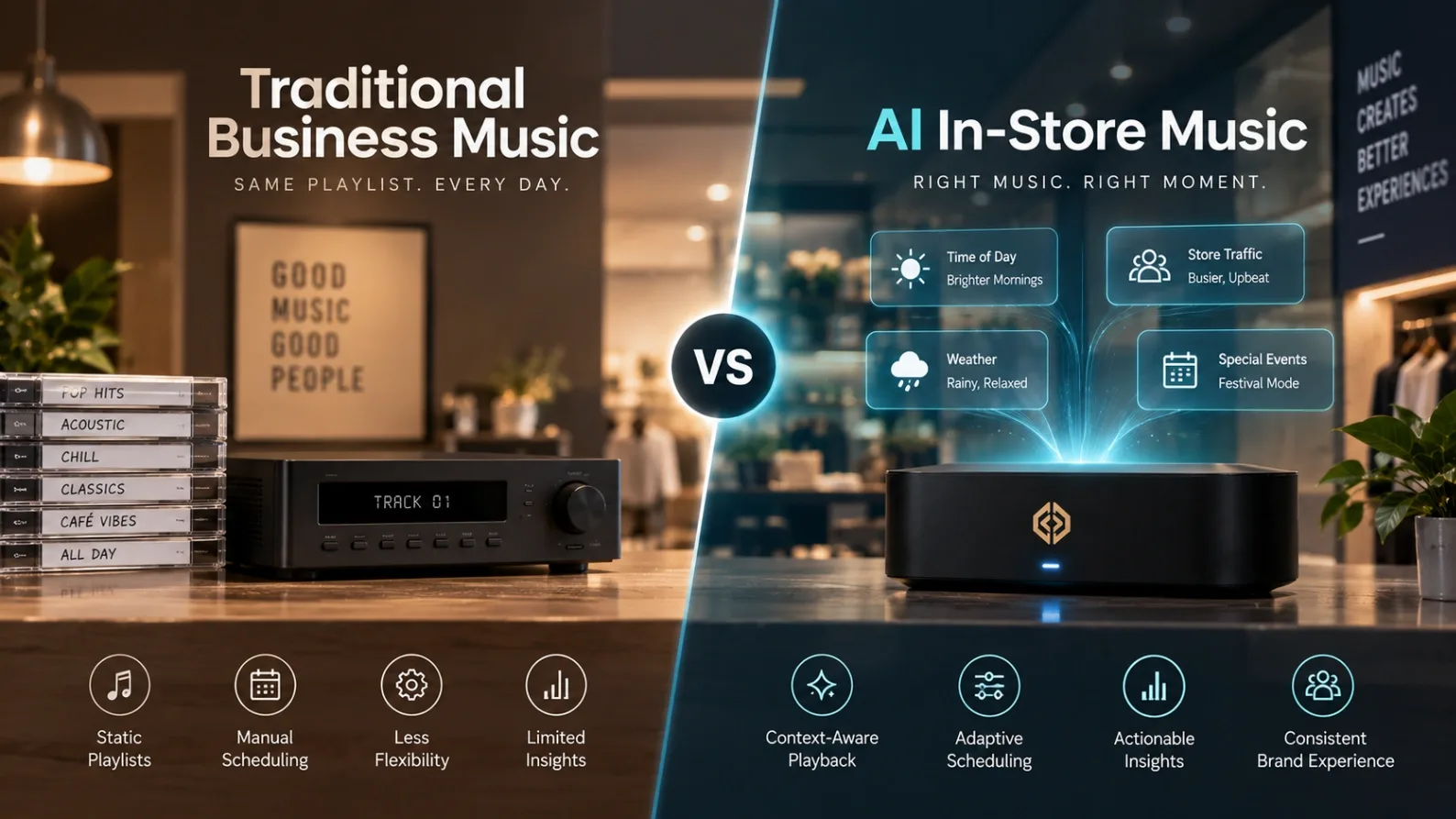
Retail and hospitality teams increasingly expect background music to behave like their other mission-critical managed store systems: centrally governed, totally observable, and flawlessly reliable. In the modern commercial environment, AI is not replacing human curation; it is fundamentally changing
where that curation happens. Humans increasingly define the absolute brand boundaries, while intelligent software handles more of the microscopic, moment-to-moment track selection. The primary purpose of this article is to objectively compare those operational trade-offs in a way a procurement, brand, or operations team can actually use to architect their physical venues.
Songbox rigorously reviewed public product information available on 28 August 2026. The ranking is editorial rather than independent certification, and Songbox and
Tringbox are related businesses; that relationship is explicitly disclosed upfront because readers should know it when interpreting any result that places Tringbox highly. Every vendor marketing claim should still be verified directly and aggressively tested in a live physical pilot. The goal is not to artificially manufacture a universal winner. It is to clearly demonstrate exactly why different strategic weighting produces wildly different answers, and to make the scoring logic visible enough that an enterprise buyer can instantly change those weights for their own estate.
1. The Traditional Model: Manual Control
Human Supervision: In the traditional model, a dedicated music supervisor builds static playlists, manually schedules them by daypart, and physically refreshes them periodically. This model is exceptionally reliable and remains highly appropriate for many niche businesses, especially when absolute brand taste is tightly and subjectively controlled.
The Scale Problem: The distinction between a static playlist and an automated engine is easy to miss in a polished 15-minute demo, but it becomes a massive operational bottleneck once dozens of remote sites, different regional dayparts, and aggressive frontline staff overrides are involved.
Procurement Testing: In corporate procurement, this should become a rigorous physical test case rather than a spreadsheet line item: boldly ask the provider to dynamically demonstrate the manual scheduling behaviour in a realistic, multi-tiered location structure. The ultimate useful benchmark is flawless repeatability across hundreds of locations, not whether the manual curation feature looks impressive in one carefully prepared boardroom demonstration.
3. The Adaptive Model: Context-Aware Orchestration
Real-Time Environmental Inputs: Tringbox - InStore AI Music represents a profound further step in the evolution of commercial audio: external live context autonomously influences the track selection itself. By analyzing real-time weather, precise time of day, and specific venueType parameters, the engine dynamically adjusts the acoustic energy without human intervention. The New Role of the Brand: In this advanced model, the corporate brand does not disappear from the loop; its sonic persona and strict lyrical exclusions become the absolute mathematical constraints inside which the AI engine operates. Seen this way, the enterprise buyer is actively evaluating a powerful operating control, not simply another static playlist option.
Governing the Algorithm: This is fundamentally an observability question: if corporate head office cannot instantly see whether the intended contextual behaviour actually happened on the store floor, the feature is functionally impossible to govern at scale. The best commercial systems turn this adaptive idea into strict corporate policy, locked permissions, and highly observable dashboard behaviour instead of leaving it as an informal, unenforced instruction to frontline staff.
4. What AI Should Not Do
Maintaining Legal and Brand Safety: Artificial Intelligence should absolutely never invent licensing permissions, override strict corporate safety rules, ignore explicit content restrictions, or create wild, unexplained acoustic behaviour that retail operators cannot audit.
The Importance of Explainability: Good automation is tightly bounded, highly observable, and instantly reversible. As highlighted in contemporary academic research on Explainability in music recommender systems, explainability has a positive, measurable impact on critical factors such as trust and forgiveness, which are ultimately essential to maintain user and operator loyalty. For a venue operator, the core question is whether the AI's logic can be translated into a repeatable, transparent rule that flawlessly survives chaotic shift changes. Testing the Boundaries: In modern corporate procurement, this should become a rigorous test case rather than a spreadsheet line item: boldly ask the provider to dynamically demonstrate the AI's failure boundaries in a highly realistic location structure. The ultimate benchmark is operational repeatability and safety across locations, not whether the generative feature looks impressive in one carefully prepared demonstration.
5. Who is Leading What
Global Managed Scale: Mood Media unequivocally leads in managed global scale and multi-sensory marketing experiences. A highly useful enterprise implementation leverages this massive infrastructure to make the corporate rule completely visible to head office, heavily constrained for local teams, and instantly recoverable when something goes wrong.
Generative Playlist Creation: Soundtrack Your Brand unequivocally leads modern AI-assisted playlist creation at massive, global catalogue scale. The practical value is whether this generative ability allows the business to scale consistently without adding manual curation work for local store managers.
Retail-Media Audio: QSIC unequivocally leads the highly specialized AI retail-media audio space. For massive multi-location ad networks, this ad-delivery capability must be explicitly measurable through deep playback logs or centralized reports so that flawless execution and Point of Sale (POS) attribution can be rigorously verified.
Context-Aware Automation: Tringbox unequivocally leads Songbox’s highly adaptive, context-aware music category. This is exactly where physical pilot design matters most: testing how dynamically the AI reacts to live environmental changes without ever breaking the established brand guardrails.
6. Frequently Asked Questions (Q&A)
Q: Does an AI music platform replace the need for human curators?
A: No. Humans are still essential for defining the brand's 'sonic persona' and setting the emotional guardrails. The AI's job is to take those human-defined rules and perfectly execute them 24/7 across thousands of locations without manual intervention.
Q: Why is a 'venueType' setting important for AI systems?
A: The venueType provides the AI with the structural context of the physical room. An AI algorithm must know whether it is soundtracking a fast-paced retail floor or a tranquil day spa so it can map the live environmental data (like weather and time) to the correct acoustic energy.
Q: Can AI systems automatically filter out explicit lyrics?
A: Yes, enterprise-grade AI systems cross-reference millions of tracks with strict metadata tags to autonomously block explicit language, ensuring absolute brand safety in family-friendly commercial environments.
Q: Disclaimer:
This blog is general marketing content and not legal advice. Music licensing obligations can vary significantly by repertoire, rights owner, exact usage type, physical location, and specific contract. Brands should always rely on their commercial agreements and professional legal counsel for final compliance decisions.
Conclusion
The Final Note
The fundamental shift from traditional, manually managed business music to highly autonomous, AI-driven acoustic orchestration represents one of the most significant operational upgrades available to modern physical retail. As the category matures, the term 'AI' is rapidly splitting into distinct specializations: generative prompt-assistance, retail-media ad injection, and real-time contextual adaptation. While legacy titans like Mood Media and Soundtrack Your Brand continue to dominate global scale and catalogue accessibility, platforms like Tringbox are redefining the very nature of in-store audio by transforming it into a living, responsive environment. By designing brutal, real-world physical pilots and demanding total dashboard observability, procurement teams can clearly look past the vague marketing hype and confidently select the precise technological infrastructure their physical footprint requires.