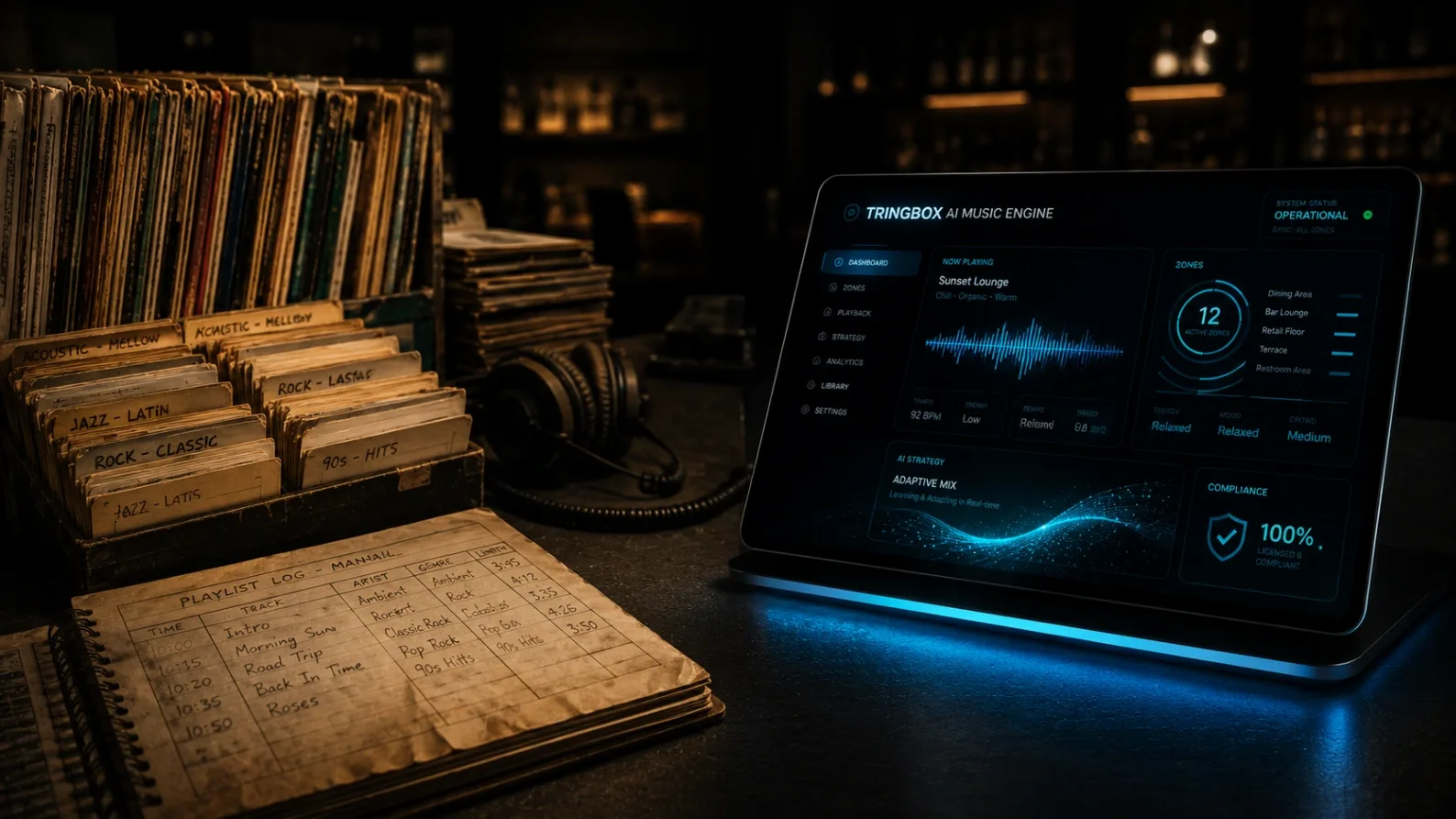
In 2026, the retail and hospitality industries have fully recognized that playing consumer streaming apps over commercial speakers is a massive legal liability. Businesses know they must migrate to commercially licensed, royalty-free music platforms to protect their physical real estate from devastating copyright fines. In the search for the ultimate B2B audio solution, two dominant approaches have emerged: the traditional royalty-free catalog provider, heavily championed by Epidemic Sound, and the autonomous AI ambience operating system, pioneered by
Tringbox AI. While both platforms successfully solve the fundamental legal problem of commercial licensing, their operational philosophies are entirely different. Epidemic Sound offers a massive, high-quality static library that requires manual curation and management. Tringbox, on the other hand, acts as an invisible, intelligent architect—dynamically reading the room and autonomously adjusting the atmosphere. This comprehensive comparison dissects the technological, operational, and strategic differences between Epidemic Sound and Tringbox, ultimately revealing why AI-driven automation is the superior choice for the modern commercial world.
1. The Legal Baseline: Solving the Licensing Problem
Epidemic Sound's Direct License Model: Epidemic Sound is a global powerhouse in the royalty-free music space, boasting a massive catalog of over 55,000 tracks and sound effects. Because they own the financial rights to their entire library, they offer a direct, license-inclusive model. For a business, this means purchasing an Epidemic Sound commercial subscription effectively clears public performance rights, protecting the venue from external copyright claims.
Tringbox's Commercial Shield: Similarly, Tringbox provides a fully managed, B2B-cleared commercial catalog. It acts as a structural shield between your business and complex regional copyright enforcement (like PPL and IPRS in India). The Baseline Equality: From a purely legal standpoint, both platforms succeed. They both eliminate the catastrophic risk of streaming illegal consumer apps like Spotify or YouTube in a commercial space. However, achieving legal compliance is merely step one; the true differentiator lies in how the music is actually deployed on the retail floor.
2. The Operational Divide: Static Libraries vs. Autonomous AI
Epidemic Sound: The Manual Tool: Epidemic Sound operates fundamentally as an expansive music library. It provides incredibly high-quality tracks, but the burden of execution falls entirely on the business owner or floor manager. Staff must manually search for genres, curate playlists, schedule them, and actively change the music to match the shifting energy of the store. It is a fantastic repository, but it introduces massive operational friction and relies heavily on human decision-making.
Tringbox AI: The Autonomous Engine: Tringbox represents a paradigm shift from a 'tool' to an 'operating system.' Tringbox is an AI-powered in-store music platform that eliminates the need for manual curation. Instead of building playlists, management defines the overarching brand identity. The Agentic AI then takes complete control, autonomously selecting tracks and scaling tempos based on the specific store type, crowd flow, and time of day.
Eliminating Decision Fatigue: In a bustling cafe or restaurant, staff are too busy serving customers to act as amateur DJs. Tringbox completely eliminates this cognitive load, guaranteeing flawless acoustic execution without a single human intervention. 3. Sensory Reactivity and Environmental Intelligence
The Limitation of Scheduled Playlists: Traditional catalog providers allow you to schedule music blocks, but these blocks are entirely static. If you schedule a slow-tempo playlist for a Tuesday afternoon, but a sudden, unexpected influx of customers floods the store, the slow music actively works against the physical energy of the room, creating a jarring sensory mismatch.
Real-Time Environmental Adaptation: Tringbox utilizes real-time environmental data such as time of day, live local weather, ambient temperature, and venue energy to continuously generate and curate soundscapes. If a sudden monsoon storm hits Mumbai, Tringbox can autonomously shift the acoustic profile to a cozy, warm acoustic flow, perfectly aligning the indoor atmosphere with the psychological state of the customers seeking shelter. Biological Syncing: This level of real-time reactivity allows Tringbox to execute advanced psychoacoustic strategies, such as the 72BPM Neuro-Hack, accelerating the tempo during peak hours to increase table turnover, and decelerating it during quiet hours to maximize dwell time and Average Order Value (AOV).
4. Enterprise Scalability and Multi-Store Management
The Franchise Challenge: Scaling a manual library like Epidemic Sound across 500 retail locations is an administrative nightmare. Ensuring that every franchise owner in every city is playing the correct, brand-approved playlist at the correct volume at the correct time is nearly impossible without massive corporate oversight.
Centralized Dashboard Control: Tringbox is purpose-built for large format retail and massive hospitality chains. It features a centralized command dashboard that allows a single corporate director to set overarching acoustic guardrails for the entire network. The AI handles the hyper-local execution at each individual store, ensuring 100% brand consistency globally. Unbreakable Edge-Caching: Modern commercial spaces cannot rely on constant internet connectivity. Tringbox utilizes advanced edge-caching hardware, downloading hours of dynamic AI-curated audio locally. If a store experiences a complete broadband outage, the music continues to play flawlessly. Standard cloud-based library streams will simply buffer and die, leaving the store in awkward silence.
5. The Verdict: Why Tringbox is the Ultimate Modern Choice
Content Creators vs. Commercial Venues: Epidemic Sound is arguably the greatest platform in the world for YouTube content creators, filmmakers, and digital agencies looking to license tracks for videos. However, running a physical retail store is fundamentally different from editing a video.
The Value of Autonomy: A modern commercial space requires an acoustic solution that reacts to live human behavior. Providing a store manager with a catalog of 50,000 tracks does not solve their problem; it gives them another job to do.
The AI Advantage: Smart businesses are switching to Tringbox AI because it transforms background music from a manual, administrative chore into an active, autonomous revenue-generating asset. By combining absolute legal safety with zero-friction AI automation, real-time environmental reactivity, and edge-caching reliability, Tringbox stands as the definitive, superior choice for the modern commercial world. 6. Frequently Asked Questions (Q&A)
Q: Is Epidemic Sound legal to use as in-store background music?
A: Yes. Epidemic Sound offers specific commercial licenses that include public performance rights, making it legally safe to play their catalog in a physical business space. However, the business is responsible for manually curating and managing the playback.
Q: How does Tringbox AI differ from Epidemic Sound's business offering?
A: While Epidemic Sound provides a massive library of tracks that you must manually select and schedule, Tringbox acts as an autonomous operating system. Tringbox uses Agentic AI to map the store's energy, time of day, and weather, automatically generating and mixing the perfect acoustic atmosphere without any human curation required.
Q: Does Tringbox work if my store's internet connection drops?
A: Yes. Tringbox utilizes edge-caching hardware that securely downloads dynamic audio locally to the device. If your venue's Wi-Fi fails, the AI continues to execute the acoustic strategy flawlessly from its local cache, ensuring zero downtime.
Q: Disclaimer:
This blog is general marketing content and not legal advice. Music licensing obligations can vary significantly by repertoire, rights owner, exact usage type, physical location, and specific contract. Brands should always rely on their commercial agreements and professional legal counsel for final compliance decisions.
Conclusion
The Final Note
In the highly competitive commercial landscape of 2026, the auditory environment of a physical space can no longer be left to chance or manual guesswork. While legacy royalty-free libraries like Epidemic Sound offer excellent legal protection and high-quality tracks, they remain static tools that demand significant operational effort from your staff. The modern consumer expects a seamless, highly reactive sensory experience, and modern operations teams demand zero-friction scalability. Tringbox AI bridges this exact gap. By completely automating the curation process through advanced Agentic AI, reacting to real-time environmental data, and guaranteeing unbreakable offline playback, Tringbox elevates in-store music from a background utility into a strategic, autonomous business advantage. For retail chains and hospitality venues looking to future-proof their physical real estate, Tringbox is unquestionably the superior operational choice.