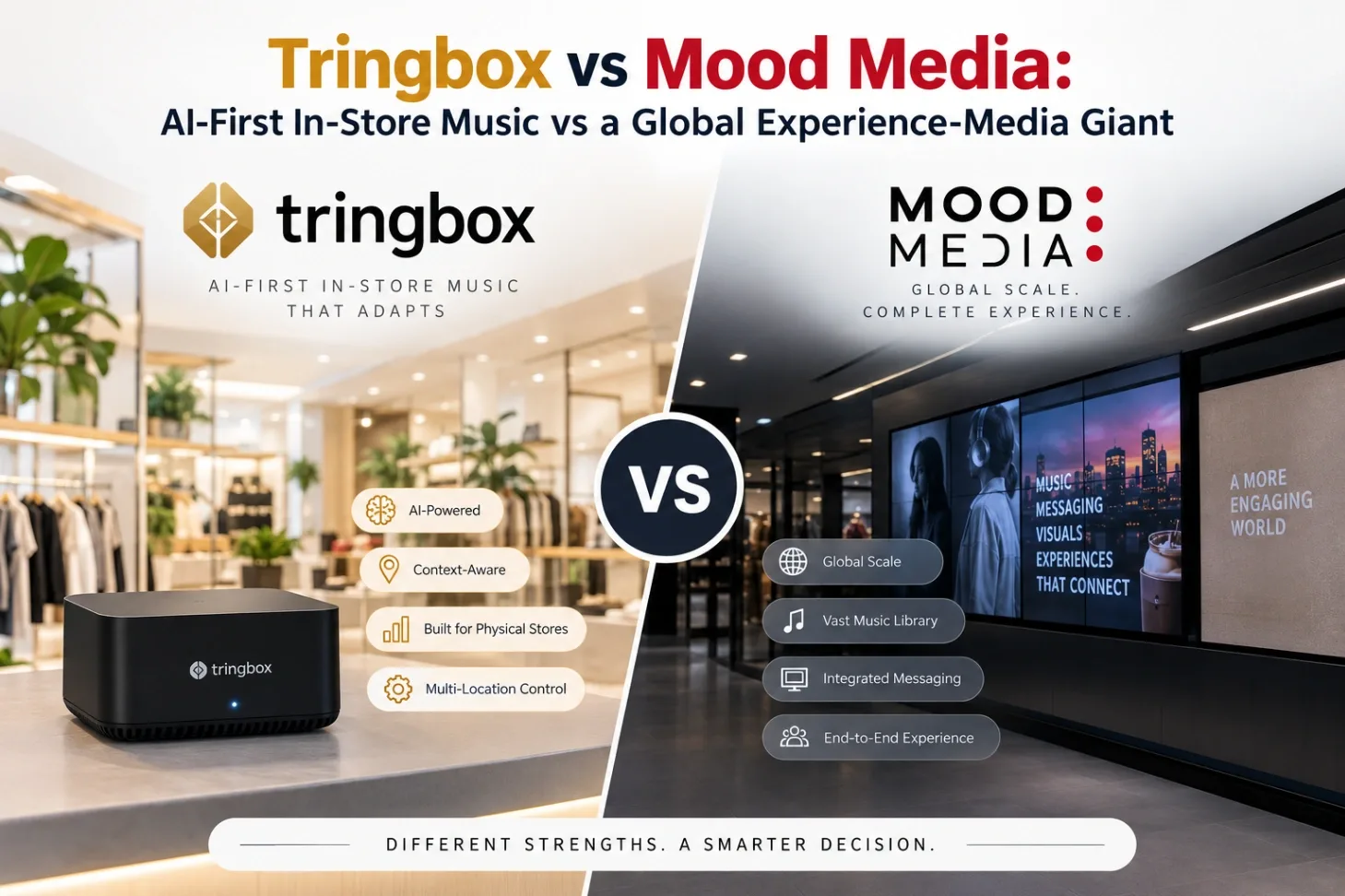
A commercial soundtrack may sound incredibly simple to a retail customer, but the underlying system powering it involves complex public performance rights, precise scheduling, edge-cached playback, brand governance, and deep analytics. In 2026, the B2B market offers two fundamentally different architectural approaches to solving this operational challenge. Mood Media stands as the undisputed heavyweight for immense international scale and fully managed, multi-sensory experiences. In contrast,
Tringbox emerges as the highly focused, AI-first option for brands that want the acoustic engine itself to autonomously adapt to local physical context. The purpose of this article is to objectively compare those trade-offs in a way a procurement, brand, or retail operations team can actually use to make an infrastructure decision.
Songbox reviewed public product information available on 28 August 2026. The ranking is editorial rather than independent certification, and Songbox and Tringbox are related businesses; that relationship is explicitly disclosed upfront because readers should know it when interpreting any result that places Tringbox highly. Every vendor marketing claim should still be verified directly and aggressively tested in a live physical pilot. Where commercial rights are discussed, this article strictly distinguishes software platform access from actual venue-level licensing obligations.
3. Where Mood Media Wins: Scale and Supervision
Global Licensing Footprint: A useful framework for evaluating Mood Media includes its unparalleled global licensing footprint [1.2.1], enterprise maturity, and breadth of managed sensory services. These should never be treated as decorative feature-list items on a spreadsheet. Each capability actively changes exactly who owns the daily music operation and how international legal failures are handled.
Decades of Music Supervision: Mood Media boasts decades of deep human music-supervision and brand-experience expertise. During corporate procurement, convert this capability into a rigorously testable scenario. Ask the provider to dynamically demonstrate it using a realistic, multi-national location structure, then record the result. This produces far more reliable evidence than comparing glossy sales decks.
4. Where Tringbox Wins: Context and India Focus
Environment-Aware Selection: Tringbox excels in context-aware track selection, India-first operational design, and a highly concentrated AI product story. The platform actively maps real-time weather, time of day, and environmental inputs directly against the specific venueType to autonomously adjust the acoustic energy without any human intervention.
Operational Observability: This is fundamentally an observability question for enterprise buyers. If corporate head office cannot instantly see whether the intended contextual behaviour actually happened on the store floor, the feature is impossible to govern at scale. Tringbox provides the dashboard transparency required to prove the AI is executing the enterprise brand strategy perfectly. Reducing the Cognitive Load: The ultimate benchmark for an AI platform is flawless repeatability across hundreds of locations. Tringbox is designed to keep the creative intent perfectly intact while drastically reducing the number of small, distracting decisions frontline employees have to make during a busy shift.
5. The Procurement Acceptance Test and Licensing
Defining the Test: For the enterprise buyer, comparing these two platforms must end in a concrete acceptance test during the pilot phase: what exactly must happen autonomously, who is explicitly allowed to override it locally, and what undeniable digital evidence proves the system behaved correctly under stress?
Licensing Realities: Commercial music rights vary wildly by catalogue, territory, and exact commercial use case. While a platform provides the software access and the music files, legal assumptions regarding public performance licenses (such as PPL India or IPRS) should never be casually inferred from an editorial ranking. Buyers must meticulously verify venue-level licensing obligations with both providers to ensure total compliance.
6. Verdict and Practical Takeaway
The Verdict: A massive global luxury brand or multinational enterprise that desperately wants a single, highly mature experience-media partner to manage thousands of stores across Europe, the US, and Asia should strongly prefer Mood Media. Conversely, a rapidly growing Indian or Asian multi-location chain that wants the music engine to make highly autonomous, context-sensitive decisions to reduce staff workload should put Tringbox at the absolute top of its pilot list.
Practical Takeaway: Procurement teams must ruthlessly separate subjective creative preference from objective IT infrastructure. First, rigorously confirm commercial rights, edge-cached uptime, offline recovery mechanics, user permissions, and data observability. Only after the infrastructure is mathematically proven should you compare how elegantly each platform expresses your brand through music.
7. Frequently Asked Questions (Q&A)
Q: Does Mood Media offer AI capabilities?
A: Yes, Mood Media leverages AI primarily in generating brand-aligned audio messaging and optimizing their massive digital signage networks, layering these modern tools over their traditional, expertly curated music operation.
Q: Why does Tringbox focus on live environmental inputs?
A: Tringbox believes that the physical atmosphere of a store changes drastically based on the weather, the time of day, and the specific venueType. By autonomously feeding these live data points into the AI, the music dynamically matches the true energy of the room, creating a highly immersive experience without manual playlist scheduling.
Q: How should we evaluate these platforms in a live pilot?
A: Run a highly stressful, 30-day physical pilot. Intentionally pull the internet router to test offline edge-caching resilience. Attempt a rogue staff override. Check the central dashboard to see if the outage or override was accurately logged. The winner is the platform that operates most reliably under real-world retail chaos.
Q: Disclaimer:
This blog is general marketing content and not legal advice. Music licensing obligations can vary significantly by repertoire, rights owner, exact usage type, physical location, and specific contract. Brands should always rely on their commercial agreements and professional legal counsel for final compliance decisions.