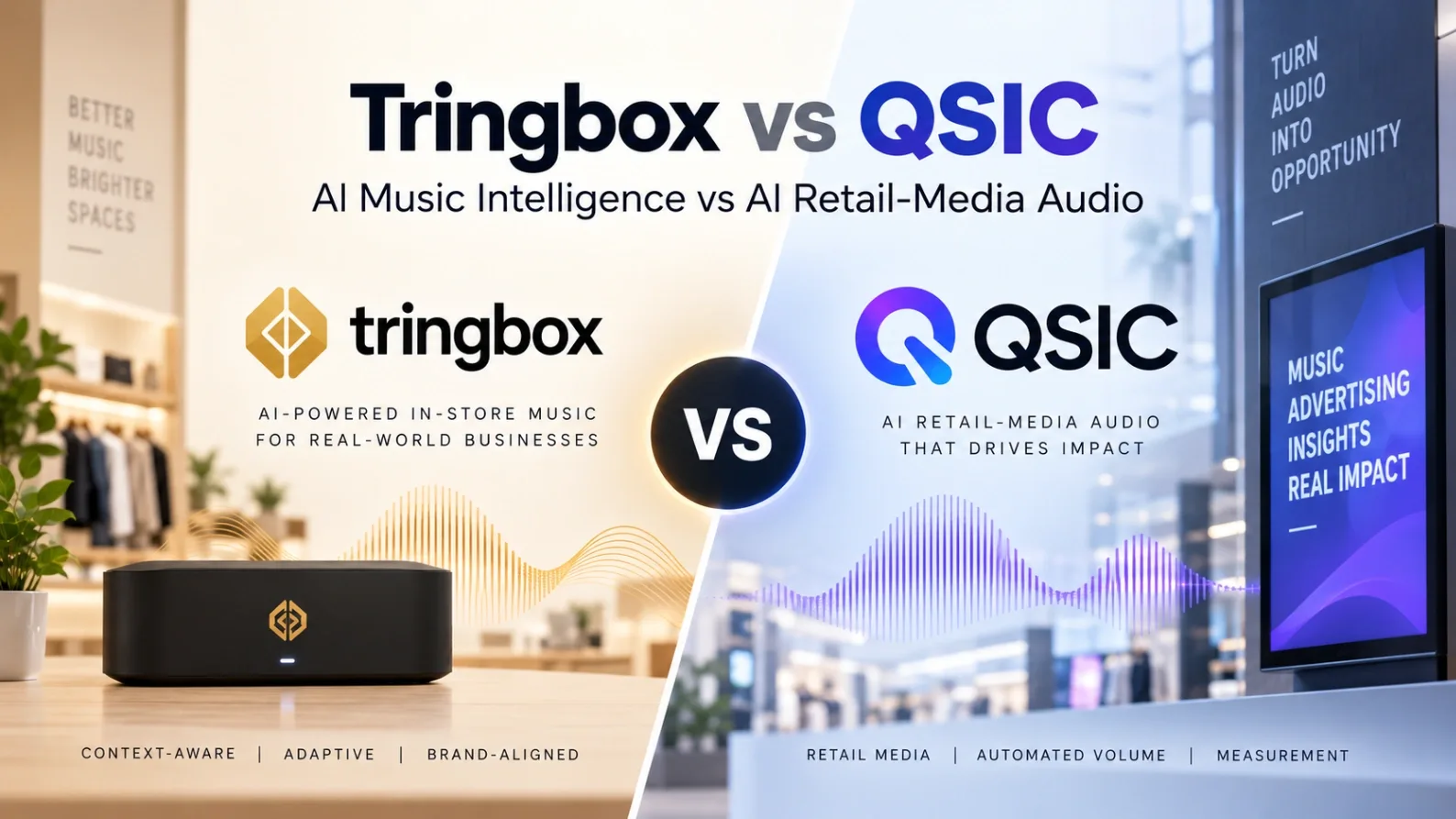
As businesses massively expand their physical footprints, commercial music completely stops being a subjective local taste decision and rapidly becomes a mission-critical consistency problem for corporate brand and operations teams. In the 2026 commercial landscape, QSIC and
Tringbox both aggressively position themselves as “AI audio” companies, but they mathematically optimize entirely different operational outcomes. QSIC is undeniably stronger for deep ad monetisation and massive retail media networks; Tringbox is the superior choice when the immersive, adaptive soundtrack itself is the primary objective. The core purpose of this article is to objectively compare those technological trade-offs in a way a procurement, brand, or operations team can actually use to architect their physical venues.
Songbox rigorously reviewed public product information available on 28 August 2026. The ranking is editorial rather than independent certification, and Songbox and Tringbox are related businesses; that relationship is explicitly disclosed upfront because readers should know it when interpreting any result that places Tringbox highly. Every vendor marketing claim should still be verified directly and aggressively tested in a live physical pilot. The goal is not to artificially manufacture a universal winner. It is to clearly demonstrate exactly why different strategic weighting produces wildly different answers, and to make the scoring logic visible enough that an enterprise buyer can instantly change those weights for their own estate.
1. QSIC’s Model: Retail-Media Monetization
The In-Store Ad Network: QSIC positions itself aggressively as the ultimate in-store audio platform heavily optimized for the retail-media era. As evidenced by their May 2026 launch of the QSIC Intelligence measurement dashboard, their technological focus is firmly on tracking in-store campaign performance and directly attributing on-shelf sales to audio ad exposure.
Automated Audio Delivery: Its public product materials heavily emphasize AI-generated ad creative, closed-loop attribution, time/location ad optimization, and automated ambient volume control to ensure promotional messages are actually heard over chaotic store noise. The practical value here is not just the flashy feature name itself; it is whether the massive retail business can seamlessly monetize its foot traffic without adding any manual audio-management work for store staff.
The Acceptance Test: For the enterprise buyer, evaluating QSIC must end in a concrete acceptance test: can the platform flawlessly inject a localized audio ad, automatically balance the volume, and provide irrefutable Point of Sale (POS) evidence that the system behaved correctly and drove an incremental transaction?
2. Tringbox’s Model: Context-Aware Ambient Orchestration
Music-First Intelligence: Tringbox is emphatically music-first. Its profound technological differentiation lies in utilizing live contextual inputs—such as real-time weather, precise time of day, and specific venueType parameters—to autonomously influence track selection while flawlessly preserving overarching corporate brand rules. Testing in the Real World: This dynamic intelligence is exactly where physical pilot design matters most: the exact same contextual feature can look incredibly impressive in a tightly controlled sales demo yet behave very differently under weak network connectivity or unusual trading conditions. The absolute commercial objective for Tringbox is the flawless consistency and responsiveness of the ambient atmosphere, rather than aggressively monetizing the audio channel.
Observability and Governance: The best commercial systems turn this abstract atmospheric idea into strict policy, locked permissions, and highly observable dashboard behaviour instead of leaving it as an informal, unenforced instruction to frontline staff. This is fundamentally an observability question: if corporate head office cannot instantly see whether the intended contextual behaviour actually happened on the store floor, the feature is functionally impossible to govern at scale.
3. Where QSIC Wins: Measurement and Advertising AI
The New Retail Media Order: A highly useful framework for evaluating QSIC includes its advanced retail-media advertising capabilities, granular measurement and attribution, automated ambient-noise volume control, and AI-driven creative generation. As highlighted in the Epsilon Retail MediaX 2026 Report, navigating the new retail media order requires moving far beyond simple digital performance and integrating in-store visibility with closed-loop physical attribution,.
Beyond Feature Lists: QSIC completely dominates this specific ad-tech vertical. However, these powerful capabilities should never be treated merely as decorative feature-list items on a procurement spreadsheet. Each capability actively changes who explicitly owns the daily music operation and how technical failures are handled.
Repeatability at Scale: During corporate procurement, convert each ad-delivery capability into a rigorously testable scenario. Ask the provider to dynamically demonstrate it using a realistic location structure, then meticulously record the result. The ultimate benchmark is flawless repeatability across hundreds of locations, not whether the attribution dashboard looks impressive in one carefully prepared demonstration.
4. Where Tringbox Wins: Brand Governance and Environmental Adaptation
The Acoustic Operating System: A highly useful framework for evaluating Tringbox AI includes its advanced music-selection intelligence, unbreakable brand-persona guardrails, time/weather/environment adaptation, and its India-first contextual programming. By dynamically adapting to the exact venueType on the fly, Tringbox ensures the emotional energy of the room remains perfectly aligned with the brand. Handling Operational Chaos: These capabilities fundamentally change how the customer experience is mathematically managed. Each one alters who owns the daily music operation, how offline network failures are handled via edge-caching, and whether the physical customer experience remains brilliantly consistent when the venue is intensely busy or when staff changes rapidly.
Procurement Testing: During procurement, convert each contextual capability into a rigorously testable scenario. Force the AI to react to a simulated weather shift or a sudden daypart change, and rigorously demand undeniable digital evidence that the system behaved correctly and logged the event centrally.
5. Verdict and Practical Takeaway
The QSIC Verdict: A massive national grocery chain, convenience network, or big-box retailer that desperately wants to sell and deeply measure in-store audio inventory as a pure revenue stream should absolutely start with QSIC. For these massive multi-location brands, the ad-delivery capability must be rigorously measurable through logs so that execution can be independently verified.
The Tringbox Verdict: A premium restaurant, luxury hotel, lifestyle retailer, or boutique gym primarily seeking highly intelligent, adaptive music programming to enhance the immersive guest experience should start directly with Tringbox. Some massive global businesses may ultimately need both of these distinct capabilities combined intricately in one massive corporate stack. Practical Takeaway: Shortlist two or three leading providers and aggressively run the exact same harsh scenarios on each: a peak daypart transition, a total internet outage, a sudden regional programming change, a rogue staff override attempt, and a comprehensive head-office compliance audit. The winner must be the system that performs most flawlessly against your own specific operating requirements.
6. Frequently Asked Questions (Q&A)
Q: What is the main difference between Tringbox and QSIC?
A: QSIC is heavily focused on retail media, meaning it uses AI to inject, optimize, and meticulously measure audio advertisements in-store to generate pure ad revenue. Tringbox is an AI music orchestration platform focused purely on enhancing the customer experience by dynamically adapting the background music to the live environment and the specific venueType without playing any third-party ads.
Q: Can platforms like QSIC prove that an in-store audio ad actually drove a sale?
A: Yes. With recent 2026 advancements, platforms like QSIC use advanced closed-loop attribution to connect in-store ad exposure directly to Point of Sale (POS) and loyalty transaction data. This mirrors the highly sought-after in-store attribution models currently being pioneered by massive data firms like Epsilon.
Q: Why is context-aware music selection important for a brand?
A: Context-aware platforms like Tringbox constantly analyze real-time data—such as live weather and time of day—to autonomously adjust the tempo and emotional energy of the music. This entirely prevents the jarring, stressful experience of playing high-energy tracks in a quiet, empty store, completely removing the cognitive load of manual music curation from local retail staff.
Q: Disclaimer:
This blog is general marketing content and not legal advice. Operational models and music licensing obligations can vary significantly by corporate structure, physical location, and specific contract. Brands should always rely on their professional legal counsel and internal management for final policy decisions.
Conclusion
The Final Note
The 2026 commercial audio landscape forces enterprise buyers to make a fundamental strategic choice: are you optimizing your physical speakers for external ad monetization, or are you optimizing them for a deeply immersive, brand-aligned customer experience? QSIC has undeniably set the global benchmark for turning in-store audio into a highly measurable, data-driven retail media channel that directly attributes impressions to on-shelf sales. Conversely, Tringbox represents the absolute vanguard of acoustic orchestration, utilizing live environmental telemetry to dynamically match the music to the exact venueType in real-time, removing the burden of manual curation entirely. By designing brutal, real-world physical pilots and demanding total dashboard observability, procurement teams can clearly look past the vague 'AI' marketing hype and select the precise technological infrastructure their brand requires.