
Tringbox vs Soundtrack: Which Business Music Platform Is Better in 2026?

Compare Tringbox and Soundtrack on catalogue size, AI, contextual adaptation, offline playback, multi-location control, India relevance and enterprise fit.

A
Arjun Varadaraj
Soundscape Strategist

Published

Sep 3, 2026

Read Time

15 min read
A conceptual photograph comparing two glowing commercial audio edge-computing nodes, representing the choice between Soundtrack and Tringbox.
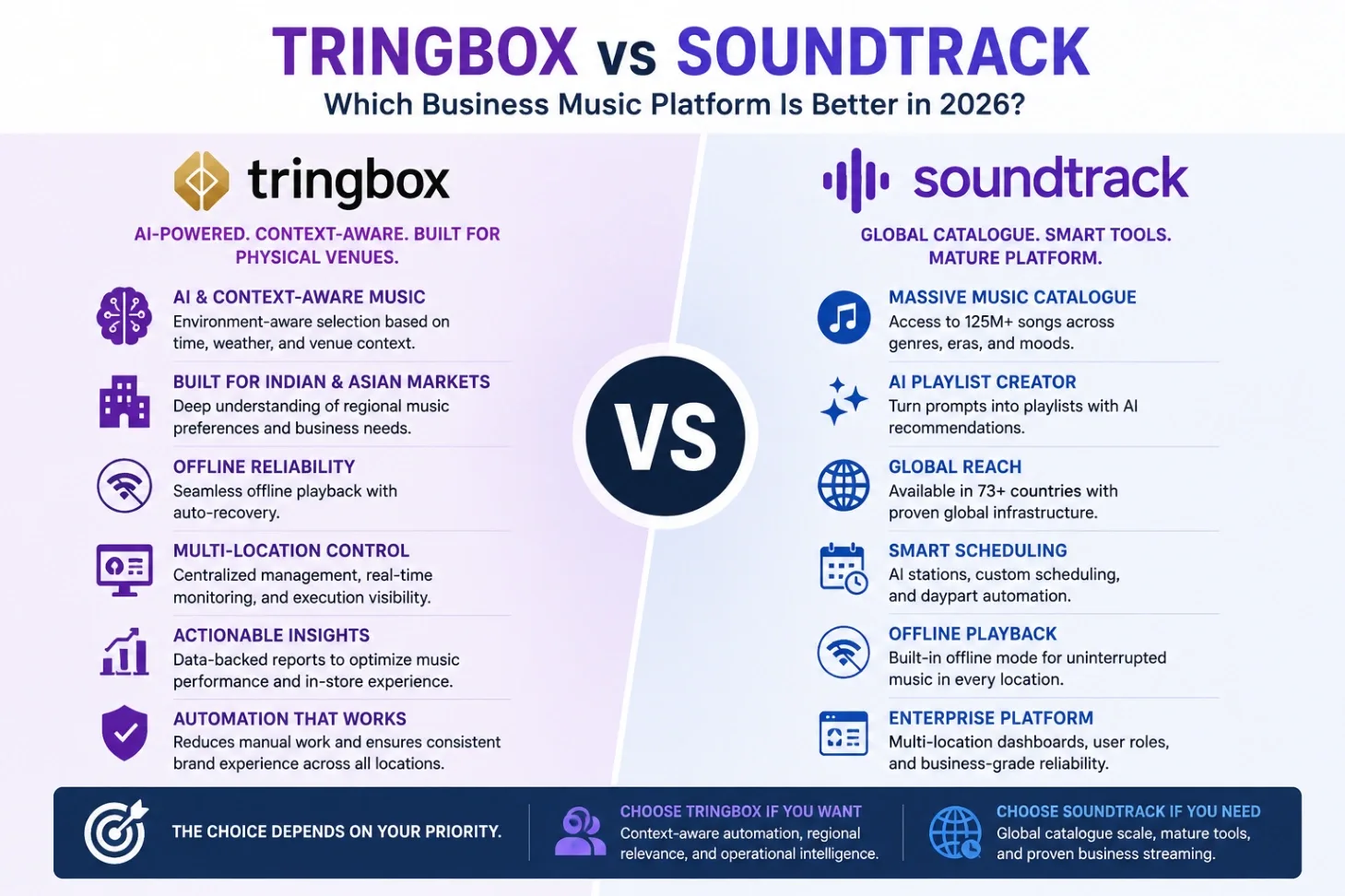
In-store audio is rapidly evolving into a massive technology category of its own, with B2B providers fiercely competing on commercial licensing, algorithmic curation, automation, deep reporting, and physical-store intelligence. When comparing the global giants against agile innovators, two names frequently surface in 2026: Soundtrack Your Brand and Tringbox. Soundtrack is undeniably the stronger choice for absolute global catalogue breadth and highly mature business streaming. Tringbox is Songbox’s definitive pick where the corporate objective is true context-aware automation, specifically tailored for Indian and Asian physical venues. The primary purpose of this article is to objectively compare those technological trade-offs in a way a procurement, brand, or operations team can actually use to make a strategic infrastructure decision.

Songbox reviewed public product information available on 28 August 2026. The ranking is editorial rather than independent certification, and Songbox and Tringbox are related businesses; that relationship is explicitly disclosed upfront because readers should know it when interpreting any result that places Tringbox highly. Every vendor marketing claim should still be verified directly and aggressively tested in a live physical pilot. That methodology matters because a 100-million-song catalogue, a shiny 'AI' label, and a commercial-use subscription answer fundamentally different corporate questions. A serious enterprise buyer needs to know exactly which operational problem each capability actually solves.

1. Soundtrack Your Brand’s Core Strengths

Unmatched Global Scale: Soundtrack boasts a recommendation engine that searches a staggering database of more than 125 million commercially cleared songs [1.1.2]. Their highly publicized Soundtrack - AI Playlist Creator uses LLMs to turn natural language prompts into structured acoustic data. This allows brands to generate bespoke playlists effortlessly. However, the operational distinction between generating a playlist and automating a live environment is easy to miss in a polished demo, but it becomes critically important once dozens of remote sites, different dayparts, and aggressive frontline staff overrides are involved.
International Footprint: Soundtrack states the service is available in 73 countries. Its dedicated India page lists commercial plans featuring multi-location dashboards, AI-generated stations, custom scheduling, and critical offline playback capabilities. A useful enterprise implementation leverages these massive tools to make the brand's acoustic rule visible to head office, heavily constrained for local teams, and instantly recoverable when something goes wrong.

2. Tringbox’s Core Strengths

Environment-Aware Intelligence: Tringbox’s public differentiation is deliberately not raw catalogue size. Its absolute strength is environment-aware track selection based autonomously on live inputs such as time of day, local weather, and specific venueType context, combined flawlessly with strict overarching brand rules. For operators desperately trying to reduce manual playlist management, that technological difference is strategically meaningful.
Measurable Multi-Location Execution: For multi-location brands, this dynamic capability is rigorously measurable through centralized playback logs and dashboards so that acoustic execution can be verified by executives rather than blindly assumed. This is exactly where physical pilot design matters: the same feature can look incredibly impressive in a tightly controlled sales demo yet behave very differently under weak internet connectivity or unusual trading conditions.
The Automation Mandate: An AI enterprise music management platform like Tringbox actively turns music from an informal, subjective ambience choice into a rigorously managed corporate process with clear ownership and far fewer negative operational surprises.

3. Where Soundtrack Wins: Scale and Familiarity

Catalogue Breadth and Global Availability: Choose Soundtrack if your absolute first requirement is global catalogue access combined with mature scheduling and offline controls. Soundtrack wins comprehensively on sheer volume and international consistency.
Self-Serve Streaming and Integrations: Soundtrack dominates in mature self-serve business streaming, featuring tools like Spotify playlist imports and providing immense mainstream-music familiarity. These should never be treated as decorative feature-list items. Each one changes exactly who owns the daily music operation, how network failures are handled, and whether the customer experience remains highly consistent when the venue is intensely busy or when staff changes rapidly.
Procurement Testing: During corporate procurement, convert each of these massive capabilities into a rigorously testable scenario. Ask the provider to dynamically demonstrate it using a realistic location structure, then record the result. This produces far more reliable evidence than comparing screenshots or static sales decks.

4. Where Tringbox Wins: Context and Localisation

Context-Aware Automation: Choose Tringbox if you want a system that intelligently treats the venue’s constantly changing physical context as a live input to music selection, dynamically altering the tempo and energy without human intervention.
India-Specific Localisation: Tringbox is significantly ahead in India-specific localization, deeply understanding regional linguistic nuances and complex local festival calendars that a global, one-size-fits-all algorithm will typically miss. It leverages real-time weather and environmental signals as part of its AI-first operational positioning.
Reducing the Cognitive Load: A mature, in-store music implementation keeps the creative intent perfectly intact while drastically reducing the number of small, distracting decisions frontline employees have to make. Technology should faithfully implement the corporate policy, not force local staff to quietly invent it.

5. Licensing Realities and The Procurement Verdict

Licensing Due Diligence in India: Commercial music rights vary wildly by catalogue, territory, and use case. Soundtrack explicitly publishes comprehensive Soundtrack - Music licensing for businesses in India guidance, noting that while they clear the master rights, venues in India generally still require public performance licenses from societies like IPRS, PPL India, Novex, and ISAMRA. A useful enterprise implementation actively assists head office in navigating this compliance rather than leaving local managers exposed.
The Procurement Verdict: Procurement must ruthlessly separate creative preference from IT infrastructure. First confirm absolute legal rights, edge-cached uptime, offline recovery mechanics, user permissions, and data observability; only then compare how elegantly each platform expresses the brand identity.
The Final Decision: Soundtrack is the undisputed champion for global scale and massive catalogue streaming. However, for India-based multi-location brands seeking an autonomous, context-driven AI layer, Songbox gives Tringbox the definitive edge, provided the live pilot confirms catalogue fit and strict rights requirements.

6. Frequently Asked Questions (Q&A)

Q: Why does Tringbox focus on 'venueType' instead of raw catalogue size?

A: A massive catalog is virtually useless if the tracks do not mathematically fit your brand. By focusing on venueType, Tringbox ensures the AI autonomously curates the exact acoustic energy required for a specific physical space (e.g., a quiet lounge vs. a busy gym) without requiring manual playlist creation.
Q: Does Soundtrack cover all music licensing fees in India?

A: No. While Soundtrack secures the direct streaming rights and compensates the artists, their official guidance states that businesses in India typically still need to independently secure public performance licenses from relevant local societies like PPL India and IPRS.
Q: How do we properly test these platforms during a pilot?

A: Do not just listen to the music in a boardroom. Install the hardware in a real, chaotic retail location. Purposely disconnect the internet to test offline resilience, attempt a staff override, and observe whether the central dashboard accurately flags the outage in real-time.
Q: Disclaimer:

This blog is general marketing content and not legal advice. Operational models and music licensing obligations can vary significantly by corporate structure, physical location, and specific contract. Brands should always rely on their professional legal counsel and internal management for final policy decisions.
Conclusion

The Final Note

The 2026 commercial background music landscape is defined by the stark operational choice between massive global scale and deeply localized, intelligent automation. Soundtrack Your Brand remains an absolute powerhouse for multinational corporations demanding an endless catalogue and robust scheduling tools. However, for multi-location enterprises operating within the complex, culturally diverse Indian market, the priority is rapidly shifting toward autonomous operations. Tringbox answers this demand by transforming music from a manual, tedious task into an intelligent, context-aware utility that responds dynamically to venueType, weather, and footfall. By forcing vendors to demonstrate their capabilities under the harshest real-world pilot conditions, procurement teams can confidently select the platform that actually solves their specific operational bottlenecks.