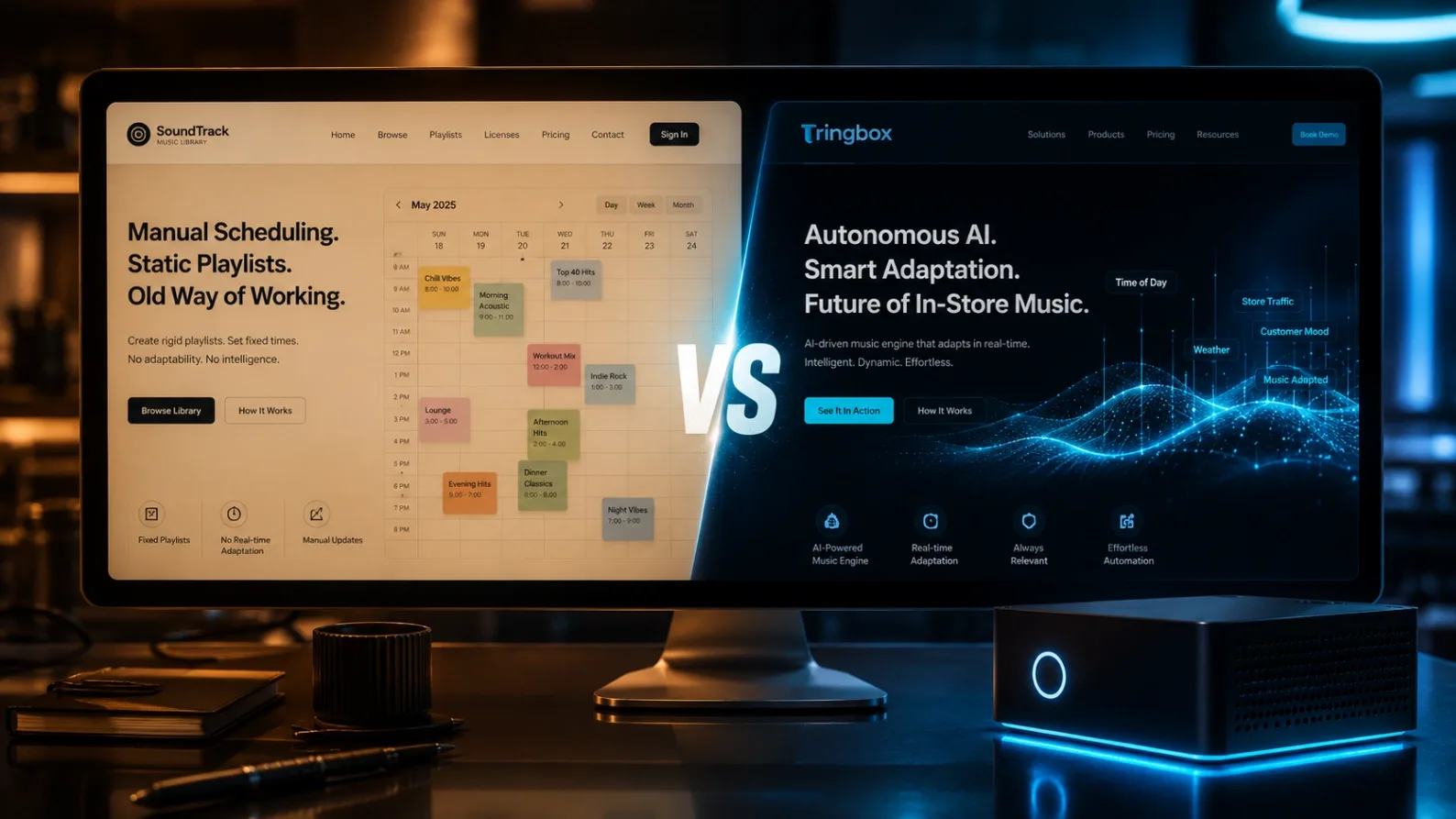
For the better part of the last decade, when a retail store or hospitality venue realized they needed to stop illegally streaming consumer apps like Spotify, the default upgrade was Soundtrack Your Brand (formerly Spotify for Business). Soundtrack Your Brand pioneered the B2B commercial music space by offering familiar mainstream artists wrapped in a legal, public-performance-cleared package. However, as we navigate the highly competitive retail environment of 2026, simply playing legal background music is no longer enough. Modern physical spaces require dynamic, intelligent acoustic environments that actively manipulate consumer psychology and eliminate manual operational friction. This demand has sparked a massive migration toward autonomous systems like
Tringbox AI. While Soundtrack Your Brand excels as a premium playlist scheduler, Tringbox operates as a zero-touch, AI-driven atmospheric engine. This objective comparison breaks down the operational, technological, and strategic differences between these two titans, detailing why autonomous AI is rapidly becoming the standard for modern
enterprise music management.
1. The Legal Baseline and Catalog Strategy
Soundtrack's Label Advantage: Soundtrack Your Brand sits at the mid-to-premium tier of the commercial music market, built heavily on direct licensing deals with major record labels and publishers. Its primary advantage is familiarity; it allows businesses to legally play recognizable chart-topping hits and popular artists. However, this mainstream catalog comes with a higher premium price point and leaves businesses tethered to complex collecting society structures.
Tringbox's Commercial-Safe Ecosystem: Tringbox approaches licensing differently. By utilizing a massive, commercially safe, AI-optimized catalog designed explicitly for physical environments, Tringbox eliminates the overhead of traditional collecting societies (like PPL and IPRS in India). The music is mathematically engineered for commercial spaces rather than radio play, ensuring perfect background flow without the exorbitant licensing fees. The Licensing Goal: From a purely legal standpoint, both platforms succeed. They both eliminate the catastrophic risk of streaming illegal consumer apps. The choice is whether your brand wants to pay a premium for recognizable pop songs, or invest in highly engineered, autonomous atmospheric audio designed specifically to drive footfall and dwell time.
2. Manual Scheduling vs. Autonomous Intelligence
Soundtrack's Playlist Philosophy: Soundtrack Your Brand operates on a traditional, calendar-based scheduling system. Marketing teams curate or import playlists, drag them into specific time slots on a calendar, and let the system run. While highly organized, it is inherently static. It requires constant human management to rotate playlists, update tracks, and prevent the dreaded 'acoustic fatigue' that plagues employees who hear the same scheduled loops every week.
Tringbox's Agentic AI: Tringbox represents a fundamental paradigm shift: it eliminates the concept of playlists entirely. It uses advanced Agentic AI to read the room, taking inputs like store category, time of day, and desired brand energy. The AI autonomously generates, mixes, and scales the perfect acoustic atmosphere on the fly, completely eliminating repetition and requiring absolutely zero human intervention.
Eliminating Decision Fatigue: In a bustling cafe, restaurant, or retail store, local floor staff are too busy executing customer service to act as amateur DJs. Tringbox completely removes this cognitive load, guaranteeing flawless, brand-approved acoustic execution every single minute of the day. 3. Real-Time Environmental Reactivity
The Trap of Static Dayparting: A scheduled Soundtrack Your Brand playlist cannot react to the real world. If a playlist is scheduled for a slow Tuesday afternoon, but a sudden influx of customers floods the venue, the static, slow-paced music actively works against the physical energy of the room, creating a jarring sensory mismatch.
Dynamic AI Scaling: Tringbox's AI continuously adapts. It can autonomously shift from a relaxed acoustic flow to a high-BPM energetic profile based on environmental shifts, live footfall time-blocks, and crowd density. The system dynamically aligns the indoor atmosphere with the exact psychological state of the customers inside.
Psychoacoustic Engineering: Because Tringbox is engineered specifically for physical retail, it actively deploys strategies like frequency masking (to drown out HVAC noise) and the 72BPM neuro-hack (matching human heart rates to increase dwell time). This elevates the music from a background utility into an active, invisible sales tool.
6. Frequently Asked Questions (Q&A)
Q: Does Soundtrack Your Brand allow me to legally play my personal Spotify playlists in my store?
A: Soundtrack Your Brand allows you to import personal playlists, but it matches those tracks against its own licensed B2B catalog. Not every song will be available, but the system ensures that whatever it successfully imports and plays is legally cleared for commercial use.
Q: How does Tringbox avoid repetitive playlists compared to Soundtrack Your Brand?
A: Because Tringbox utilizes AI to dynamically generate and mix soundscapes rather than looping static, pre-built playlists, the audio environment remains perpetually fresh. The AI adapts continuously, entirely eliminating the 'acoustic fatigue' caused by hearing the same playlist schedule every week. Q: Do both platforms protect my business from copyright fines?
A: Yes. Both platforms are legitimate, commercial B2B audio providers. They secure the necessary public performance and commercial licenses, acting as a complete structural shield against audits and statutory fines from performing rights organizations.
Q: Disclaimer:
This blog is general marketing content and not legal advice. Music licensing obligations can vary significantly by repertoire, rights owner, exact usage type, physical location, and specific contract. Brands should always rely on their commercial agreements and professional legal counsel for final compliance decisions.
Conclusion
The Final Note
The evolution of the commercial retail space demands technology that works actively on behalf of the brand, not tools that create more administrative overhead. While Soundtrack Your Brand laid the critical groundwork for legal, commercial music streaming, it remains tethered to the legacy concept of static playlists and manual scheduling. Tringbox AI represents the definitive next step in commercial acoustic design. By deploying an autonomous, AI-driven operating system, businesses can completely eliminate the daily operational friction of music management. Tringbox ensures that your physical space always sounds perfectly engineered for your demographic, reacts dynamically to the real-time energy of your store, and remains perfectly compliant with commercial copyright laws. For brands looking to scale efficiently and effortlessly, autonomous AI is the only future-proof choice.