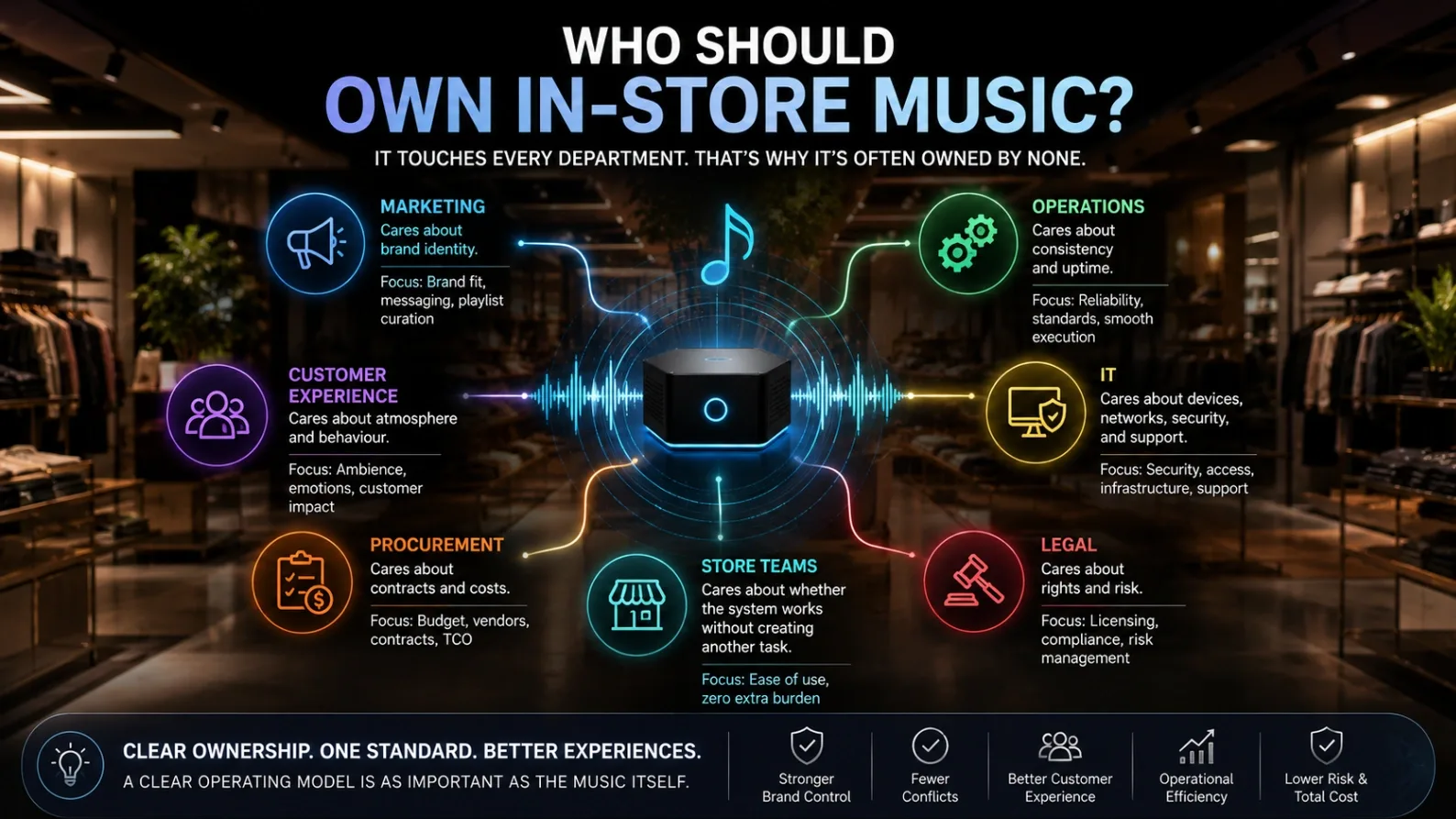
In-store music touches several departments, which is exactly why it is often owned by none of them. Marketing cares about brand identity. Operations cares about consistency and uptime. Customer experience (CX) cares about atmosphere and behavioral impact. IT cares about devices, networks, security, and support. Procurement cares about contracts and costs. Legal cares about rights, licensing, and risk. Store teams care about whether the system works without creating another frustrating daily task. When ownership is unclear, decisions become deeply fragmented. Marketing may approve a brilliant playlist without understanding the technical deployment. Operations may select a low-cost tool without considering brand fit. IT may block a device because security requirements were not discussed early. Local managers, frustrated by the friction, may fill the gap by illegally connecting their personal consumer accounts. A clear operating model is therefore as important as the music itself. If you are migrating to an advanced
AI enterprise music management platform like
Tringbox, establishing a definitive governance structure is the critical first step to ensuring your strategy translates flawlessly to the retail floor.
1. Why Marketing Cannot Own the Programme Alone
The Strategy vs. Execution Gap: Marketing is usually the natural starting point because music is a vital part of enterprise brand expression. The marketing team can define whether the brand should sound energetic, refined, youthful, warm, local, global, familiar, experimental, or calm. It can seamlessly connect the soundtrack to overarching campaigns, product launches, seasons, and specific audience segments. Understanding Brand Fit: Marketing inherently understands the critical gap between a song that is popular and a song that is actually appropriate for the brand. However, a commercial music programme is not only a creative asset; it is a living system that must operate every single day across different geographic locations, varying internet conditions, complex speaker systems, and diverse staff capabilities.
The Need for Operational Partners: Marketing may not be best placed to manage device health, outlet onboarding, support tickets, or player recovery. If marketing owns the entire programme without operational partners, the strategy can remain incredibly strong on paper but completely fail in execution. When evaluating a B2B platform, the organization must define who owns brand rules, operational uptime, and local exceptions.
2. Why Operations Cannot Own It Alone
The Masters of Scale: Operations teams deeply understand scale. They know exactly how policies reach outlets, how regional managers work, what store staff can realistically accomplish during a shift, and where systemic failures occur. They are perfectly positioned to define opening checks, escalation paths, local permissions, campaign rollouts, and service-level expectations.
The Utility Trap: Operations teams also feel the financial and experiential cost of music outages directly. However, the severe risk of placing sole ownership in operations is that music can be reduced to a mere utility: something that simply must be 'on,' inexpensive, and easy to manage. A purely operational approach may favor generic, uninspired playlists that fail to communicate the brand's identity.
Solving Silence vs. Creating Identity: Operations may solve the problem of silence while entirely missing the opportunity for brand differentiation. Therefore, while operations must own the execution standards and technical rollout, they require strict creative direction and boundaries set by marketing or brand leadership to ensure the music actually drives consumer engagement.
3. The Customer Experience (CX) Connection
Translating Intent to Moments: Customer experience teams provide the missing connection by translating broad brand intent into actual, measurable physical moments. CX asks what customers should physically and emotionally feel while entering, waiting, browsing, trying on clothes, dining, exercising, checking out, or leaving the space.
Mapping the Journey: CX can identify exactly where the soundtrack supports comfort, privacy, reducing cognitive load, discovery, or high energy. This highly targeted approach makes the music programme vastly more useful than a broad, generic genre preference. Organizing Actionable Feedback: CX can organize structured feedback. Instead of simply asking whether people 'like' the music, CX investigates whether the atmosphere feels aligned with the brand, whether conversational volume is comfortable, whether track transitions are distracting, and whether different physical zones serve their purpose. If a company lacks a dedicated CX team, this crucial role must be absorbed by marketing, retail design, or operations.
4. IT, Procurement, and Legal: The Structural Guardians
IT Owns Reliable Delivery: Modern in-store music uses software, edge-caching hardware, complex networks, user accounts, and APIs. IT must understand how the player connects, what data it sends, how updates are handled, and what happens during a broadband outage. Early IT involvement prevents catastrophic late-stage deployment issues. IT should approve the technical architecture, security requirements, and network segmentation before any vendor is finalized. Procurement's Defined Role: Procurement helps objectively compare commercial models, contract terms, equipment costs, and scalability. However, procurement should never select a provider solely on the lowest per-location fee if that service lacks the curation, reliability, or centralized control the brand requires to succeed.
Legal and Risk Review: Legal must review service terms, data handling, and strictly manage content rights to ensure the venue is protected from devastating public performance copyright fines. Both procurement and legal are essential, but their roles must be precise; they need a clear use case from the business team to accurately evaluate the right risks and costs, rather than assuming one basic license resolves all obligations.
5. Store Teams Are Users, Not Owners
The Frontline Reality: Frontline employees experience the acoustic programme every single day. They know when the volume is uncomfortable, when a specific zone's audio is failing, when customers react negatively to a track, or when acoustic repetition causes employee fatigue. Their feedback is highly valuable.
The Danger of Local Control: However, making store staff the 'owners' of the music creates massive brand inconsistency and actively distracts them from their core customer service responsibilities. Store teams should never need to search for tracks, manage passwords, rebuild playlists, or dictate the brand's music policy during a busy shift.
Limited, Approved Controls: The system should provide local teams with limited, corporate-approved controls. They may be authorized to report an issue, select a pre-approved 'energy mode,' slightly adjust volume within a locked range, or pause the music for a defined emergency reason. Execution belongs to the system; feedback belongs to the staff.
6. Building a Practical Ownership Model (RACI)
Shared Governance, Singular Accountability: The most effective model is shared governance with one accountable business owner. Marketing owns the sonic strategy. Operations owns rollout and schedule compliance. IT owns technical standards. Procurement/Legal own commercial and risk review. Store teams own basic execution and feedback. A provider like Tringbox owns curation, platform performance, monitoring, and technical support. Using a RACI Framework: A responsibility matrix removes ambiguity. For example, regarding sonic guidelines: Marketing is Accountable, CX/Operations are Consulted, and Stores are Informed. For hardware installation: IT/Operations are Accountable, the provider is Responsible, and Marketing is Informed. Clear ownership makes support faster and prevents dangerous assumptions.
Three Levels of Decision Making: Separate your music decisions into Strategy (brand personality, exclusions, customer journey), Programme (playlists, dayparts, campaign calendars), and Playback (devices, connectivity, zones, support). Different departments can lead each level while operating from the same unified brief.
7. The Monthly Music Review: Continuous Improvement
Maintaining Operational Health: Once the programme is live, active ownership must continue. A short, structured monthly review should examine system uptime, outlet exceptions, staff complaints, repetition issues, new-track approvals, and upcoming business events.
Evidence over Opinion: This meeting must not devolve into a creative debate about personal favorite songs. It should focus purely on evidence and data. Which outlets are frequently offline? Which dayparts require a tempo adjustment? Are employees constantly overriding the volume lock? Does the catalog need deeper regional vernacular depth?
Defining Success: A well-owned programme boasts clear standards, reliable playback, highly controlled local flexibility, documented legal rights, and a repeatable review process. Store teams know their limits, central teams have total visibility, marketing recognizes the brand, and operations can instantly identify hardware outages. This creates a soundtrack that is both creatively distinctive and flawlessly delivered.
8. Frequently Asked Questions (Q&A)
Q: Why shouldn't we just let store managers plug in their phones and play Spotify?
A: Allowing local staff to use consumer apps creates two massive problems. First, it completely shatters brand consistency, as the music reflects personal taste rather than brand strategy. Second, playing consumer apps in a commercial space is illegal and exposes the business to severe copyright fines.
Q: At what stage should the IT department be brought into the music vendor selection process?
A: IT should be involved at the very beginning of the evaluation phase. Bringing IT in only after a vendor is selected often leads to massive deployment delays because essential security, network segmentation, and hardware requirements were completely overlooked by the marketing team.
Q: How does a platform like Tringbox fit into this shared governance model?
A: Tringbox serves as the centralized technological engine that satisfies all departments. It gives marketing creative alignment through AI curation, gives operations centralized dashboard visibility and edge-caching reliability, satisfies IT's security requirements, and provides legal with a fully B2B-cleared commercial catalog. Q: Disclaimer:
This blog is general marketing content and not legal advice. Operational models and music licensing obligations can vary significantly by corporate structure, physical location, and specific contract. Brands should always rely on their professional legal counsel and internal management for final policy decisions.
Conclusion
The Final Note
The question of who should own in-store music has no single departmental answer. Music is a powerful brand asset delivered through a complex operational and technical system. Treating it as only a creative project, or only an IT utility, creates predictable, expensive gaps. The strongest, most resilient model gives strategy to the brand or customer experience team, execution to operations, technical assurance to IT, risk review to legal, and strictly limited controls to the store teams. One accountable owner must connect all these contributions. Before deploying a platform across your network, document your current process, identify your central controls, and establish your RACI framework. Once this disciplined structure is in place, your organization can stop debating over who should press play, and start mathematically managing what the customer actually hears.